

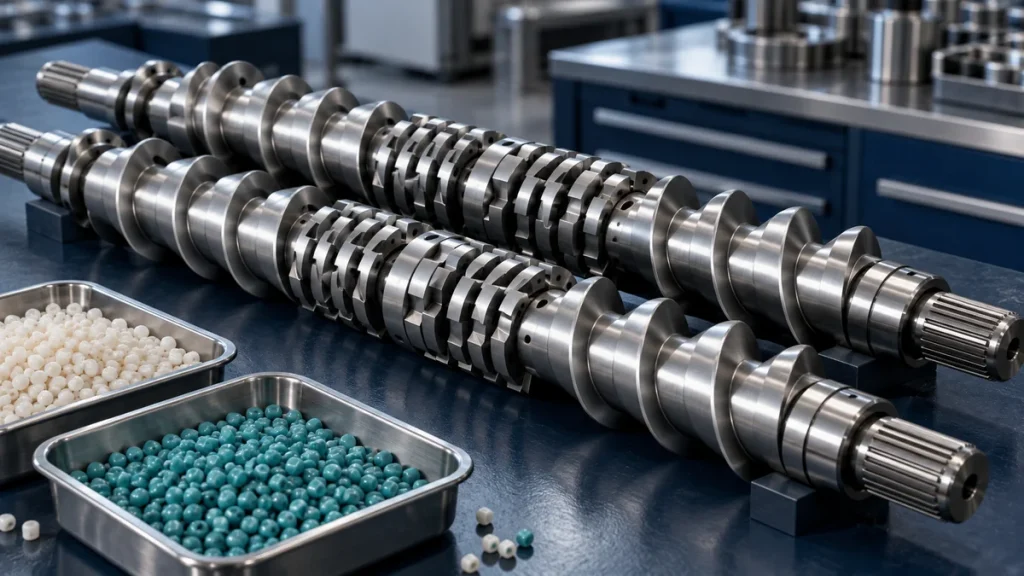
A twin screw extruder uses two rotating screws to move and process material inside a barrel assembly. In plastics manufacturing, it is especially useful when a formulation needs controlled mixing, additive incorporation or removal of moisture and other volatile components.
But “twin screw” describes a family of machines, not one universal process. A line for glass-fiber-reinforced polypropylene has different demands from a PVC profile line or a laboratory compounder. The screw arrangement, feeding system and downstream equipment must suit the material and the required product.
This guide explains the working principle, main types and plastic-processing uses, then gives you a practical way to decide what to specify.
What Is a Twin Screw Extruder?
The extruder is the processing unit at the center of the line. Its screws convey material through a sequence of operations, which may include melting, mixing, venting and pressure generation. A compounding line also needs equipment before and after the extruder: feeders, material handling, cooling and often a pelletizing system.
Compounding means combining a polymer with other ingredients to obtain a specified material. Those ingredients might include pigments, mineral fillers, glass fibers, stabilizers or another polymer. The aim is a repeatable composition and useful material properties, not simply a visually uniform pellet.
Two important mixing tasks are:
- Distributive mixing: spreading ingredients throughout the material.
- Dispersive mixing: applying sufficient stress to break down agglomerates where the formulation requires it.
These tasks can call for different screw elements and operating conditions. The distinction is described in Charlie Martin’s technical review of twin-screw continuous mixing. More mixing intensity is not automatically better if it damages the polymer or reinforcement.
How Does a Twin Screw Extruder Work?
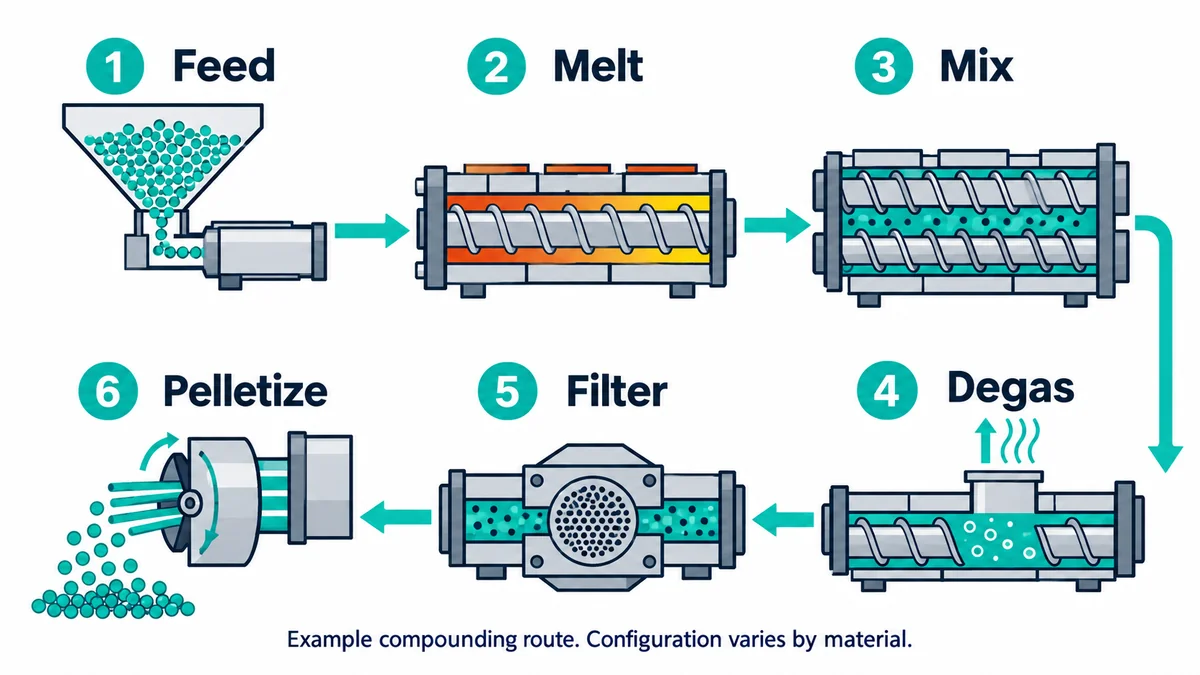
For many plastic compounding projects, the route can be understood as feed → melt → mix → degas → filter → pelletize. This is a functional overview: operations can overlap or repeat, and some formulations do not require every stage.
1. Feed the Ingredients
Feeders deliver the polymer and other ingredients at controlled rates. A premix may enter through the main feed opening, or separate feeders may meter individual components. The feeding approach should account for powder flow, bulk density and the recipe’s required dosing accuracy.
Some components enter farther downstream through a side feeder or liquid-injection point. Coperion’s auxiliary-equipment information shows side feeding for powders, pellets and chopped glass fibers. The correct location depends on the intended process.
2. Convey and Melt the Polymer
Conveying elements move material along the process section. Barrel heating and mechanical energy transferred by the screws contribute to melting; barrel cooling helps manage the resulting temperature.
The temperature displayed for a barrel zone is not the same measurement as the temperature of the melt. A useful process review considers both, together with screw speed, feed rate and motor load. Raising the heater setting alone does not establish better melting.
3. Mix and Incorporate the Additives
Conveying flights, kneading blocks and other mixing elements create the required sequence of operations. Their arrangement affects where ingredients are incorporated and how much mixing the material receives.
For example, pigment dispersion and glass-fiber incorporation are different tasks. A configuration that breaks down pigment agglomerates may expose fibers to more mechanical working than desired. Suppliers should explain their proposed configuration against the actual formulation, rather than offering one screw layout for every product.
4. Vent and Degas
Atmospheric or vacuum vents allow gases and volatile components to leave the process. Effective venting depends on the material, exposed melt surface, local filling conditions and the vacuum system.
A vent is not a substitute for controlling the incoming material. Whether drying, washing or another pretreatment is required must be established for the polymer and feedstock. For a deeper diagnostic discussion, see our extruder vacuum and degassing guide.
5. Filter and Build Discharge Pressure
The discharge section supplies pressure to the die and other downstream equipment. Where filtration is needed, the filter must match the contamination level, allowable pressure and product requirements.
A finer screen is not always an improvement: it can add restriction and must be considered alongside throughput and melt temperature. The quotation should identify the filter arrangement, screen-changing method and how production will be managed during a change.
6. Cool and Pelletize, or Form the Product Directly
A pelletizing line converts the processed melt into granules for later manufacturing. The cooling and cutting arrangement depends on the formulation, output and pellet requirements. Our strand versus underwater pelletizing guide compares those system choices.
Some lines instead feed the melt directly into a product-forming process. Do not assume every twin screw extruder must end with a pelletizer. Confirm the required final output before defining the downstream equipment.
The Main Parts of a Twin Screw Extruder Line
When comparing proposals, check the equipment around the screws as carefully as the main machine:
- Feeders and material handling: introduce each ingredient in the required quantity and condition.
- Motor and gearbox: provide the operating speed and torque within the machine’s mechanical limits.
- Screws and barrel: define the available processing space and sequence of operations.
- Heating and cooling circuits: manage the temperature of the process section.
- Vents and vacuum equipment: remove gases and condensable vapors where required.
- Controls and instrumentation: monitor variables such as temperatures, pressure, speed and load.
- Discharge and downstream equipment: filter, shape, cool, cut and handle the output.
Coperion’s STS process overview illustrates how these operations are configured as an integrated system. For a buyer, this means that “extruder capacity” is only one part of the required line performance.
Types of Twin Screw Extruders
Three separate questions describe the architecture. They should not be treated as interchangeable categories.
| Classification | Main options | What it tells you |
|---|---|---|
| Rotation direction | Co-rotating or counter-rotating | Whether the screws turn in the same or opposite directions |
| Screw engagement | Intermeshing or non-intermeshing | How the screws are positioned relative to each other |
| Screw geometry | Parallel or conical | Whether the screw diameter remains constant or tapers along its length |
Co-Rotating Twin Screw Extruders
Both screws turn in the same direction. Closely intermeshing, co-rotating machines are widely used for polymer compounding. Their modular process sections can combine material transport, mixing and devolatilization.
The closely interacting screw profiles also provide a self-wiping effect. This helps move material through the process section, but it does not mean the whole line cleans itself. Dies, filters, feed equipment and recipe-change procedures still matter.
Coperion describes these functions in its twin screw extrusion and compounding overview.
Counter-Rotating Twin Screw Extruders
The screws turn in opposite directions. Low-speed, intermeshing counter-rotating systems are commonly associated with PVC pipe and profile processing, where controlled plasticization and pressure generation are important.
That is a typical application pattern, not a rule covering every counter-rotating design. Ask the supplier which architecture is being proposed and why it fits your material. Avoid comparing unrelated machine types using screw count alone.
Parallel and Conical Designs
Parallel screws maintain a constant diameter along their length; conical screws taper. Geometry is separate from rotation direction, so a quotation needs to specify both.
Milacron’s twin screw equipment range includes both conical and parallel configurations and discusses low-shear processing for sensitive materials. Laboratory micro-compounders can also use conical arrangements. “Conical” should therefore not be used as shorthand for one production application.
What Is a Twin Screw Extruder Used For?
For plastic processors, the most useful classification is the work the material needs to undergo.
| Application | Main process duty | What the buyer should verify |
|---|---|---|
| Color and additive masterbatch | Incorporate and distribute concentrated ingredients in a carrier resin | Dosing, dispersion, temperature exposure and consistency |
| Filled and reinforced compounds | Introduce mineral fillers or fibers into a polymer | Feeding, mixing, wear specification and final material properties |
| Polymer blends and engineering plastics | Combine ingredients to achieve a defined compound | Formulation suitability, temperature limits and repeatable quality |
| Recycled-plastic compounding | Homogenize suitable recovered feedstock and incorporate required additives | Input condition, filtration, volatile removal and output quality |
| Laboratory and pilot development | Evaluate formulations and process settings using smaller quantities | Sample requirements, available measurements and scale-up relevance |
These applications should not be reduced to a list of polymer names. Two PP formulations can create very different demands if one contains a colorant and the other a high proportion of mineral filler.
For project-specific considerations, explore our masterbatch and filler compounding and engineering plastic compounding pages.
A Special Note on Recycling
A twin screw extruder can be useful when recovered material needs mixing, additive incorporation or devolatilization. It does not make arbitrary mixed waste suitable for every end product.
Define the incoming polymer mix, contamination, moisture and bulk density first. Then assess pretreatment, feeding, filtration and the required compound properties as one route. Our plastic recycling lines page covers the wider system.
Laboratory Machines Are a Different Buying Brief
Small sample consumption, accessible cleaning and useful measurements may matter more to a laboratory than maximum hourly output. Anton Paar’s TwinLab information emphasizes formulation testing, screw configuration and process-window development.
A successful sample is a starting point for production planning. Scale-up still needs the supplier to account for geometry, heat transfer and the relevant process limits; Coperion discusses this in its extrusion technology overview.
Benefits and Limitations to Consider
The main attraction is the ability to organize several processing functions within one configurable machine. A suitable line can introduce different ingredients, adjust mixing and provide venting at selected locations.
The tradeoff is a more involved specification. More feeders, vacuum equipment, wear-resistant components and process controls introduce cost and maintenance requirements. Abrasive or corrosive formulations also require careful material selection for the processing components.
A flexible machine still needs a defined operating window. One configuration should not be assumed to cover every recipe at the same output. Request evidence for the formulations that matter to the business, including cleaning and changeover requirements.
Judge the result by saleable output at the agreed material quality—not by maximum screw speed or motor power alone.
When Might a Single-Screw Extruder Be Enough?
If the feedstock is already compounded and the main task is stable melting and shaping, a single-screw solution may meet the requirement. Examples can include processing a consistent resin into a finished product, depending on the application.
A twin screw extruder becomes more relevant when substantial mixing, staged ingredient addition or another specific processing function is needed. The decision should start with the process duty, not the assumption that two screws are always an upgrade.
Read our single-screw versus twin-screw selection guide for the fuller comparison.
What to Specify Before Requesting a Quotation
Give potential suppliers the same brief so that differences between their proposals are meaningful:
- Input materials: polymer grades, ingredient proportions, physical form and representative samples.
- Input condition: moisture, contamination, bulk density and expected variation.
- Required product: pellet or direct-extrusion output, with measurable quality requirements.
- Production target: sustained saleable output, operating schedule and expected recipe changes.
- Supply boundary: feeding, extruder, vacuum, filtration, cooling, pelletizing and material handling.
- Site conditions: available electricity, cooling, compressed air, layout and destination requirements.
- Verification and support: trial material, acceptance method, training, spare parts and service responsibilities.
Ask the supplier to explain how screw diameter, L/D, available torque and operating speed fit that brief. None of these parameters establishes the output on its own.
Before comparing prices, use our pelletizing line RFQ checklist to align the supply scope. Our factory acceptance test guide helps turn the proposed performance into a documented test.
Frequently Asked Questions
What Is the Main Purpose of a Twin Screw Extruder?
In plastics processing, it is often used to combine a polymer with additives, fillers, fibers or other polymers under controlled conditions. Depending on the design, it can also provide melting, conveying, venting and pressure generation.
Are All Twin Screw Extruders Intermeshing?
No. Intermeshing and non-intermeshing designs both exist. Rotation direction, screw engagement and geometry are separate characteristics, so ask for the full architecture rather than accepting “twin screw” as a complete specification.
Does a Twin Screw Extruder Always Have Higher Output?
No. Useful output depends on the formulation, feed system, processing limits, required quality and downstream equipment. Compare sustained production on the same material and acceptance criteria, rather than nameplate figures from different applications.
What Does L/D Mean?
L/D expresses the specified processing length relative to screw diameter. It helps describe the available process-section length. Confirm how the supplier defines and measures it; a longer process section is useful only when the application needs the functions it provides.
How Much Does a Twin Screw Extruder Cost?
A meaningful price needs a defined configuration and supply scope. A laboratory compounder, a production extruder and a complete pelletizing line are different purchases. Obtain itemized quotations against the same material, quality and output requirements before comparing totals.
Plan the Process Before Choosing the Machine
The right twin screw extruder is the one whose architecture and complete line configuration can meet your material and product requirements. Start with a testable production brief, then use trials and the acceptance plan to assess the proposal.
Extruder China helps overseas buyers compare Chinese machinery options and coordinate project sourcing. Share your material, target output and project location through our project inquiry form, or explore pelletizing and compounding lines.