

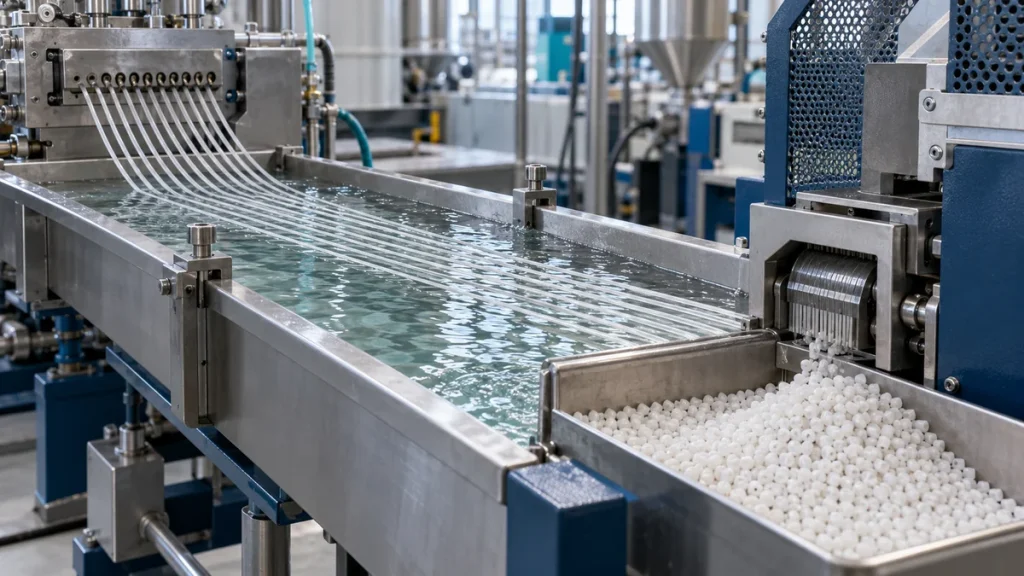
A pelletizing method should be selected around the polymer, required pellet and operating workflow. Comparing only the cutter price leaves out equipment and responsibilities that can determine whether the whole system fits your plant. Start by asking each supplier to draw the complete path from melt delivery to finished pellets.
Confirm which process is being quoted
In a conventional strand arrangement, polymer strands are formed and conditioned before cutting. In a die-face underwater system, cutting takes place in a water-filled chamber at the die. MAAG also lists distinct strand-system variants, so the word “underwater” alone is not enough to identify the proposed configuration.
Have the supplier name the method and label every major stage on the flow diagram. When quotations use different terminology, ask for a plain description of what happens during start-up, stable production and an interruption. This prevents two superficially similar offers from being compared as equivalent systems.
Start with the pellet acceptance sheet
Identify the next use of the pellets and ask the receiving team which properties determine acceptance. Record the agreed measurements for pellet consistency, moisture and unwanted material. Specify sample identification and the point in the process where a sample will be collected.
Bring representative feed to the discussion. Instead of requesting a generic statement that a method “works with recycled plastic,” ask what has been demonstrated for the proposed feed and how the result was assessed. Separate documented trial findings from supplier expectations that still need confirmation.
Compare the surrounding equipment
| Scope item | What the buyer should clarify |
|---|---|
| Cooling or process water | Supply boundary, treatment, temperature control and drainage |
| Drying and conveying | Included equipment and the product condition at discharge |
| Start-up workflow | Operator tasks, collected off-spec material and restart demonstration |
| Maintenance | Wear-part references, access requirements and supplier instructions |
MAAG’s system descriptions show why water handling and drying belong in a pelletizing discussion. Your quotation should identify the relevant packages explicitly. Ask which items are supplied with the cutter and which need a separate selection, rather than assuming a package is complete because it is described as a line.
Test the workflow your operators will inherit
Plan a demonstration that includes the normal sequence your team needs to understand. Agree in advance how an interruption will be handled under the supplier’s approved procedure. Record who performs each task, the required training and the points where product is diverted from acceptable output.
Do not introduce a universal ranking based on purchase price, automation or pellet appearance. Different material ranges, staffing models and plant services can change the decision. Compare the proposed arrangement against your written requirements and identify any remaining validation work.
Make the recommendation traceable
Keep a decision note containing the tested material, process configuration, acceptance results and unresolved conditions. It will be more useful during a later expansion than a simple statement that one pelletizing method was preferred.
Review our pelletizing line scope when requesting a complete quotation. If the project needs a witnessed trial, define the evidence through an inspection and acceptance plan before the demonstration takes place.