

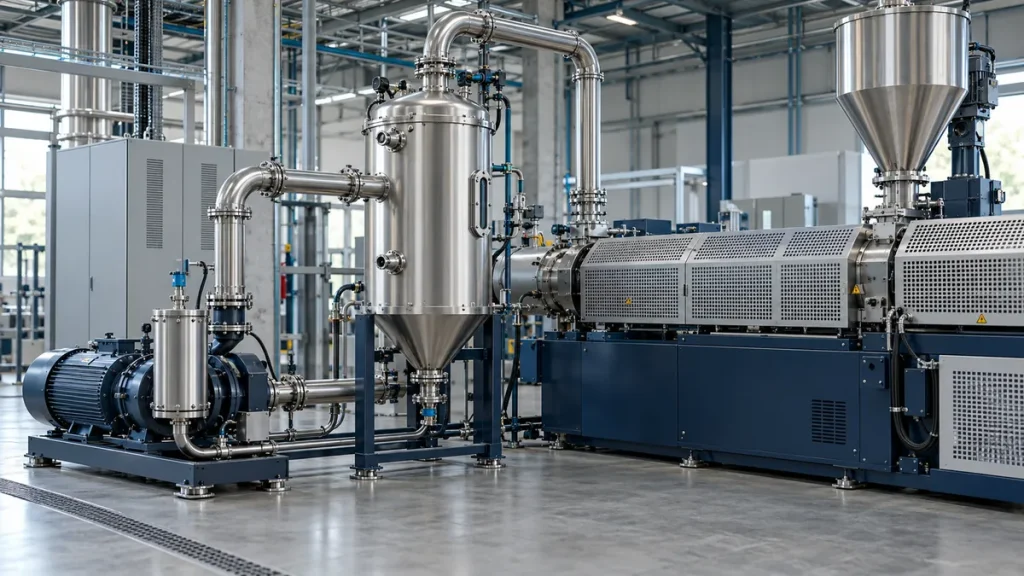
An extruder vacuum complaint can describe several different events: an unexpected gauge reading, material appearing at a vent, deposits in the vacuum path or a change in pellet quality. Treating all of them as “not enough vacuum” makes it harder to identify the next useful check. Begin with an accurate description of the symptom and the conditions in which it appears.
Separate the observations
Coperion’s degassing guidance distinguishes blockage or material-related vent issues from an inadequate vacuum level. It also discusses changes in melt conditions and the vacuum system as relevant considerations. This supports a structured investigation; it does not establish a universal adjustment for every screw design or material.
Record the vent location, the displayed value and the exact gauge units. State whether the reading is absolute or relative where this is known, and preserve the display photograph if it is unclear. A number without its unit and measurement location can be misleading when forwarded between teams.
Describe the material history
Identify the polymer, batch and preparation route. Note known moisture information and any change in washing, storage, drying or formulation. Keep observed measurements separate from assumptions based on how the material looks.
Integrated recycling systems such as EREMA’s INTAREMA K illustrate that preparation and feed conditioning form part of the wider process. For troubleshooting, the practical question is whether the feed arriving today is comparable with the feed used during an acceptable run. Do not assume a vacuum-system repair can compensate for every upstream change.
Assemble a synchronized operating record
| Record | Why it belongs in the review |
|---|---|
| Event timeline | Shows whether the symptom follows a start-up, refill or material change |
| Relevant process trends | Allows the supplier to compare the event with a known acceptable case |
| Gauge and alarm details | Defines what was measured and which warning occurred |
| Recent work | Identifies configuration or maintenance changes that need consideration |
Collect information through approved observation points and system records. Hot polymer, pressure, rotating equipment and vacuum-system residues require trained personnel and the applicable isolation procedure. Do not open a vent, disconnect a line or clear material while the system is operating.
Ask for a configuration-specific diagnosis
Send the screw configuration reference, line model, vacuum equipment identification and maintenance history with the operating record. If a part was recently changed, include its identifier and the approved work record. Request a review of the actual installation rather than applying settings found for another machine.
Avoid simultaneously altering temperature, throughput and vacuum settings in search of a quick improvement. Where a qualified supplier proposes a test, record the approved change, expected outcome and stopping conditions. The objective is to distinguish explanations with evidence, not simply make the symptom disappear for one sample.
Verify both process and product
After corrective work, evaluate the agreed operating case and the relevant product checks. Preserve sample identifiers and the conditions behind them. If the event is intermittent, agree an appropriate follow-up observation with the technical team before closing the case.
See film recycling and pelletizing for process-scope discussions. For an existing line, our after-sales support information explains the identification details that help coordinate a supplier response.