

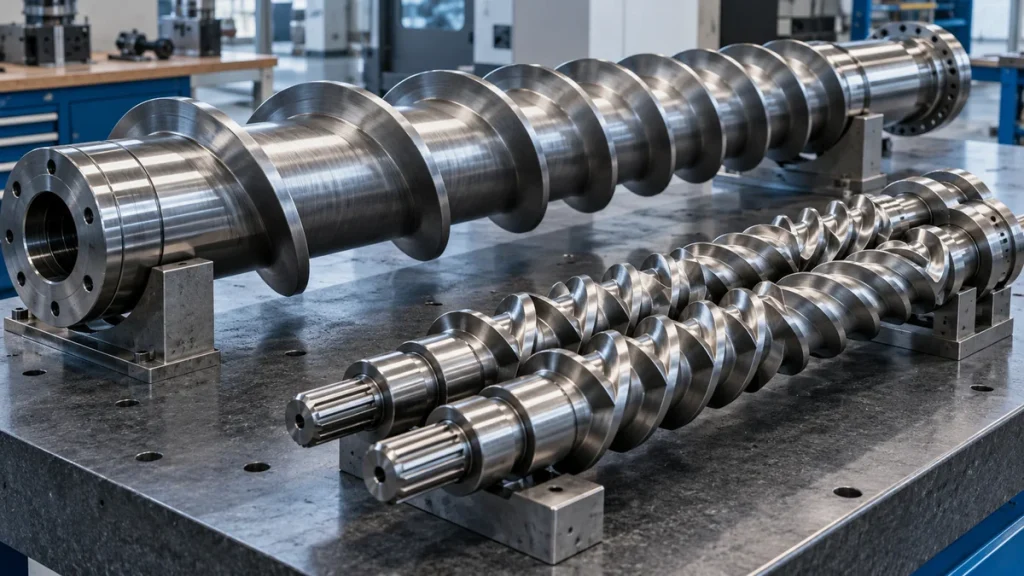
Choosing between a single-screw and a twin-screw extruder starts with the process duty. The right question is what the system must accomplish between receiving the material and delivering an acceptable product. A screw count on its own does not establish whether a complete line will suit your application.
Write a process statement first
Use one sentence to describe the job: for example, convert a defined recycled feed into pellets, or incorporate specified additives into a polymer formulation. Then list the transformations that must occur. Separate conveying and melting from dispersion, ingredient addition and removal of unwanted volatiles.
Coperion describes co-rotating twin-screw systems in a broad compounding context. That establishes a relevant process family to investigate, rather than a guarantee that every twin-screw machine can handle every formulation. Suppliers still need to justify the configuration for your material and product requirements.
Compare three levels of evidence
| Level | Useful evidence |
|---|---|
| Material | Representative feed, formulation range and preparation requirements |
| Process | Proposed flow, addition points, control concept and trial observations |
| Product | Agreed output tests, sampling plan and repeatability records |
Ask both single-screw and twin-screw suppliers to respond to these same levels. A photograph of a successful pellet sample is less informative than a sample identified with its input batch and trial conditions. When a trial uses a substitute material, record the substitution and the limits of the comparison.
Keep material preparation in the decision
It is tempting to attribute an entire line’s behavior to the extruder. In practice, the proposal may also depend on sorting, drying, conditioning or specialized feeding. EREMA’s INTAREMA K is one example of a system that combines preparation and extrusion functions. It should prompt a scope question, not an assumption that all recycling systems use the same arrangement.
Request a clear boundary between the material your plant supplies and the condition the extruder expects. If one offer needs a preparation stage and another includes it, reconcile that difference before comparing footprint or purchase cost.
Evaluate the operating window you expect
List the grades, colors and material sources you plan to run. Distinguish the routine recipe from occasional work, then ask which cases have been demonstrated and which require development. A system selected around one favorable trial may need further validation for the rest of the product mix.
Include changeover expectations in the discussion. Ask how cleaning, recipe control, operator training and spare-part identification will be documented. Have the supplier explain proposed operating restrictions and the support available for your actual configuration, without treating a generic brochure as a process warranty.
Select a complete proposal
Avoid universal rules such as “single screw for all recycling” or “twin screw is always better.” Review the line diagram, demonstrated material range, output criteria and operating responsibilities together. Where evidence is incomplete, make the next step a focused trial with a written question to answer.
Our pelletizing and compounding lines page provides a starting point for comparing equipment scope. For formulation-led projects, also explore masterbatch and filler compounding and engineering plastic compounding requirements before requesting quotations.