

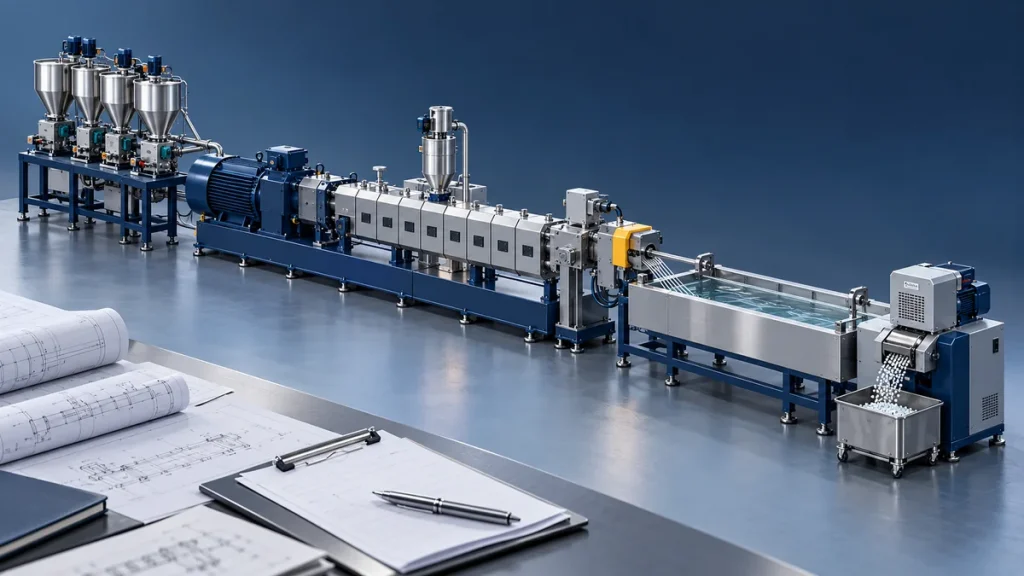
A twin screw extruder price is meaningful only when it is tied to a material, a production target and a defined supply scope. A quotation for the main machine cannot be compared directly with a quotation that includes dosing, filtration, pelletizing, controls and commissioning. The useful buying question is: what will this system cost to produce an agreed quantity of acceptable material at our site?
This guide explains how to build that comparison without relying on unsupported market price ranges. For a refresher on the equipment itself, read our twin screw extruder guide.
Start With Three Different Cost Boundaries
The first boundary is the main extruder: typically its drive, gearbox, process section, screws and a stated control package. Even here, suppliers can include different items. A side feeder or vacuum package shown in a brochure may be optional.
The second boundary is the operating line. This adds the equipment needed to turn specified ingredients into the intended output. It may include raw-material handling, dryers, gravimetric feeders, side feeding, venting, melt filtration, a die, cooling, cutting, pellet drying and packing.
The third boundary is the installed project. This includes the operating line plus transport, site preparation, utility connections, installation, commissioning, training and an initial spare-parts allowance. Keep these boundaries separate in the budget, then reconcile them into one project total.
A Practical Extrusion Line Cost Breakdown
Use a scope table before comparing the headline totals. Ask each supplier to mark every item as included, optional, excluded or supplied by the buyer.
| Cost group | What to clarify | Why the total can change |
|---|---|---|
| Main extruder | Process length, drive rating, gearbox duty, screw and barrel materials | Different process and wear requirements can lead to different constructions |
| Material preparation | Drying, blending, conveying and storage | The supplied feedstock may need treatment before it enters the machine |
| Dosing and side feeding | Number of ingredients, feeder type, usable feed range | Low-rate additives and difficult powders need suitable handling |
| Vacuum and filtration | Vent arrangement, pump package, filter duty and screen-changing method | Volatiles and contamination create separate demands |
| Pelletizing | Strand, water-ring or underwater system; drying and classification | The formulation and required pellet form determine the equipment |
| Controls and integration | Included machines, interfaces, recipe functions and data access | A shared screen does not necessarily mean a fully integrated line |
| Site and start-up | Utilities, rigging, installation, trial material and operator training | Factory delivery is only one milestone in becoming operational |
Do not add an arbitrary percentage for missing equipment and call the comparison complete. Ask for a defined option or obtain a separate quotation. An explicit exclusion is easier to budget than a vague promise to discuss it later.
What Drives the Main Machine Price?
Diameter Does Not Define the Whole Specification
Two machines with similar screw diameters can have different torque capability, free volume, speed range, barrel configuration and acceptable operating limits. A larger motor does not, by itself, prove that the machine will deliver more saleable compound on your recipe.
Ask which operating constraint determined the proposed size: torque, feed intake, heat removal, dispersion, devolatilization or downstream capacity. The answer is more useful than a model number alone.
Process Length and Additional Equipment Must Have a Purpose
A longer process section can provide room for staged additions and venting, but more length is not automatically better. It also affects layout, cleaning and the time the material spends in the system. Ask the supplier to explain the function of each proposed process zone.
Similarly, a side feeder, melt pump or more elaborate filter can be valuable when the process needs it. Avoid treating every optional component as an upgrade without asking which problem it solves and how that improvement will be checked.
Wear Protection and Maintainability Affect the Ownership Cost
Abrasive fillers and reinforcement can change the required wear protection. The comparison should identify the proposed metallurgy, replaceable components, inspection method and available replacement parts. A low purchase price is less attractive if routine replacement requires an unusually long shutdown.
Access also matters. Consider how operators will clean the feed system, remove screws, service the filter and change pelletizer blades. These activities affect labour and availability even when they are not separate quotation lines.
Compare Quotations on the Same Basis
Create one process brief and send the same version to every supplier. It should identify the material family, ingredient forms, formulation boundaries, intended product quality, continuous output target and available utilities. Use our pelletizing line RFQ checklist for the wider documentation.
For each offer, record:
- The recipe or representative material behind the output claim.
- Whether output means gross discharge or acceptable finished pellets.
- The conditions and duration under which performance will be demonstrated.
- Included upstream and downstream equipment and every buyer-supplied item.
- The quotation currency, validity, payment milestones and delivery assumptions.
- The stated trade rule, named place or port, and applicable version.
Trade terms help allocate transport-related responsibilities, costs and risk. They do not replace a technical scope or a performance agreement. Obtain a freight and site estimate using actual packing dimensions and weights rather than assuming that similar-looking machines ship at the same cost. Our shipping and export service page explains the coordination scope.
Look Beyond the Purchase Total
For an operating comparison, use cost per acceptable kilogram, with a clearly defined accounting boundary. Divide the included operating costs by saleable production over the same period. Record what the calculation covers: electricity, labour, consumables, planned wear parts, waste and other relevant costs.
Do not estimate electricity consumption from the motor nameplate alone. Nameplate power is a rating, not a measured average load. A useful trial records actual energy use alongside formulation, output, operating conditions and product quality. Compare like with like: including a dryer on one line but excluding it from the other distorts the result.
Changeovers deserve their own allowance. A plant running frequent colour changes may lose more time and material through cleaning than a plant running one stable recipe. Ask for a practical changeover demonstration if this is central to the business case.
Questions to Resolve Before Paying a Deposit
- Which items are essential to operate the quoted line but are not included?
- What evidence supports the output and quality proposal on our material?
- What happens if the agreed trial does not meet the acceptance conditions?
- Who supplies utility equipment, interconnecting pipework and installation labour?
- Which wear parts should be available at start-up, and how are replacements identified?
- What support is included during commissioning and after handover?
Put the answers in the quotation or agreed technical documents. For performance verification, connect the commercial milestones to a documented factory acceptance test.
Frequently Asked Questions
Can I Get a Useful Budget Before the Recipe Is Final?
Yes, if the assumptions are explicit. Describe the likely formulation range and identify unresolved items. Ask for a budgetary offer with options and exclusions, then revise it after representative trials. Do not treat an early estimate as a final project commitment.
Is the Cheapest Twin Screw Extruder Always the Highest-Risk Choice?
No. A simpler line can be appropriate for a well-defined task. The important distinction is whether the price difference comes from a sensible process choice, a different supply boundary or an unresolved technical risk. Obtain evidence before drawing a conclusion.
Should Every Line Use the Same Pelletizer?
No. Material behaviour, output, pellet requirements and changeovers affect the choice. Compare the complete cooling and cutting system using our strand versus underwater pelletizing guide.
Build a Comparable Project Budget
Start with the material and quality target, define the line boundary, and ask suppliers to explain the proposed configuration. Then add the costs required to bring that line into reliable operation at your site.
Extruder China helps overseas buyers compare Chinese machinery options and coordinate sourcing. Explore pelletizing and compounding lines or send your material, target output and destination through our project inquiry form.