

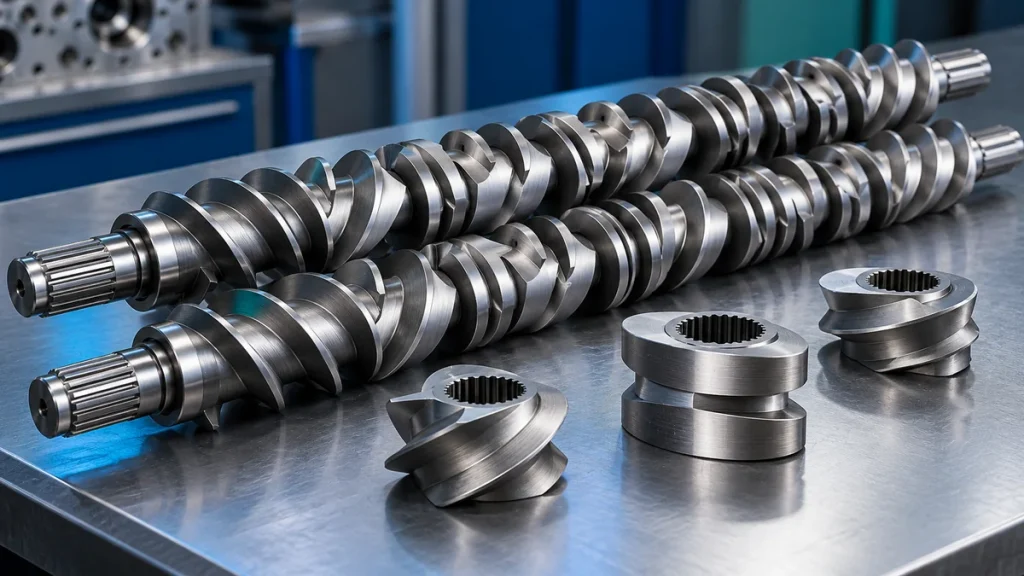
Twin screw extruder screw design is the arrangement of functional elements that conveys, melts, mixes and discharges a formulation within its acceptable processing limits. A useful design gives each operation enough capacity and controls the material’s history. It is not simply the arrangement with the largest number of kneading blocks.
This article focuses on modular co-rotating compounding screws. It explains what a buyer should understand and request from a supplier, rather than offering a universal assembly recipe. For the wider machine classification, see our twin screw extruder guide.
Think in Process Functions Before Individual Parts
Begin with a functional sequence: take in ingredients, melt the required polymer, incorporate other components, achieve the necessary mixing, remove unwanted gases where appropriate, then establish suitable discharge conditions. Some formulations need repeated additions or mixing stages; others require a simpler path.
The screw arrangement must work with the barrel openings. A side feeder needs a process location that can accept its material. A vent needs suitable local conditions for gas removal. A design cannot be judged from an isolated screw photograph without knowing what enters the machine, where it enters and what the downstream equipment requires.
Ask for a function-labelled layout rather than a page of unexplained element codes. Supplier naming systems can differ, so a code should be accompanied by its geometry, intended action and position.
The Main Screw Element Families
| Element family | Main purpose | What a buyer should ask |
|---|---|---|
| Forward conveying elements | Move material and establish suitable transport through each section | Why are the pitch and length appropriate for this location? |
| Kneading blocks | Apply mixing and mechanical work through their disc geometry and arrangement | What mixing result is required, and what temperature or pressure trade-off follows? |
| Distributive mixing elements | Rearrange material to improve spatial uniformity | Is distribution sufficient, or must agglomerates also be broken down? |
| Restrictive or reverse-acting elements | Change local filling and resistance as part of a designed process | What is the reason for the restriction, and how are the consequences controlled? |
| Discharge elements | Support the required transfer to the die or downstream equipment | What discharge resistance and pressure duty were assumed? |
These are functional descriptions, not interchangeable part specifications. Profiles, clearances, shaft connections and operating limits must match the machine. A similar-looking replacement part can still be unsuitable.
Distributive and Dispersive Mixing Solve Different Problems
Distributive mixing spreads ingredients through the material. Think of reducing concentration differences so that the final compound has a more uniform composition. Dispersive mixing addresses agglomerates or a dispersed phase that must be broken down under appropriate stress.
A formulation may need both, but in different proportions. A pigment concentrate may need evidence of adequate dispersion in addition to overall colour consistency. A reinforced compound needs fibres wetted and distributed without avoidable damage. A heat-sensitive additive may impose a narrow processing window.
Ask which finished-product test will confirm the mixing objective. “Better mixing” is too vague to serve as an acceptance criterion. A uniform-looking pellet can still conceal an unsuitable dispersion level or a change in polymer properties.
Match the Screw Layout to Feeding, Melting and Venting
Feeding and Melting Must Be Compatible
The feed section has to accept the ingredients in their actual physical forms. Low-bulk-density powder, irregular flakes and dense pellets do not behave identically. If intake is unstable, adding mixing intensity farther downstream is unlikely to solve the underlying supply problem.
The melting section should establish the material condition needed before later ingredients enter. For some formulations, feeding a sensitive or abrasive component downstream can be useful; it must still leave enough process capacity for incorporation and discharge. There is no universally correct side-feed position expressed as a fixed distance.
Mixing Sections Need a Defined Job
Specify what each mixing stage must achieve and which ingredients are present there. Evaluate changes through material-quality evidence and operating trends, not just higher torque or a visually more complex screw profile.
Element geometry, disc arrangement and local restriction can change filling, stress and temperature. A change that improves one property may worsen another. Review the entire processing window rather than treating an individual element as an isolated upgrade.
Venting Depends on Local Process Conditions
A vacuum connection alone does not guarantee effective devolatilization. The surrounding arrangement must support gas removal while controlling material transport and avoiding inappropriate carry-over. Feedstock moisture and upstream preparation remain part of the system.
If venting is the immediate problem, begin with our vacuum and degassing diagnostic guide and preserve the operating record before proposing a screw change.
Why More Intensive Mixing Can Be the Wrong Answer
Additional mechanical work can raise melt temperature or alter the material history. Depending on the formulation, that may contribute to polymer degradation, changes in viscosity, damage to reinforcement or an unwanted change in the additive system. Less intensive mixing can also fail if it leaves poor incorporation.
The goal is the required product at a stable operating point, not maximum shear. Evaluate a proposed change against the relevant quality tests, acceptable melt conditions, process stability and usable output. If one result improves while another deteriorates, record the trade-off rather than announcing the new arrangement as universally superior.
Wear changes the effective geometry over time. If performance has declined on a previously successful arrangement, investigate condition and feeding before redesigning the process. Our screw and barrel wear inspection guide covers the separate measurement task.
What to Request With a Supplier’s Screw Proposal
Request a revision-controlled drawing or configuration record that includes:
- Machine identification, shaft arrangement and direction conventions.
- Element identification and axial sequence, with the supplier’s nomenclature explained.
- Barrel openings, ingredient entry points and vent locations.
- The intended function of each major zone.
- The formulation and operating conditions used to justify the arrangement.
- Material-quality results and the limits of the supporting trial.
- Wear materials, replaceable parts and an assembly reference for future maintenance.
These records help distinguish a documented configuration from an undocumented collection of spare elements. Preserve them with the approved recipe and process record so that subsequent trials can be compared.
Changes should be reviewed with the equipment supplier and implemented by qualified personnel using the machine’s procedures. An article or conceptual image is not an assembly drawing, and it cannot establish safe clearances, orientation or mechanical compatibility.
Frequently Asked Questions
Does a Higher Kneading-Disc Angle Always Improve Dispersion?
No. Geometry influences the process, but the result depends on the full element arrangement, material, filling and operating conditions. Request a technical explanation and a trial result rather than selecting by one geometric value.
Can I Copy a Screw Configuration From Another Machine?
Not without checking architecture, dimensions, element profiles, process length and the material duty. Even when the machines are related, the operating conditions and downstream resistance may differ.
Do I Need a New Screw Arrangement for Every Recipe?
Not necessarily. A supplier may validate a useful recipe range on one arrangement. Define its boundaries and identify changes that require a different configuration rather than assuming unlimited flexibility.
Make the Design Review Traceable
Extruder China helps buyers organize process requirements and compare Chinese machinery proposals. Explore spare parts or share your material, current process concern and target product through our project inquiry form. A useful review starts with the configuration and evidence, not a generic promise of stronger mixing.