

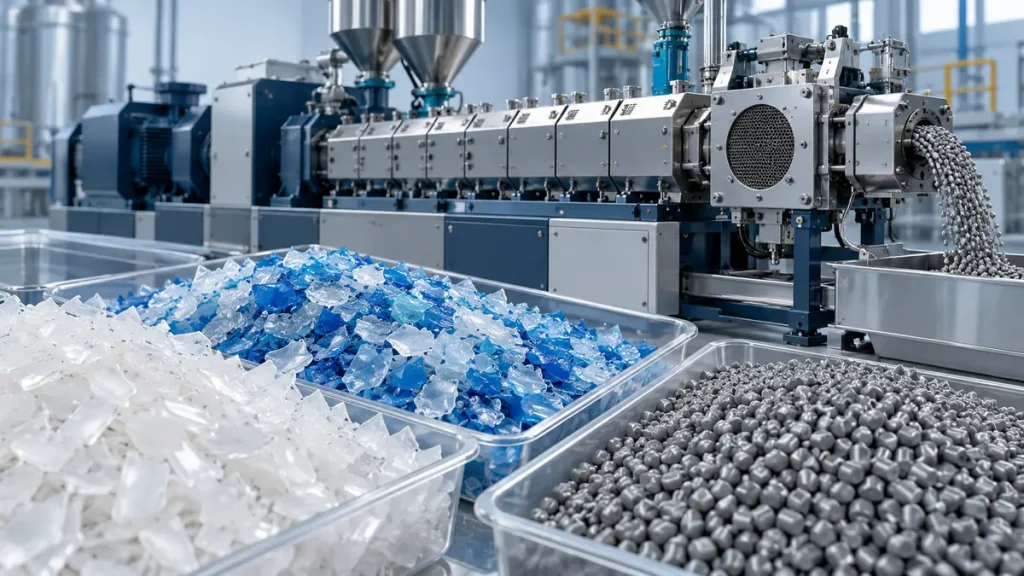
A twin screw extruder is worth considering for plastic recycling when the project needs controlled incorporation of additives, fillers or reinforcement, intensive homogenization, or a specific devolatilization and compounding route. It is not automatically necessary for every recycling operation, and it does not make unsuitable feedstock acceptable by itself.
Begin by distinguishing re-pelletizing a sufficiently prepared material from recompounding it to achieve a defined property profile. That distinction helps explain when a relatively simple extrusion route may be sufficient and when additional compounding capability deserves evaluation.
Define the Job After Sorting and Preparation
A line receiving clean, consistent production scrap has a different duty from one receiving variable post-consumer flakes. The extrusion process cannot be specified responsibly without knowing the polymer composition, contamination, moisture, physical form and variability of the incoming material.
Create an incoming-material specification before asking for a machine. Identify the intended polymer stream and how off-spec lots will be managed. A sample bag from the best lot is not a complete representation of a variable supply.
Also define the destination for the pellets. Material for a non-demanding application and material intended for an engineered product may need different controls and evidence. Explore the wider preparation and equipment boundary on our plastic recycling lines page.
Re-Pelletizing and Recompounding Are Different Duties
Re-pelletizing aims to convert prepared plastic into a usable pellet form with the necessary melt handling and contamination control. Recompounding adds a material-development task: combining the recyclate with other components to achieve specified properties.
For example, adding an agreed stabilizer, modifier or filler package introduces dosing and incorporation requirements. Selecting the additive package is a formulation task; buying a twin screw extruder does not establish that the package will work with every incoming stream.
Our single-screw versus twin-screw guide provides a broader comparison. For recycling, choose the process route using the actual material and target rather than assuming that a higher screw count means a better recycling line.
A Route-Selection Matrix
| Feedstock and required task | Useful starting question | Evidence to obtain |
|---|---|---|
| Clean, consistent scrap needing pellet form | Can a simpler route meet the required melt and pellet quality? | Stable output, contamination control and product checks |
| Recyclate needing additives or fillers | What feeding and mixing duty does the formulation require? | Composition stability and relevant material properties |
| Low-density flakes or film-derived material | How will the system deliver stable mass flow? | Trials on representative bulk form and feed variability |
| Moisture- or volatile-related problems | Which preparation and devolatilization stages are necessary? | Incoming condition, operating records and output quality |
| Variable or mixed polymer supply | Is the stream suitable for the intended application at all? | Material characterization, sorting limits and formulation validation |
This matrix does not prescribe a machine for each row. It identifies the question a supplier must resolve before making a performance proposal.
Feeding Can Limit the Whole Project
Irregular shape, low bulk density, bridging or varying flow can interrupt a recycling process even when the extruder has unused drive capacity. Review storage, transfer, metering and the feed interface as one system.
A proposal may use densification, force feeding, side feeding or another material-specific arrangement. Ask what incoming condition it assumes and how it responds to normal supply variation. Include any required preparation equipment in the line scope rather than treating it as a future accessory.
During trials, observe refill events, short interruptions and rejected production, not only average throughput. Our feeding troubleshooting guide explains why recording the disturbance is important before changing settings.
Degassing Does Not Replace Feedstock Control
Venting and vacuum systems can address defined air and volatile-removal duties, but they operate within a specific process arrangement and material window. They are not a universal replacement for washing, drying or separating the incoming plastic.
Ask how the line establishes the material condition entering each venting stage, handles carry-over and manages the downstream requirements. Record incoming moisture and the relevant product checks alongside process observations. A vacuum reading alone does not demonstrate that the pellet meets its quality target.
For an existing operating problem, use our separate vacuum and degassing diagnostic record. Keep diagnosis separate from an unsupported assumption that the plant needs a different architecture.
Place Filtration Within the Actual Process Route
Contaminants, additive introduction, reinforcement and downstream requirements affect where and how filtration belongs. Different line architectures may filter at different stages; a supplier should explain the proposed sequence.
Ask what contamination the filter is intended to remove, its operating assumptions, screen-changing method, expected pressure behaviour and material losses during service. Do not treat a finer screen as a cure for incompatible polymers, degradation or dissolved contaminants.
If a proposal combines recycling and compounding in one route, compare it with the alternative using the same quality target and supply boundary. Fewer process stages can be attractive, but the benefit must be demonstrated on the material rather than assumed from the layout.
PP, PE and PET Need Different Questions
For PP or PE streams, characterize polymer consistency, contamination and the intended additive or blending task. Similar-looking flakes can differ in composition and processing behaviour. Test the properties the final customer actually needs.
For PET, moisture management and the material’s processing history are especially important to the project brief. Define the required viscosity-related and application-specific results with a competent material specialist. A general-purpose equipment description does not establish suitability for every PET route.
Do not infer food-contact suitability from the presence of a twin screw extruder, a vacuum system or a clean-looking pellet. Such applications require their own qualified process and applicable verification; they are outside a generic machine selection claim.
Validate the Input Range, Not Just One Sample
Prepare a trial plan around representative incoming lots, including realistic difficult cases. Keep samples traceable to their source and preparation. Agree on the accepted input limits as well as the finished-pellet requirements.
Record the full line configuration, feeding behaviour, operating conditions, filtration events, output and rejected material. Relate the samples to stable production periods and retain the test methods. If the input changes outside the agreed range, identify what needs retesting.
Our rigid plastic recycling solution page provides a relevant project entry point. The supplier’s evidence should show how the selected route handles the defined stream, not promise to process every plastic waste mixture.
Frequently Asked Questions
Is Twin Screw Extrusion Always Better for Recycled Plastic?
No. Its additional functions are valuable when the process needs them. A simpler route may be appropriate when prepared material already meets the required composition and only needs a suitable pelletizing process.
Can It Solve Incompatible Mixed Plastics?
Not by machine choice alone. Sorting, characterization, formulation development and application testing remain necessary. Mixing incompatible materials more thoroughly does not automatically produce an acceptable compound.
Can Vacuum Eliminate the Need for Drying?
Only a validated material-specific process can establish the required preparation route. Do not remove a preparation stage solely because the proposed machine includes vacuum equipment.
Choose the Recycling Route Around the Material
Extruder China helps overseas buyers compare Chinese recycling and compounding proposals. Share your polymer stream, physical form, known contamination, target application and output requirement through our project inquiry form to organize a practical supplier brief.