

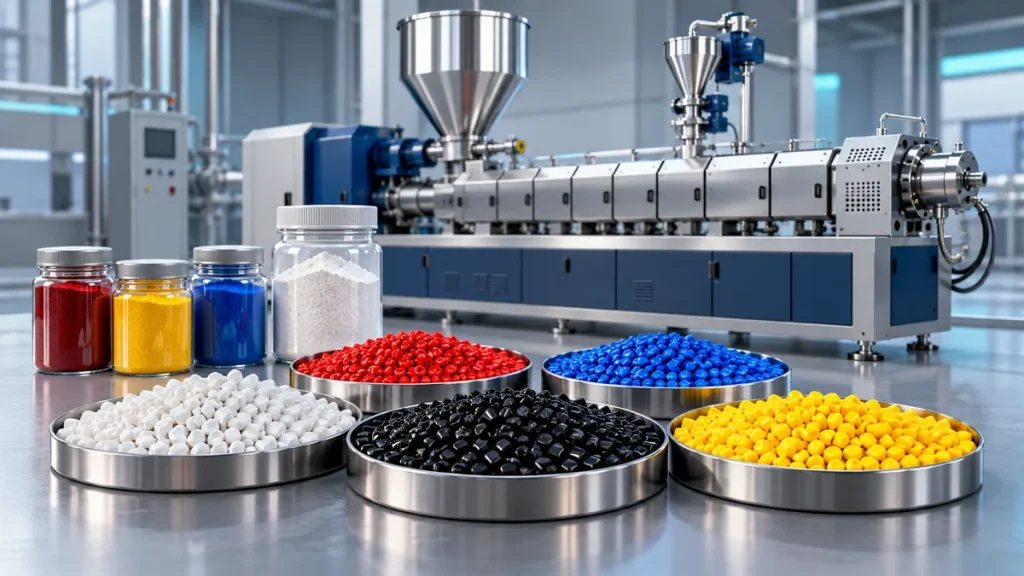
A twin screw extruder for masterbatch should be selected around the carrier resin, pigment or additive system, required dispersion and intended let-down application. Output alone is not enough. A line that produces attractive pellets can still fail the customer’s colour, filtration or processing requirements.
The equipment brief should distinguish colour concentrates, white or black masterbatch, additive concentrates and filler masterbatch. They can share machine families while placing different demands on feeding, mixing, wear protection and cleaning. Our masterbatch and filler compounding page introduces the wider project scope.
Define the Product Before the Loading Target
Start with the carrier and its compatibility with the customer’s process. Identify ingredient forms, intended concentration range, relevant thermal limitations and the final application. Include the customer’s let-down conditions where these influence acceptance.
A high concentration is not a complete quality specification. The masterbatch must also be usable: ingredients should be distributed appropriately, agglomerates controlled where required, and pellet handling consistent with downstream dosing. Ask which properties the customer actually measures and how samples should be prepared.
Avoid borrowing a supplier’s maximum filler or pigment percentage as a guarantee for a different formulation. Material identity, surface treatment, carrier, feeding route and equipment configuration all affect feasibility.
Match the Line to the Masterbatch Family
| Masterbatch family | Important process questions | Useful acceptance evidence |
|---|---|---|
| Colour concentrate | Pigment wetting, dispersion, colour consistency and contamination control | Agreed colour and dispersion tests on representative let-down samples |
| White or black masterbatch | Powder handling, composition consistency, dispersion and wear duty | Defined composition and application-relevant quality checks |
| Additive concentrate | Low-rate dosing, ingredient sensitivity and functional performance | Composition records plus the intended functional test |
| Filler masterbatch | Powder intake, carrier incorporation, abrasive duty and pellet handling | Filler-content checks and performance in the intended application |
Select methods with the buyer and material specialist. Do not assume one visual check or one laboratory number proves suitability for every end use.
Choose a Feeding Route Deliberately
Premix Feeding
In a premix route, ingredients are blended before entering the extruder. This can simplify the arrangement at the machine inlet, but the complete process must preserve the intended recipe during storage, conveying and feeding.
Check the premixer’s usable batch range, the blend’s behaviour and whether segregation or inconsistent delivery is a concern. The relevant evidence is repeatable composition at the extruder, not merely a stated mixing time.
Split Feeding
A split-feed route meters ingredients separately and can introduce a component downstream after the carrier has been melted. It creates another option for controlling incorporation, but also adds interfaces that must work reliably.
Ask how the selected feeder handles the actual powder across its required rate range. Check refill behaviour, air displaced at the feed point, access for cleaning and how the main and side feeders respond to interruptions. A side feeder is not proof that any powder loading will be stable.
Colour Matching From Existing Concentrates
Some processes combine pre-existing concentrates to achieve a target shade. The question then includes accurate dosing and homogenization of those concentrates rather than treating every input as raw pigment. Keep this duty separate from producing a primary pigment concentrate.
There is no universally best feeding route. Choose using the recipe, ingredient behaviour, batch pattern and quality evidence, then include all preparation and feeding equipment in the quoted scope.
Balance Dispersion, Temperature and Usable Output
Dispersion requires an appropriate combination of material preparation, wetting and mechanical action. Raising speed or adding restriction may change the processing history without delivering the required product. Evaluate dispersion alongside actual melt conditions, stability and application results.
Record the screw arrangement, ingredient entry points, feeder rates and operating conditions during trials. If acceptable quality is achieved only at a much lower rate than proposed, that is an important selection result. Conversely, do not demand unnecessary processing intensity when the intended application already meets its requirements.
The twin screw extruder overview explains the general process. For a purchase, the supplier should connect those functions to the actual formulation rather than repeating a generic claim about strong mixing.
Plan for Changeovers and Cleanliness
Frequent colour changes can influence the economics of a masterbatch line. Review the mixer, transfer paths, feed hoppers, side feeder, screw and barrel access, die and pelletizing system. Material left in any of these areas can affect the next product.
Ask for a practical changeover procedure and, when important to the project, a demonstration between representative colours or formulations. Record the sequence, time, material consumption and acceptance condition for the next product. A cleaning claim without a defined end point is difficult to compare.
Also identify which components need dedicated equipment or special handling because of the formulation. Keep the operating and cleaning procedures consistent with the ingredient suppliers’ and equipment manufacturer’s requirements.
Review Filtration and Pelletizing as Quality Decisions
Filtration can address specified contamination or agglomerate-related requirements, but the filter duty must be compatible with the compound. Screen choice also affects pressure and operating continuity. Do not assume a finer screen is automatically the right remedy for every dispersion problem.
The pelletizing system must handle the formulation’s melt and cooling behaviour. Assess pellet size distribution, fines, moisture and handling after cutting. Compare the whole cooling, cutting and drying arrangement using our strand versus underwater pelletizing guide.
Build a Trial Matrix That Reflects Real Orders
Select representative products from the intended range, including difficult feeding, dispersion and changeover cases. Agree on ingredient identification, conditioning, sample timing and the tests used to accept the masterbatch.
For each trial, retain:
- The formulation, raw-material lots and intended let-down application.
- The preparation and feeding route, including refill observations.
- Screw configuration and relevant operating records.
- Measured continuous output and rejected material.
- Composition, colour, dispersion or functional results as appropriate.
- Changeover observations and unresolved limitations.
This evidence turns an equipment proposal into a process discussion. Use our factory acceptance test checklist to document the agreed demonstration.
Frequently Asked Questions
Can One Line Produce Colour and Filler Masterbatch?
Possibly, but the useful range needs validation. Feeding, wear protection, cleaning and downstream equipment may require changes. Ask the supplier to identify the necessary change parts and the limits of each configuration.
Is Higher Loading Always More Economical?
No. Concentration must be considered alongside quality, saleable output, dosing behaviour, reject rate and the customer’s actual use. A higher nominal loading does not help if it creates an unacceptable product.
Is Colour Matching Enough to Prove Dispersion?
Not by itself. Agree on the relevant dispersion and application tests in addition to colour measurement when the end use requires them.
Specify the Product Range, Then the Machine
Extruder China helps overseas buyers compare Chinese pelletizing and compounding lines. Share your carrier, ingredient system, product range and quality expectations through our project inquiry form to begin a more precise supplier brief.