

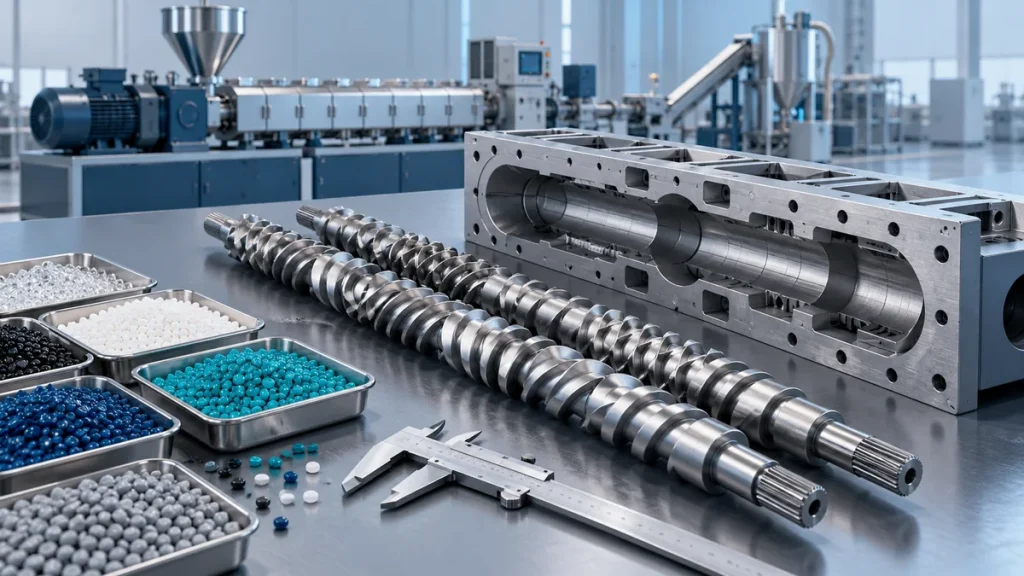
To choose a twin screw extruder, define the material, the transformation it needs and the quality you must achieve before selecting a machine size. Screw diameter, motor power and maximum speed are useful specifications, but none can establish process suitability on its own. The strongest selection is supported by a representative trial and a clear explanation of the complete line’s limiting conditions.
This guide focuses on selecting a compounding system for plastics. If the architecture is still unfamiliar, begin with our twin screw extruder overview.
Define the Process Duty Before the Model
“Producing pellets” can describe very different tasks. One project may require uniform distribution of colour concentrate in a polymer. Another may need pigment agglomerates broken down, glass fibres incorporated, or recycled material modified with additives. Similar finished pellet shapes do not make those processes equivalent.
Write a short duty statement that connects the input to the required output. For example, identify a resin family, the form and range of added ingredients, the intended application and the quality properties used for acceptance. Keep uncertain information visible rather than allowing the supplier to fill the gaps with an unrelated reference recipe.
Also define the operating pattern: continuous campaigns or short batches, expected recipe changes, available shifts and cleaning requirements. A line that performs well during one long trial may be inconvenient for a business built around frequent small orders.
Turn Material Information Into Selection Inputs
| Input to define | Information to provide | Selection question it informs |
|---|---|---|
| Base resin | Family, grade, supply form and conditioning needs | Can the proposed line prepare and melt it appropriately? |
| Fillers and additives | Form, loading range, flow behaviour and sensitivity | How will each ingredient be metered and introduced? |
| Feedstock variation | Moisture, bulk density, contamination and lot changes | What variation must the feeding and process sections tolerate? |
| Required quality | Relevant dispersion, composition, viscosity or mechanical tests | Which operating window produces an acceptable product? |
| Production rate | Continuous acceptable output and recipe range | What limits output across the actual product portfolio? |
| Changeovers | Frequency, cleaning expectations and product sequence | What access, purging and handling provisions are necessary? |
Use actual samples where possible. A nominal bulk density or a photograph is less useful than representative material for a feeding trial. If several formulations matter, choose a trial matrix that includes difficult cases rather than testing only the easiest recipe.
Read the Main Specifications Together
Diameter, Free Volume and Feeding
Diameter influences machine scale, but the usable channel space and the material’s bulk behaviour also affect intake. A low-density filler or irregular recyclate can become feed-limited before the drive reaches its torque limit.
Ask the supplier to explain the main feed opening, screw geometry, feeder choice and any side-feeding arrangement. If a quoted production rate assumes densification or a particular powder-handling system, include that equipment in the selection boundary.
Torque and Speed
Torque capacity matters when the process requires mechanical work at the proposed operating conditions. Speed affects the way material is conveyed and worked, but increasing rpm is not a universal solution to poor dispersion or low throughput.
Compare the expected operating point with the machine’s available limits and the formulation’s quality window. Ask whether the proposed duty leaves a practical margin for normal variation. Do not invent a universal percentage: the appropriate allowance depends on the machine and process.
L/D and Process Layout
The length-to-diameter ratio, or L/D, indicates process length relative to screw diameter. It does not describe how that length is used. Two arrangements with the same L/D may allocate very different space to melting, side feeding, mixing, venting and discharge.
Request a functional process layout. For each opening or screw zone, ask what it does, which ingredients have already entered, and what material condition is expected there. More length is useful only if the process needs the additional functions and can tolerate the resulting history.
Temperature and Wear Protection
Barrel temperature settings do not fully describe the melt’s actual temperature. Mechanical work, feed conditions and cooling capacity also matter. Include a suitable method of observing melt temperature and identify the material’s acceptable window.
For abrasive or otherwise demanding formulations, identify the screw and barrel materials, replaceable wear components and maintenance access. Selection should include serviceability rather than leaving it until after delivery.
Find the Bottleneck Outside the Extruder
The practical line rate is constrained by the slowest necessary operation at acceptable quality. A larger compounder will not fix an undersized dryer, unstable minor-ingredient dosing, a restricted filter or a pelletizer unsuited to the formulation.
Review the interfaces in sequence:
- Preparation and conveying must deliver the required feed condition.
- Feeders must maintain the recipe across their usable ranges, including refill events.
- Side feeding and venting must work together without uncontrolled carry-over or interruptions.
- Filtration and discharge must handle the required pressure and contamination duty.
- Cooling, cutting, drying and collection must maintain pellet quality at the intended rate.
Our pelletizing and compounding line page covers the system boundary. For existing feed problems, use the separate unstable feeding diagnostic guide rather than assuming the machine needs a larger drive.
Ask for Evidence From a Representative Trial
A useful trial produces a traceable relationship between the material, machine configuration, operating conditions and finished product. A video of pellets leaving the die does not establish dispersion, retained fibre properties or stable continuous operation.
Record the recipe and sample identification, conditioning, feeder rates, screw arrangement, speed, torque or load indication, measured melt conditions and downstream settings. Collect samples after the process stabilizes and agree how they will be tested. Capture interruptions and rejected output as well as the best operating period.
If the test machine differs from the proposed production machine, ask which parts of the evidence transfer directly and which require further verification. A supplier should make the assumptions visible rather than presenting a laboratory result as a production guarantee.
Build a Selection Record You Can Compare
For every candidate, write down the proposed size and configuration, the demonstrated material and quality, the limiting operation, the assumptions still open, and the supplier’s proposed acceptance conditions. Record the included support and replacement-part arrangements alongside the technical assessment.
Reject comparisons based only on maximum brochure output. Equally, do not select the most complicated machine simply because it offers the most options. The right system covers the intended product range with evidence, manageable operation and a supply scope that fits your project.
Use our factory acceptance test checklist to turn the selected process duty into a documented verification plan.
Frequently Asked Questions
Is a Larger Motor a Better Choice?
Only if the process needs and can use the available capability. Feeding, heat removal, product sensitivity and downstream equipment can limit performance first. Compare measured acceptable output under the same formulation and scope.
Should I Select the Longest Available L/D?
No. Select the process functions and their layout. Additional length is not a substitute for appropriate screw elements, feeding or temperature control.
Can One Twin Screw Extruder Handle Every Formulation?
A modular system can offer flexibility, but ingredients, contamination, processing temperatures, cleaning and downstream requirements still impose boundaries. Define which changes require a different screw arrangement, feeder, die or pelletizing system.
Match the Machine to the Product
Extruder China helps overseas buyers organize process requirements and compare Chinese equipment proposals. Share your material, quality targets and continuous production requirement through our project inquiry form. A clear process brief makes a supplier’s recommendation easier to assess and verify.