

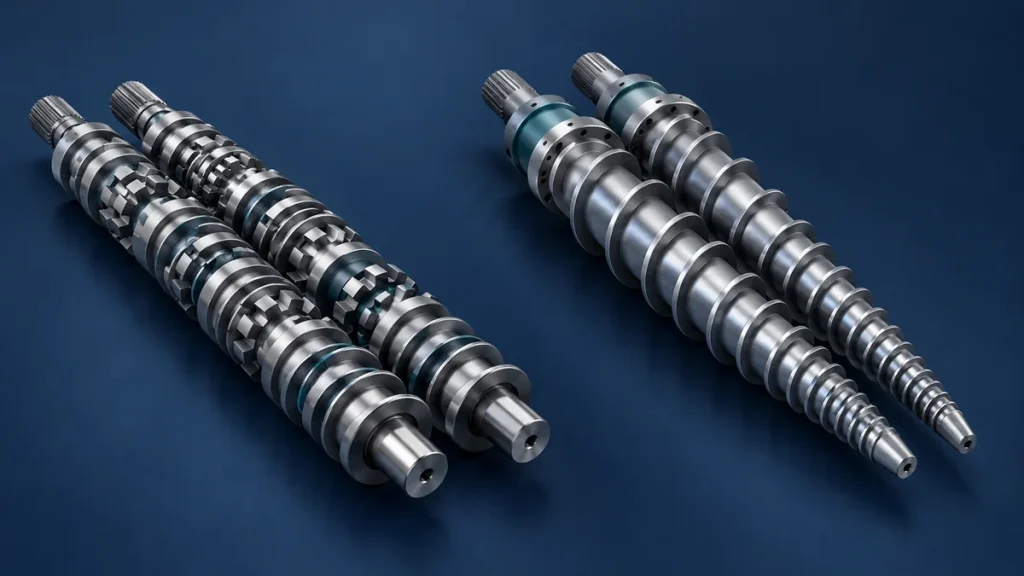
Co-rotating twin screw extruders turn both screws in the same rotational direction; counter-rotating machines turn them in opposite directions. For plastic processing, the useful distinction is how a particular screw architecture handles the required mixing, conveying, pressure development and material history. Neither direction is universally better.
Co-rotating intermeshing machines are commonly associated with compounding, while counter-rotating designs are widely used for duties such as PVC extrusion. These are typical starting points, not a complete selection rule. The actual screw geometry, operating conditions and downstream process must be considered together.
Keep the Classification Dimensions Separate
Rotation direction is only one way to classify a twin screw extruder. Intermeshing describes how the screw profiles engage. Parallel or conical describes the geometry along their length. These terms answer different questions.
Ask a supplier to state the complete architecture rather than accepting “twin screw” as a sufficient description. A pair of conical screws in a photograph does not establish its direction of rotation, and a modular parallel screw assembly should not be selected solely by appearance.
For an introduction to these categories, see our twin screw extruder types and working principle guide.
A Comparison for Plastic Machinery Buyers
| Buying question | Co-rotating intermeshing systems | Counter-rotating systems |
|---|---|---|
| Common process context | Compounding with staged feeding, mixing and venting | Applications including PVC processing and direct product extrusion |
| Main evaluation focus | Ingredient incorporation, distribution, dispersion and controlled material history | Plasticization, conveying, pressure stability and material sensitivity for the intended duty |
| Screw arrangement | Frequently modular, allowing process-specific element combinations | Geometry and construction depend on the machine family and application |
| Addition of ingredients | Main feeding, side feeding and liquid addition can be configured | Available feeding routes must be checked on the specific machine |
| Discharge requirement | Often connected to pelletizing or another downstream process | Often selected as part of an integrated forming line |
| Evidence to request | Representative formulation, composition and material-quality results | Representative formulation, melt behaviour and finished-product results |
This table compares typical purchasing contexts. It is not a claim that every co-rotating machine mixes more effectively or that every counter-rotating machine produces lower shear under all conditions.
Why Co-Rotating Machines Are Common in Compounding
A compounding task may need several operations in sequence: melting the polymer, introducing powders or fibres, distributing the ingredients, developing the required dispersion and removing air or volatiles. Modular co-rotating systems allow the screw elements and barrel openings to be arranged around those functions.
That flexibility is useful when a manufacturer changes formulations. It also creates a need for disciplined process design. Adding more kneading elements or raising the speed can change temperature, residence behaviour and the stress experienced by the material. More intensive processing is not automatically a better product.
For example, a colour concentrate and a glass-fibre compound can require different mixing objectives. Breaking down pigment agglomerates is not the same task as wetting and distributing fibres while retaining useful length. The chosen screw configuration must reflect that difference.
When evaluating a pelletizing and compounding line, ask the supplier to explain the role of each major process zone and how the finished material will demonstrate that the arrangement works.
Why Counter-Rotating Machines Are Common in PVC Lines
PVC processing requires careful management of plasticization and thermal history. Counter-rotating twin screw designs are established options for applications such as pipe and profile extrusion. The exact machine must be matched to the formulation, product and downstream equipment.
The buying brief should distinguish rigid and flexible formulations, ingredient preparation and the intended forming process. A machine suitable for one PVC duty does not become suitable for every PVC recipe merely because it has the same rotation category.
Pressure stability and melt quality should be evaluated with the actual die and downstream requirements in mind. Depending on the application, the finished-product checks may include dimensions, appearance and relevant material or performance tests. A short demonstration without the intended formulation does not establish the full operating window.
Avoid concluding that low rotational speed alone guarantees gentle processing. Material stress depends on geometry, filling, restriction and operating conditions as well as rpm.
Parallel and Conical Is a Separate Decision
Both the geometry and the associated machine construction affect how a system fits a production duty. Parallel and conical counter-rotating designs appear in commercial equipment ranges, but the appropriate choice depends on the required operating window and application.
Ask for a reasoned comparison using the same formulation and output requirement. Include the drive and gearbox arrangement, feeding behaviour, temperature management, service access and downstream integration. Do not treat “conical” as a synonym for counter-rotation or use it as a blanket claim of better mixing.
If a supplier proposes a different architecture from the one you expected, ask for its demonstrated basis. A justified exception is more valuable than a category label presented as a universal rule.
Select by the Quality Problem You Need to Solve
For a masterbatch project, begin with composition, dispersion, colour consistency and changeovers. For a reinforced engineering compound, consider fibre incorporation and the resulting material properties. For a PVC forming line, define plasticization, stable discharge and the finished-product requirements.
Use the following decision sequence:
- Define the material, ingredient forms and intended end product.
- Identify the necessary transformations and the properties that must be preserved.
- Ask which architecture and configuration can perform those tasks within the material’s limits.
- Check feeding, venting, filtration and discharge as an integrated system.
- Validate the proposed operating window on representative material.
The same sequence helps distinguish a real process recommendation from a supplier offering the model already available in its catalogue.
Questions to Ask Before Choosing the Rotation Type
- What is the full architecture, including rotation, intermeshing and geometry?
- Which part of our process makes this design a suitable starting point?
- What screw arrangement and feed locations are proposed?
- Which quality results demonstrate suitability rather than just successful material discharge?
- Where are the operating limits, and what changes are needed for other recipes?
- What downstream equipment is included in the performance proposal?
Agree on the evidence and acceptance method before ordering. Our factory acceptance test guide explains how to document that verification.
Frequently Asked Questions
Is Co-Rotating Always Better for Mixing?
It is a common choice for compounding, but a meaningful answer requires a defined mixing task, material and screw configuration. The best design is the one that achieves the required product quality within acceptable operating conditions.
Are All Counter-Rotating Twin Screw Extruders Conical?
No. Counter-rotation describes direction; conical describes geometry. Commercial counter-rotating machines include parallel and conical configurations.
Does This Replace the Single-Screw Versus Twin-Screw Decision?
No. That is a different comparison. If the need for two screws is still unresolved, start with our single-screw versus twin-screw selection guide.
Define the Process Before the Category
Extruder China helps overseas buyers compare Chinese machinery proposals against the intended material and production task. Send your formulation outline, product requirement and target output through our project inquiry form to organize a more useful equipment brief.