

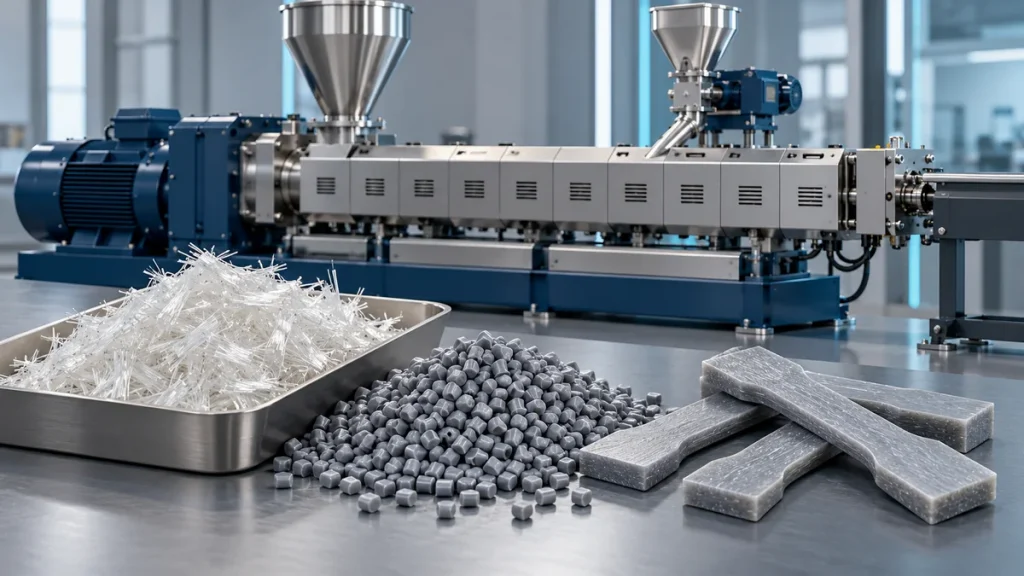
A twin screw extruder for glass-fiber compounding must incorporate reinforcement into the polymer while preserving the material characteristics needed by the finished application. The objective is an acceptable compound, not maximum mixing intensity or the highest possible discharge rate.
For short-glass-fiber compounds based on materials such as PA or PP, selection connects resin preparation, fibre feeding, screw design, wear protection and downstream handling. The final mechanical properties depend on the formulation and subsequent processing too, so an extruder specification alone cannot guarantee them.
Start With the Intended Compound Performance
Define the application and the properties used for acceptance. These may include composition, stiffness, strength, impact behaviour, dimensional requirements or another application-specific result. Agree on specimen preparation, conditioning and test methods so that supplier samples can be compared fairly.
Distinguish the fibre content from the fibre condition. Two samples can contain a similar amount of glass while having different fibre-length distributions, wetting or dispersion. Pellet appearance does not reveal all of these differences.
Our engineering plastic compounding page covers the broader system. For procurement, turn the desired compound performance into measurable trial requirements.
Specify Both the Resin and the Reinforcement
Identify the resin grade, supply form, conditioning needs and relevant thermal limitations. PA and other moisture-sensitive materials need preparation consistent with their grade and process requirements. Do not substitute an arbitrary universal drying temperature or time.
For the glass fibre, record the product identification, supply form, nominal starting dimensions, sizing or compatibility information and intended loading range. Ask the material suppliers to confirm suitability for the resin and application.
This guide primarily addresses short-fibre compounding with chopped glass. Long-fibre pellet production and other reinforcement routes can require different equipment and process arrangements. A supplier should make that distinction explicit rather than presenting one general-purpose line as proof of all reinforcement capabilities.
Why Downstream Fibre Addition Can Be Useful
Introducing chopped glass after the polymer has been melted is a common way to separate initial melting from reinforcement incorporation. This can reduce unnecessary exposure of the fibres to earlier process stages, but the actual position must leave sufficient capacity for wetting, distribution and discharge.
The feed system must deliver a stable glass-to-polymer ratio. Review bulk handling, bridging tendencies, refill events, displaced air and the interface between the metering feeder and the side feeder. A stable average rate over a long period can conceal short disturbances that affect product uniformity.
Ask the supplier to explain why the proposed entry location suits the formulation. There is no universal side-feeding position that guarantees the correct result on every screw diameter or process length.
Balance Incorporation Against Fibre Damage
The process needs enough action to incorporate and distribute the reinforcement. Excessive or poorly placed mechanical work can also shorten fibres or change the polymer’s properties. The useful operating window is found by evaluating the resulting compound, not by maximizing a single machine setting.
Review the screw arrangement both before and after fibre addition. Identify which elements melt the resin, which introduce or distribute other additives, and which provide the remaining mixing and discharge functions. Compare changes through measured material results and stable process records.
| Question | Evidence to request | What it helps distinguish |
|---|---|---|
| Is the recipe being delivered consistently? | Feeder records and measured composition | A feeding problem from a mixing problem |
| Are fibres incorporated appropriately? | Relevant dispersion or microscopy assessment | Poor incorporation from acceptable distribution |
| Is useful fibre length retained? | An agreed fibre-length evaluation with its sampling method | Nominal incoming length from the processed distribution |
| Does the compound meet the application? | Agreed tests on consistently prepared specimens | Material potential from differences in specimen processing |
| Is the process repeatable? | Samples and operating records over a stable run | One good sample from a usable production window |
These checks should be selected with the customer’s technical team. They are a trial framework, not a guarantee that every project needs the same test package.
Include Wear Protection and Service Access
Glass-filled formulations create a demanding wear duty. Request the proposed screw and barrel materials, replaceable wear components and the basis for their selection. Also check how inspection and replacement will be performed on the installed line.
Do not accept an unsupported universal service-life promise. Actual wear depends on formulation, loading, operating conditions, component construction and maintenance. Ask how the supplier identifies replacement parts and which measurements will be used to assess condition.
If an existing line’s performance changes, preserve the process history and inspect condition before attributing everything to the formulation. Our screw and barrel wear guide explains the separate inspection task.
Review the Die, Filtration and Pelletizing Route
Downstream equipment can influence pressure, stability and the finished pellet. Filtration must be chosen with reinforcement and the actual contamination requirement in mind. An unsuitable restriction can create another problem instead of improving the compound.
Discuss the die and pelletizing system using representative material. Evaluate stable discharge, cooling, cutting, pellet consistency and the ability to collect a dry, usable product. A larger extruder cannot compensate for a downstream system that cannot handle its acceptable output.
Ensure the quoted performance includes the necessary feeders, venting, discharge and pelletizing equipment. Otherwise, the comparison describes a main machine rather than a working compounding line.
Structure a Trial Around a Process Window
Test the intended material and reinforcement, not a convenient substitute chosen only to demonstrate discharge. Where several recipes matter, include representative differences in resin, glass content or other additives.
Record ingredient lots, preparation, actual feed rates, screw arrangement, speed, load indication, melt observations and downstream settings. Relate the samples to a stable operating period. Keep off-spec output and interruptions visible in the record.
If changing speed or throughput, evaluate both quality and stability. Avoid declaring a setting optimal merely because one result improves. The relevant question is whether the compound consistently meets the complete specification at the intended production rate.
Use the agreed trial record to define the supplier’s acceptance proposal. Our factory acceptance test guide provides a broader framework for documenting that agreement.
Frequently Asked Questions
Does More Mixing Always Produce a Stronger Glass-Filled Compound?
No. Incorporation is necessary, but processing also affects fibre length and polymer condition. Final properties must be evaluated on appropriately prepared specimens rather than inferred from screw speed or torque alone.
Can the Same Machine Process PA and PP With Glass Fibre?
Potentially, with a validated configuration and suitable preparation, temperature capability, feeding and downstream equipment. The supplier should identify required changes and demonstrate the intended recipe range.
Can a Chopped-Fibre Line Automatically Make Long-Fibre Pellets?
No. Long-fibre products involve a different process brief and may require dedicated impregnation and handling arrangements. Confirm the required product structure before comparing equipment.
Specify the Evidence Alongside the Equipment
Extruder China helps overseas buyers compare Chinese machinery options for defined compounding tasks. Send the resin, fibre product, intended loading range, quality tests and output requirement through our project inquiry form to build a focused supplier discussion.