

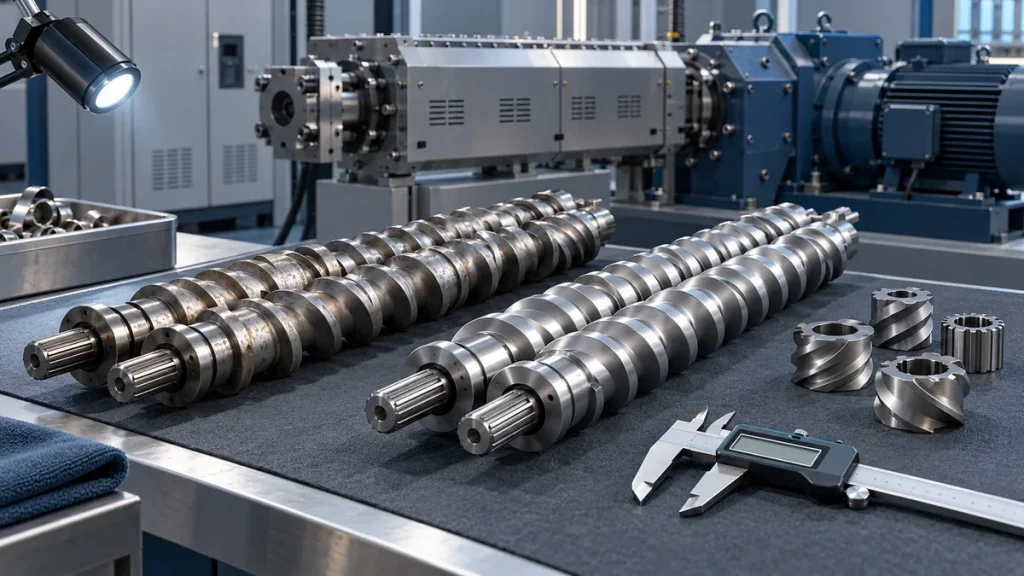
Choosing between a new and a used twin screw extruder means comparing two possible routes to an acceptable operating process. The purchase price is only the starting point. Condition, configuration, missing equipment, controls, spare parts, transport and commissioning can change the practical result.
A used machine can be a sensible option when its condition and process fit are documented. A new machine can still be a poor choice if it is selected against an incomplete brief. Compare both against the same material, product quality, continuous output and installed-line boundary.
Check Process Fit Before Assessing the Discount
Identify what the candidate was designed to do and what the project now requires. Record its complete architecture, screw size, process length, drive and gearbox details, barrel openings and available operating range.
Then compare the feeding, mixing, venting and discharge arrangement with the intended formulation. A machine’s previous application can provide context, but it does not establish suitability for a new resin, abrasive filler or heat-sensitive ingredient.
Start with our twin screw extruder guide if the architecture is unclear. Do not treat an attractive model name or nominal diameter as a substitute for a process review.
Establish Exactly What Is Included
Inspect the actual sale scope, not just the equipment visible in an old photograph. The offer may exclude feeders, vacuum equipment, filters, cooling, pelletizing, cables, controls or documentation that were part of the original installation.
Create an inventory with equipment identification, photographs, condition, included accessories and ownership of the documentation or software needed for operation. Record which items can be demonstrated together and which have already been disconnected.
A new-machine offer needs the same discipline. Optional components in a catalogue image should not silently enter the comparison as included equipment. Compare a working pelletizing and compounding line with a working line, or explicitly price the gaps.
Inspect Mechanical Condition With Evidence
Screws, Shafts and Barrels
Request identification and measurement records for the process section. Use suitable inspection methods and the manufacturer’s references where available. Surface appearance alone cannot establish remaining dimensional condition, correct clearances or suitability of the wear materials.
Check whether the actual screw arrangement is documented and whether replacement elements are available. An undocumented mixed assembly may require engineering review before its process function can be evaluated. Our screw and barrel wear inspection guide describes the separate measurement issue.
Drive and Gearbox
Review service records, identified repairs and the opportunity to observe the system under an appropriate load. Qualified inspection may consider operating observations and relevant condition evidence. A brief unloaded start does not demonstrate the intended production duty.
Ask who can support the installed gearbox and drive, how replacement parts are identified and whether an anticipated change in duty is technically acceptable. Do not assume that fitting a larger motor makes the mechanical system suitable for greater torque.
Heating, Cooling and Utilities
Record the condition and completeness of heaters, sensors, cooling circuits and related equipment. Compare the electrical supply and utilities at the new site with the candidate’s requirements. The adaptation cost should be based on a defined scope rather than a casual allowance.
Controls and Documentation Can Determine Feasibility
Identify the controller, operator interface, drives, I/O and associated software or licences. Confirm that authorized backups, necessary access and usable documentation are included. The presence of an operating screen does not prove that a future owner can maintain or modify the system.
Ask a qualified integrator or the equipment supplier to assess obsolete components, unavailable support and any proposed control conversion. Include verification and recommissioning in the scope. Do not weaken guarding or safety functions to make an older machine easier to start.
The same questions apply to new equipment: identify the delivered documentation, agreed access, backup arrangements and ongoing support. “Latest controls” is a marketing description until the actual platform and deliverables are listed.
Compare the Route to Installed Operation
| Cost or risk area | New-machine questions | Used-machine questions |
|---|---|---|
| Process configuration | Is the proposed arrangement supported by trials? | Can the installed arrangement meet the new duty, and what must change? |
| Equipment scope | Which required items are optional or buyer-supplied? | Which original components are missing or excluded? |
| Condition and wear | What construction and acceptance evidence are included? | What measured condition and repair evidence are available? |
| Controls | What platform, backups, access and documentation will be delivered? | Can the existing platform be supported or economically replaced? |
| Logistics | What are the packing, shipment and installation responsibilities? | Who disconnects, identifies, preserves, packs and reinstalls the equipment? |
| Schedule | When can manufacture, trials and shipment occur? | When can inspection, repair, missing parts and commissioning be completed? |
| Support | What assistance and warranty terms are agreed? | What support remains available, and what does the seller actually commit to? |
Assign estimates to identified work rather than assuming a used machine needs a fixed refurbishment percentage. Some candidates may need little adaptation; others may be unsuitable even after substantial expense. Preserve the basis and uncertainty of each estimate.
Do Not Confuse Availability With Time to Production
A machine ready for collection can still require inspection, disassembly, repair, utility adaptation and integration. Missing drawings or long-lead replacement parts can dominate the schedule.
For a new machine, manufacture is only part of the calendar too. Material trials, design confirmation, shipping, installation and operator readiness all affect the route to acceptable output.
Build a schedule around the actual work and dependencies. Include the point at which the system will demonstrate the agreed product quality, rather than declaring the project complete when the machine arrives at the site.
Use Evidence-Based Decision Gates
First, decide whether the architecture and configuration can satisfy the process. Next, establish equipment completeness and condition. Then obtain supportable estimates for adaptation, logistics and commissioning. Finally, define the trial or acceptance evidence and compare the remaining uncertainty with the business’s tolerance.
A candidate with major unknowns should remain an unresolved option, not automatically become the cheapest option. If inspection or a representative trial is unavailable, make that limitation visible in the decision rather than inventing confidence.
Our factory audit and inspection service page explains the project coordination scope. An inspection brief should identify the actual machine and questions to resolve; it should not imply an unlimited certification of future performance.
Frequently Asked Questions
Is a Used Twin Screw Extruder Always Better Value?
No. Value depends on usable condition, process fit, completeness and the cost and uncertainty of reaching acceptable production. Compare the installed result rather than the asking price alone.
Does Low Operating Time Prove Good Condition?
No. Records, storage, previous formulation, maintenance and measured condition still matter. Treat operating hours as one piece of evidence rather than a complete condition assessment.
Can an Older Machine Be Modernized?
Sometimes. Feasibility depends on the mechanical system, available parts, controls and intended duty. Obtain a defined technical and commercial proposal from a suitable supplier before budgeting an assumed upgrade.
Compare the Complete Buying Case
Extruder China helps overseas buyers compare Chinese machinery proposals and coordinate sourcing. This guide is a decision framework, not a claim of current used-machine inventory. Send your material, production target and candidate equipment details through our project inquiry form to organize the questions that need evidence.