

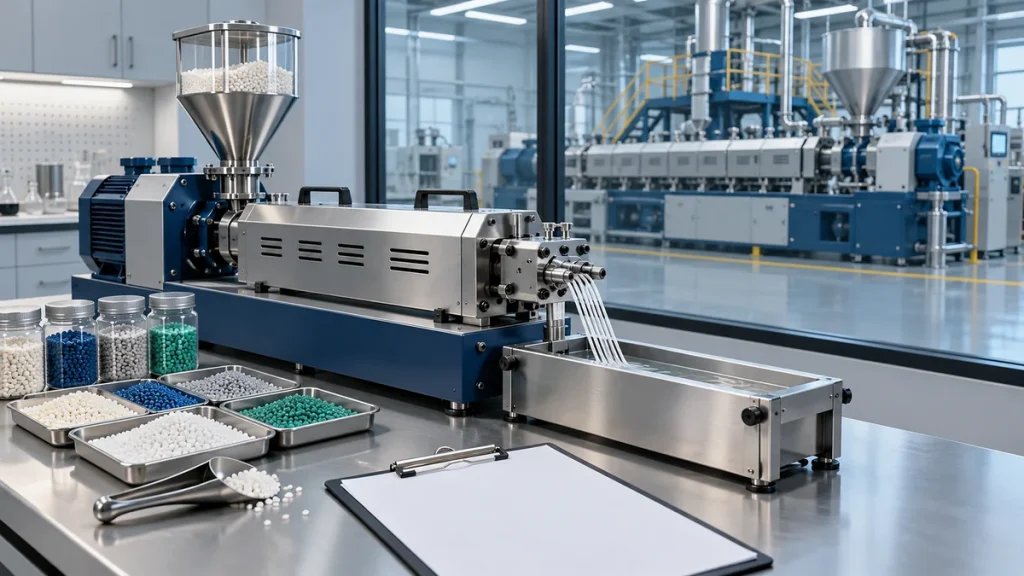
A lab-scale twin screw extruder helps develop formulations and understand processing behaviour using manageable quantities of material. Turning a successful laboratory sample into a production specification requires more than increasing the screw diameter or copying the rpm. The larger process must deliver the required material quality under its own feeding, thermal and downstream conditions.
The most useful laboratory programme is designed around a decision: formulation screening, process-window development, pilot verification or equipment procurement. These objectives do not require identical machines or the same amount of evidence.
Distinguish Micro-Compounding, Continuous Lab and Pilot Equipment
A recirculating micro-compounder can be useful when sample quantity is limited and the objective is material screening. Its material history and discharge arrangement can differ from a continuous production process. A good sample is informative, but it is not automatically evidence of continuous throughput.
A continuous laboratory twin screw extruder allows controlled feed and discharge through a configured process section. It can support systematic investigation of formulation and operating conditions. Its small dimensions still affect feeding, usable channel space and heat transfer.
Pilot equipment moves closer to the intended production duty. It may allow more representative feeding, venting and downstream operations, but the degree of similarity must be stated rather than assumed from the word “pilot.”
For the machine’s basic functions, see our twin screw extruder guide.
Set the Trial Question Before Choosing the Equipment
For early material screening, the question may be whether a formulation concept is promising. For process development, the objective may be a repeatable operating window that produces the required dispersion, composition or material properties.
For a production purchase, ask a further question: what evidence connects this trial to the proposed line? Define what can be transferred directly, what needs engineering interpretation and what must be verified at a larger scale.
This prevents a common mismatch: treating a small batch of good material as proof that a complete production line will achieve a stated hourly output without further work.
Record More Than the Final Sample
| Record group | Useful information | Why it matters for transfer |
|---|---|---|
| Materials | Grade, lot, ingredient form, preparation and composition | A changed feedstock can be mistaken for a scale effect |
| Machine geometry | Diameter, process length, screw elements and barrel openings | The material does not see the same process in every machine |
| Feeding | Actual rates, rate ratios, refill behaviour and interruptions | Stable composition requires representative delivery |
| Operating conditions | Speed, load or torque indication, temperatures and pressure where available | Settings alone do not fully describe the material’s experience |
| Material history | Relevant melt observations, residence-time information and energy measurement basis | Heat and mechanical exposure can change the product |
| Downstream | Die, cooling, cutting, drying and sample handling | The sample can change after leaving the process section |
| Quality | Sampling point, preparation, test method and result | Comparable specimens are needed for a useful conclusion |
Preserve the configuration revision and link every sample to its run record. “Run three worked” is difficult to use later if run three’s screw arrangement or ingredient conditioning is uncertain.
Why Copying RPM Is Not a Scale-Up Method
The same rotational speed on different screw sizes does not recreate every aspect of flow, stress and heat transfer. The machines may also differ in channel geometry, filling, process length and available openings.
Likewise, a geometric throughput estimate cannot establish product quality by itself. Feeding behaviour, mechanical capacity, heat removal, venting and discharge can impose different limits on the larger line. Treat calculations as assumptions to be checked against the actual process.
Ask the supplier which similarities it is trying to preserve and which differences it expects. A defensible explanation identifies the important variables for this formulation rather than presenting one scaling formula as a universal production guarantee.
Use Material History to Compare the Runs
Residence-time behaviour describes how long material spends in the process, while measured mechanical energy per unit mass provides another view of processing intensity. Both need a clear measurement basis and interpretation alongside melt condition and quality.
An average can conceal a distribution or a transient. Therefore, specify how a measurement was made and what operating state it represents. Do not claim equivalent processing simply because one recorded value matches between machines.
Energy comparisons also need consistent boundaries. Motor input, calculated shaft work and energy for the complete line are different quantities. A trial record should state which was used rather than reporting a bare number labelled “energy consumption.”
Ultimately, the finished-material results determine whether the transfer is useful. Matching a process indicator is supporting evidence, not a substitute for the agreed product tests.
Move Through Development Stages With Clear Exit Conditions
Stage One: Establish Feasibility
Use the available material efficiently to identify whether the formulation can be processed and whether the product shows the intended characteristics. Record limitations such as incomplete feeding representation or a recirculating material history.
Stage Two: Define a Repeatable Window
Investigate a planned range of operating conditions rather than changing several settings without a record. Collect samples after an appropriate stable period and check repeatability. Include realistic recipe or feedstock variation when it matters.
Stage Three: Verify the Production Route
Review the intended preparation, feeders, process layout, venting, filtration and pelletizing equipment. Conduct a suitable larger-scale or supplier trial where needed. Record which earlier findings remain valid and which assumptions change.
Stage Four: Write the Procurement Specification
Translate the evidence into input-material limits, required product tests, continuous acceptable output, supply scope and acceptance conditions. Keep unverified assumptions visible. The resulting specification should explain what a proposed compounding line must demonstrate.
Create a Trial-to-Production Handover File
Prepare one controlled package containing the formulation range, source material identification, conditioning, successful and unsuccessful trial conditions, configuration drawings, sample results and measurement methods. Add the proposed production layout and a list of unresolved risks or assumptions.
Separate confirmed facts from estimates. If a feeder, vent or downstream device was absent from the laboratory work, explain how its production duty will be checked. If the production machine is not geometrically similar, ask for a more explicit engineering and trial basis.
Use our factory acceptance test checklist to connect that handover file to the supplier’s demonstration rather than restarting the evidence trail after ordering.
Frequently Asked Questions
Can a Micro-Compounder Predict Production Throughput?
Not on its own. It can support material screening, but its operating mode and material history may differ substantially from a continuous production line. Further evidence is needed for a throughput commitment.
Must Every Process Variable Stay the Same During Scale-Up?
No. The important task is to preserve the material characteristics that determine quality while accommodating the larger equipment’s limits. Relevant settings may need adjustment and verification.
Is One Successful Laboratory Run Enough to Order a Line?
Usually it leaves important questions open. Assess repeatability, representative feeding, scale differences and the complete production route before using the result as a purchasing basis.
Turn Trial Data Into a Useful Equipment Brief
Extruder China helps overseas buyers organize process requirements and compare Chinese machinery proposals. Send your formulation outline, available trial records, required quality and production objective through our project inquiry form to define the evidence needed for the next stage.