

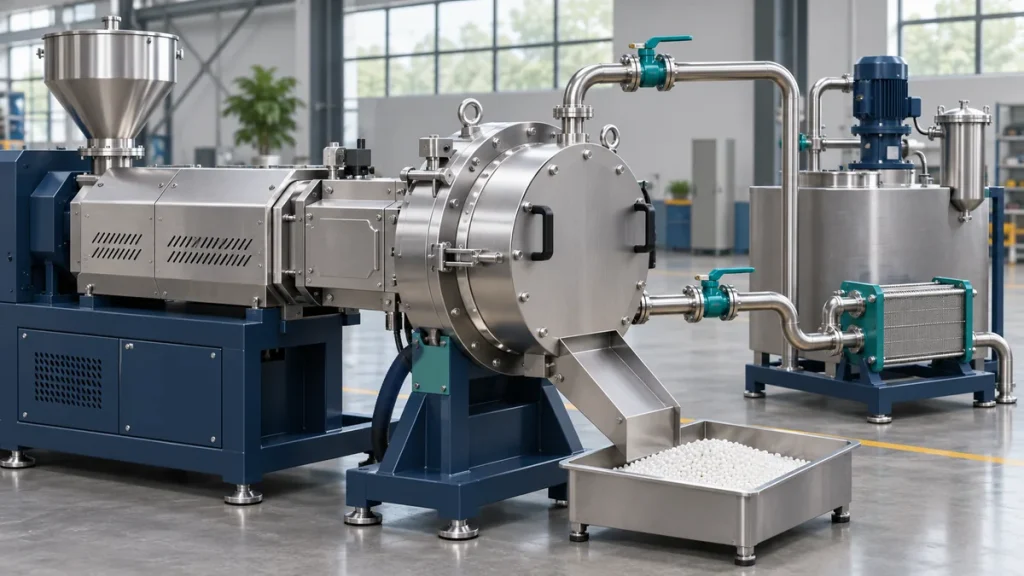
Water-ring pelletizing cuts polymer at the die face and uses a circulating ring of water to cool and transport the cut pellets. It can provide a compact alternative to handling long strands, but suitability depends on the polymer, formulation, throughput and required pellet condition.
Do not choose it simply because a quotation calls the process “automatic.” Confirm the cutting arrangement, material limits, water system and drying package, and evaluate the resulting pellets under realistic production and storage conditions.
The process from melt to collected pellets
The extrusion system delivers melt to a die. Rotating knives cut the emerging material near the die face. The surrounding water-ring arrangement cools and carries the pellets into the water separation and drying section.
Water-ring and underwater pelletizing are distinct arrangements. In an underwater system, cutting takes place in a water-filled cutting chamber. A water-ring system uses a different water-contact configuration. Suppliers may use overlapping commercial terms, so request a process description and drawing rather than relying on a product name.
The broader strand versus underwater pelletizing guide explains other cutting routes. Each option needs to be compared on the same material and acceptance basis.
What makes a material suitable?
The polymer must behave suitably as it emerges from the die, is cut, contacts water and moves through drying. Melt behavior, tackiness, filler content and pellet strength all influence the result.
Water-ring systems are available for selected thermoplastic applications, including certain polyolefin duties. That does not establish compatibility with every recycled PE or PP stream, much less every engineering polymer or elastomer. Formulation changes can affect cutting and cooling behavior even within one polymer family.
Send the supplier a real material description: polymer grade or waste source, relevant flow properties, additives, fillers, contamination and expected variation. Ask which materials are excluded and why. A supplier who identifies a limitation provides more useful information than a broad promise of universal compatibility.
Look beyond the cutting chamber
A complete package may include the die and cutting assembly, water circulation, water separation, pellet drying, screening, controls and connections to downstream handling. The exact scope varies.
| Part of the package | Question to resolve |
|---|---|
| Melt and die interface | Are pressure, temperature and flow compatible with the extrusion duty? |
| Cutting assembly | How are knife condition, adjustment and wear managed? |
| Process-water system | How are temperature, cleanliness and circulation maintained? |
| Separation and drying | Can the equipment handle the actual pellets and water load? |
| Screening and discharge | How are fines, oversize material and unsuitable startup pellets handled? |
Clarify whether a chiller, heat exchanger, filtration equipment, pumps or tanks are included or supplied separately. A compact cutting unit still depends on adequate utilities and accessible maintenance space.
Judge pellet quality after cooling and handling
Inspect more than pellet shape at the discharge point. Check the proportion of fines and oversize pieces, consistency of cutting, residual surface water and behavior during conveying and packaging.
Some products can look acceptable while warm and loose but agglomerate after collection. Others may be damaged during drying or conveying. A trial should follow the pellets to the condition in which they will be stored, transported or used.
Define the sampling and inspection method before the demonstration. If the finished product has a specific size distribution or moisture requirement, measure it using an agreed procedure rather than relying on visual approval alone.
Check startup, interruptions and product changes
Stable operation is only part of the operating cycle. Ask how the system starts, how unsuitable material is diverted and what happens if melt flow or water circulation is interrupted.
Product changes can involve different cutting behavior, cleaning requirements or contamination risk. Establish the expected changeover procedure and the parts or settings that may need adjustment. Do not assume that a successful run on one resin validates a whole proposed production schedule.
Safety interlocks and maintenance instructions need to cover the hot melt, rotating knives and associated pressure. Knife inspection or cleaning should follow the supplier’s isolation and depressurization procedure, never an improvised intervention during operation.
Compare it with the alternatives on a shared basis
A meaningful comparison includes the same feedstock, accepted output, operating schedule, product quality and utility boundary. Consider staffing, startup waste, consumables, cleaning and downstream handling alongside the machine footprint.
A strand system may offer a useful route for some materials and operating preferences. An underwater package may suit other duties. Water-ring cutting deserves consideration where its demonstrated material fit and complete system scope match the project. None of these labels alone establishes the lowest total operating cost.
When requesting a pelletizing-line proposal, include representative material and the finished-pellet requirements. Use the RFQ checklist to make sure the cutting system is evaluated as part of the whole line, including water, drying and discharge.