

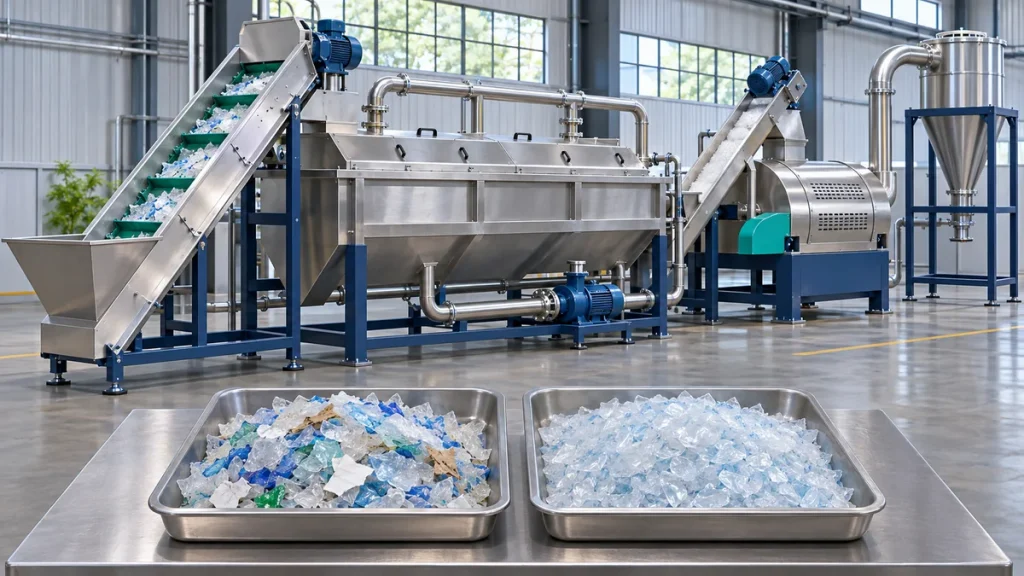
Not every plastic recycling project needs a washing line. Clean, segregated production scrap may be suitable for dry preparation and extrusion. Post-consumer packaging with food residues, soil, labels or incompatible materials usually needs a more extensive preparation route. The decision starts with what is on and in the waste, and what the next user expects from the pellets.
Washing, melt filtration and degassing perform different jobs. A filter cannot wash a greasy surface before it reaches the extruder, and an extruder cannot reliably turn an unidentified mixture into a consistent resin. Select these operations as a connected process rather than alternative ways of solving every contamination problem.
Begin with the incoming waste, not the machine quotation
Describe the source of each material stream. Factory trim collected beside a film line has a different history from agricultural film or discarded detergent bottles, even when the main polymer is the same.
For each stream, record polymer identity, source, collection method, storage conditions, typical contaminants and variability between deliveries. Keep representative samples from ordinary and difficult loads. A photograph of the cleanest handful is a poor basis for a washing-system decision.
A useful first division is between contamination that can be removed mechanically before melting and contamination that remains within, or is compatible with, the polymer. Loose dirt, paper and some surface residues may respond to appropriate washing and separation. Dissolved substances, mixed polymers and absorbed odor compounds need separate evaluation. Washing does not guarantee their removal.
When dry preparation can be enough
Clean edge trim, rejected parts and segregated offcuts may only require sorting, metal removal, size reduction and controlled feeding. Adding a wash stage without a material need can add water handling, drying duty, wastewater treatment and another opportunity for contamination.
However, the word “industrial” does not prove cleanliness. Scrap swept from a floor, exposed to rain or mixed with other production waste can need further treatment. Check actual collection practice and intended reuse before excluding washing.
For a dry route, acceptance controls should still cover foreign objects, material identification and storage. Reject unsuitable loads before they reach the extruder rather than relying on a finer screen to compensate for every upstream problem.
What a washing line needs to accomplish
A washing system is a series of preparation and separation operations. Its sequence depends on whether the feed is film, bottles, rigid regrind or another form.
| Material problem | Preparation question | What to verify downstream |
|---|---|---|
| Loose soil and fines | Can pre-cleaning remove part of the load before wet treatment? | Residual dirt and water-treatment burden |
| Labels and lightweight fractions | Which removal and separation steps suit the material combination? | Remaining paper, adhesive and foreign polymers |
| Food, oil or other surface residues | What washing chemistry and mechanical treatment are appropriate? | Residual contamination, odor and rinse quality |
| Mixed materials | Which sorting or separation principle can distinguish them? | Actual composition of the recovered fraction |
Hot washing is not automatically necessary for every stream, and cold washing is not automatically sufficient. Temperature, chemistry, contact time and mechanical action must fit both the contamination and the polymer. Trial results are more useful than a generic “hot wash included” line in a quotation.
For bottle projects, the PET washing-line buying guide explains additional preparation questions specific to that feedstock.
Washing changes the extrusion feed
A successful wash stage can create a difficult extrusion feed if the flakes leave too wet, too variable in size or too low in bulk density. Mechanical dewatering and, where necessary, further drying must be sized with the extrusion system.
Film is particularly sensitive to handling and retained water. A supplier should show how material moves from washing and squeezing or drying into storage and feeding without uncontrolled rewetting or bridging. PET requires a different moisture-control discussion from non-hygroscopic polyolefins; a visibly dry surface does not prove that absorbed moisture is acceptable.
Specify the condition at the extruder inlet, not merely at the washing-line outlet. Intermediate storage, conveying and ambient exposure can change that condition.
Do not overlook the water and reject streams
The project scope should identify fresh-water demand, circulating-water treatment, discharge requirements and the destination of separated solids. The exact treatment depends on contamination and local requirements; copying another plant’s arrangement can leave important gaps.
Ask who supplies tanks, pumps, screens, sludge handling and controls. Establish responsibility for civil work, drainage, chemical storage and safe maintenance access. A low machine price can be misleading when essential infrastructure sits outside the quoted boundary.
Material recovery also matters. Record input mass, recovered plastic, rejected fractions and retained water on a stated measurement basis. A high wet output figure is not the same as a high recovery of usable dry polymer.
Make the decision with a connected trial
Evaluate representative material through the proposed preparation route and then through extrusion. Check the resulting pellets against the receiving process rather than judging washed flakes by appearance alone.
The trial record should connect incoming contamination, washing conditions, residual moisture, extrusion behavior, filter loading and pellet quality. If an improvement appears only on carefully hand-sorted feed, the production plan needs to include that sorting step.
A clear purchasing brief says which materials will be accepted, what contaminants must be removed, what feed condition extrusion needs and which utilities and waste streams are included. Use that brief to compare plastic recycling lines or discuss a rigid-plastic recycling project. The right question is whether washing creates a suitable, consistent feed for the intended pellet product.