

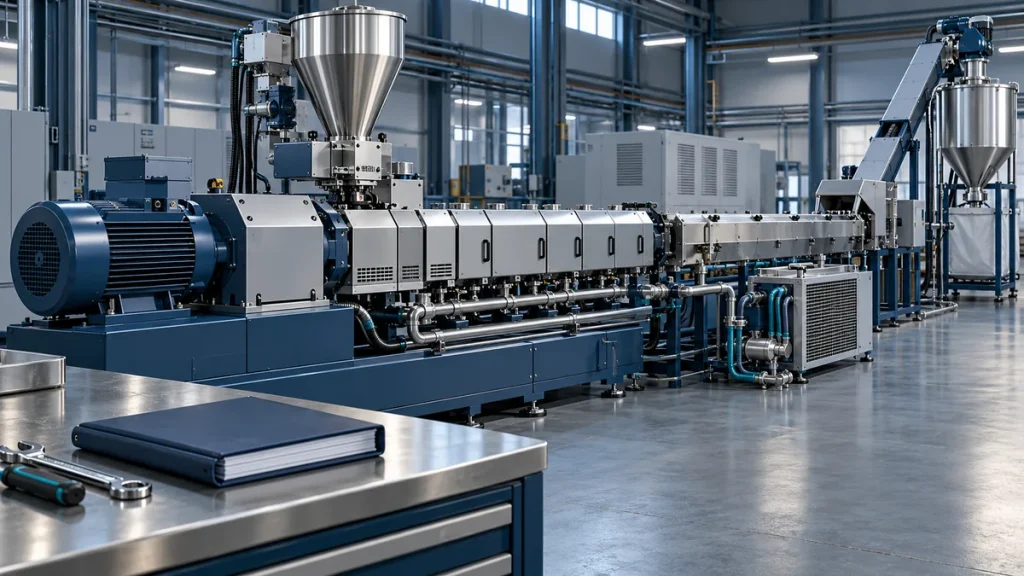
A planned twin screw extruder shutdown should leave the line in a known condition, with clear ownership of the next action. A controlled process pause, a maintenance shutdown and a long storage period are different situations; they should not share an improvised “stop and restart” routine.
The restart plan must account for the actual machine configuration and the material left in the process. This checklist helps production and maintenance teams agree that plan. The OEM’s operating instructions, material requirements and site procedures determine the physical sequence.
Choose the correct shutdown category
Before scheduling work, identify why the line is stopping and whether anyone will enter a guarded area, open a connection or remove a component. Stopping screw rotation is not the same as establishing a safe maintenance state.
| Situation | Main planning question | Required handover |
|---|---|---|
| Controlled production pause | What standby conditions are permitted for this material and equipment? | Approved operating state and responsibility for monitoring |
| Planned maintenance | What material condition and isolation does the task require? | Work scope, isolation arrangements and release responsibility |
| Extended shutdown or storage | What preservation and periodic checks are needed? | Equipment-specific storage and recommissioning instructions |
| Emergency or protective stop | What caused the stop, and what must be resolved before restart? | Fault investigation and authorized release |
An emergency stop must follow the emergency response procedure. It should never be delayed to complete a normal cleaning sequence.
Decide the material condition before stopping
Identify the formulation, any cleaning or transition material, and the components included in the material route. A planned screw pull may require a different preparation from a short pause before producing the same compound.
Do not assume that every line should be emptied, left filled with purge or held at one standby temperature. Those choices depend on the resin, purge grade, equipment and shutdown purpose.
Use the cleaning and changeover requirements in your maintenance plan to assign responsibility. If a specific cleaning compound is used, its instructions must be compatible with the machine’s shutdown and startup protocols.
Record the condition in which maintenance receives the line
A handover should describe what has actually been completed. “Ready for maintenance” is insufficient if the next team cannot tell which components contain material or which connections were opened.
Include the material present, cleaning performed, known faults, pending work and applicable isolation records. Name the equipment covered: feeders, cooling, vacuum and downstream equipment may have separate service boundaries.
A maintenance team should not infer depressurization, electrical isolation or material condition from a stopped control screen. Those conditions require the site’s specified verification.
Review changes before releasing the equipment
Before restart, compare the completed work with the planned scope. Confirm the identity of replacement parts and whether the screw configuration, control settings or material route has changed.
The mechanical and electrical release should address the relevant guards, couplings, sensors, connections and protective functions. Any outstanding restriction must be explicit, with an authorized decision about its effect on restart.
Do not use production startup as a way to discover whether an unresolved assembly concern matters. Return-to-service checks should already have a defined method and responsible person.
Check utilities and thermal readiness
Confirm the required lubrication, cooling and other installed utilities under the OEM’s startup instructions. A service job may have left a valve, connection or circuit in a different state from normal production.
Thermal readiness requires the equipment’s specified conditions. A displayed barrel setpoint does not justify assuming that all material and internal components are ready for rotation. Conversely, a temperature number copied from another line cannot establish readiness.
If a drive fails to turn or an abnormal torque condition appears, follow the machine’s stopping and review procedure. Increasing torque allowance or overriding an interlock is not a substitute for resolving the cause.
Conduct the authorized startup and identify the first material
Use the approved startup sequence for the machine, downstream equipment and actual material state. Document any controlled changes so the first acceptable production case can be reconstructed.
Keep transition material separate from released product according to the site’s quality procedure. A stable display is not, on its own, a product acceptance result. Define which samples and checks confirm that production may be released.
Where maintenance changed the screw assembly or a melt-path component, compare the agreed operating case with its previous baseline. State differences in material, throughput or other conditions rather than presenting an unlike comparison as proof of improvement.
Use a short restart handover sheet
A practical record can contain:
- Shutdown reason, material identity and final material condition.
- Completed work and installed configuration references.
- Mechanical, electrical and protective-function release.
- Utility and thermal-readiness checks.
- Startup observations, alarms and approved adjustments.
- Product sample references and the release decision.
For a long shutdown, add preservation status and the supplier’s recommissioning requirements. Do not treat storage preparation as merely a longer version of an overnight stop.
Questions worth resolving with the supplier
Can the same restart procedure be used after every maintenance job?
Only where the applicable instructions and work scope support it. Replacing a sensor, rebuilding a screw assembly and recommissioning stored equipment create different verification needs.
Is reaching the temperature setpoint enough to start the screws?
Not necessarily. The approved startup protocol determines the necessary thermal condition and checks for the actual equipment and material.
During equipment handover, obtain the operating documents and responsibilities described in installation and training planning. For an existing line with incomplete records, prepare the machine identification and completed-work details before requesting after-sales coordination.