

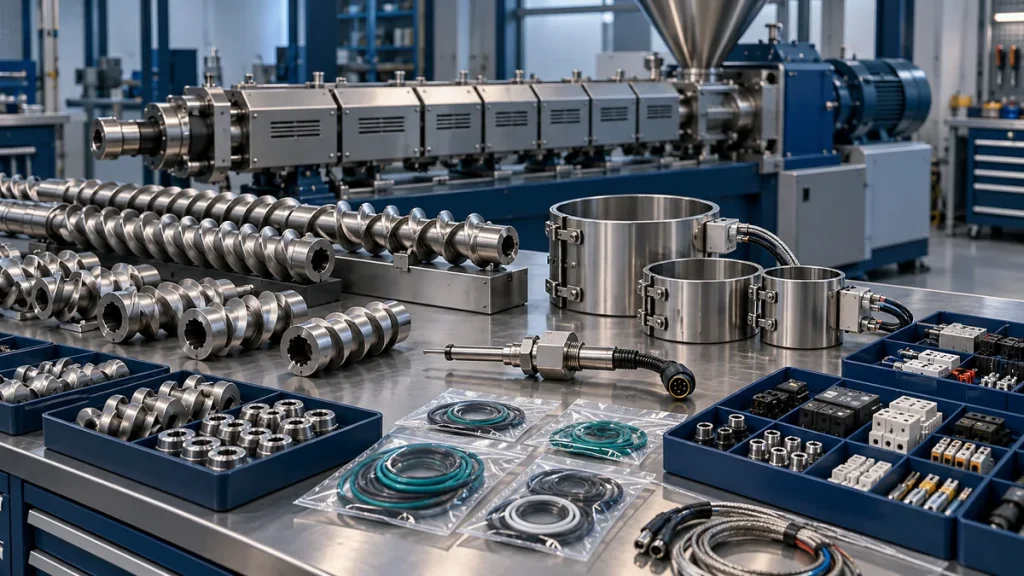
The right twin screw extruder spare-parts stock is not a universal list of components. It is a set of identified, compatible parts selected around the consequences of a failure, the time needed to obtain a replacement and the site’s ability to restore the equipment.
A small service component can stop an otherwise functional line. A large spare can also sit unused, become unsuitable after a modification or deteriorate in poor storage. The aim is to make those trade-offs explicit before purchasing.
Build the installed-parts register before the shopping list
Start with the actual equipment: main extruder, gearbox, feeders and the installed cooling, vacuum, filtration and pelletizing packages. Each may have a different supplier and parts system.
For every candidate spare, connect the part reference to its installed location and document revision. A photograph helps with identification but does not establish compatibility on its own.
| Register field | Why it matters |
|---|---|
| Equipment model and serial number | Connects the request to the installed machine |
| OEM part number and description | Distinguishes visually similar components |
| Drawing or bill-of-materials revision | Captures configuration changes |
| Installed position and quantity | Shows where the part is used |
| Approved replacement reference | Records a reviewed substitution |
| Storage and inspection requirements | Helps keep the spare usable |
| Supplier and current lead-time basis | Supports a realistic replenishment decision |
Do not assume that an old parts list still matches the line after a control upgrade or screw-configuration change.
Group parts by maintenance role
Common service categories can help organize the discussion, but they are not an instruction to buy every item.
Routine service parts may include specified filter elements, seals or other consumables for the installed design. Condition-dependent parts can include screw elements or components whose replacement follows an inspection. Critical assemblies may require a repair or exchange strategy rather than permanent on-site stock.
Electrical and instrumentation items need complete specifications. A temperature sensor or pressure transducer that looks similar may differ in its signal, range or installation requirements. A heater needs more identification than its apparent shape.
The preventive maintenance plan should explain which tasks consume these parts and how a completed work order triggers replenishment.
Decide stocking priority with a consequence-and-supply review
Ask the maintenance, production and purchasing teams to review each candidate together. Use current supplier information instead of an assumed delivery time from an old quotation.
| Situation | Stocking option to evaluate |
|---|---|
| A failure stops an essential function and no timely recovery route exists | A verified on-site spare or another approved availability arrangement |
| Planned service consumes a known item | Purchase against the work schedule with a replenishment rule |
| A part is expensive and has a specialist repair route | Compare repair, exchange and owned-spare arrangements |
| The requirement depends on inspection findings | Arrange identification and supply planning before the shutdown |
| A configuration change may obsolete the part | Review the change before committing stock |
These options are a decision framework, not automatic stocking rules. Actual priorities depend on the plant’s response time, maintenance capability and supplier arrangements.
Separate “available” from “ready to install”
A spare on a shelf is not necessarily ready for service. Verify its identity, preservation condition and required supporting items before relying on it in a shutdown plan.
A replacement assembly may also require specialist installation, alignment, approved configuration or commissioning. Buying it does not eliminate those needs. Confirm the expected documents, tools and service resources with the responsible supplier.
For screw assemblies and modular elements, retain the approved configuration and matching interface information. An individual element should not be treated as interchangeable merely because its outer diameter resembles the installed part.
Manage substitutions as technical changes
When an original part is unavailable, distinguish an approved replacement from an unreviewed alternative. Record who confirmed the relevant mechanical, electrical, material and application requirements.
Do not allow a purchasing description such as “equivalent sensor” to become the only compatibility record. Include the actual replacement model and its approved installed use.
Apply the same discipline to major assemblies. Gearbox or barrel exchange services can be useful options, but availability, suitability and service scope must be confirmed for the machine. They are not a promise that any supplier stocks a ready replacement for every extruder.
Preserve stock and keep it connected to the line
Use the supplier’s storage requirements for corrosion protection, packaging, handling and any storage-life limitations. Preserve identification on the packaging and in the inventory system.
Record inspections and movements so a borrowed or consumed spare does not remain listed as available. If the installed component changes, review the stock linked to that location.
Keep clean parts protected from the workshop environment. A seal, sensor tip or machined mating surface can be damaged before installation even when the part has never been used.
Close the loop after a part is consumed
Connect the issued spare to the work order and the reason for replacement. Record whether the removed component was confirmed faulty, sent for assessment or retained for another reason.
Then decide whether to replenish, revise the stock level or review the equipment problem. Repeated consumption can justify a technical investigation; automatically buying another identical part may preserve the stock while leaving the cause unresolved.
Review dormant expensive stock as well. Verify that it still matches an active asset before describing it as part of the site’s recovery capability.
Send a complete spare-parts inquiry
A useful inquiry includes the machine and component references, installed location, photographs of markings, drawing revision, service findings and required delivery context. State whether you need the part alone or an assessed service package.
Extruder China helps overseas buyers coordinate sourcing with suitable Chinese machinery suppliers. Share the identification details through the spare-parts request process or the project inquiry form. Compatibility, actual availability and installation requirements should be confirmed before an order is finalized.