

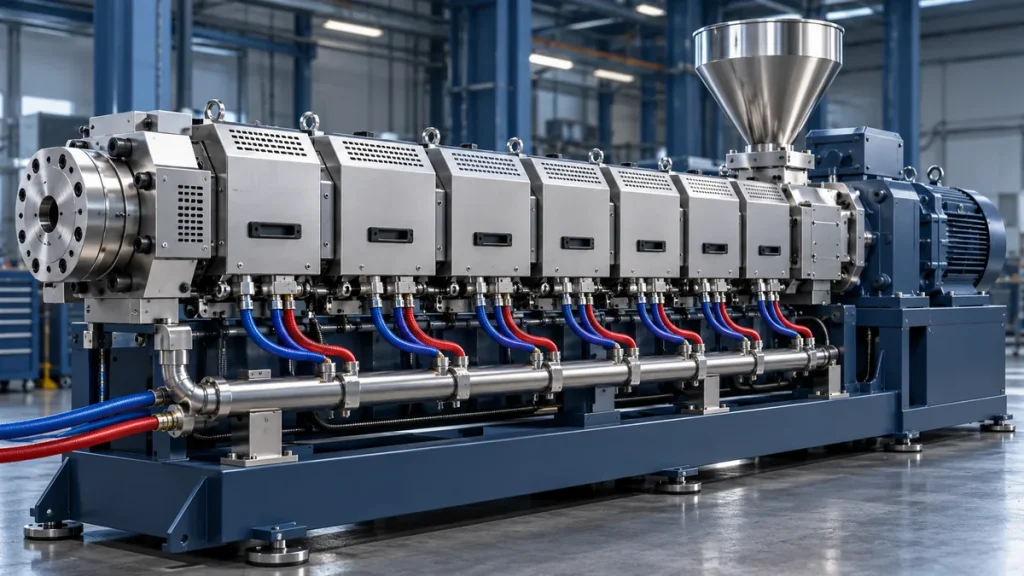
Maintaining a twin screw extruder’s heating and cooling systems means checking how each temperature zone generates heat, removes heat and measures its condition. A stable number on the control screen does not, by itself, confirm that every part of that system is working correctly.
On a plastics compounding extruder, temperature behavior also reflects material, throughput and mechanical energy input. Maintenance should distinguish those process influences from a heater, cooling or measurement fault. The checks below are a planning framework for the installed design, not a universal temperature-setting procedure.
Map each temperature zone to its hardware
Begin with a zone register. Match the control-screen name to the barrel section, temperature sensor, heater arrangement and cooling circuit where fitted. Include adapters and the die if their controls form part of the same line.
This mapping matters after component replacement. A sensor attached to the wrong zone can produce a plausible reading while the controller acts on a different location. A hose or valve label left over from an earlier configuration can create a similar identification problem.
Retain the current wiring and cooling drawings. Record approved changes so the next maintenance visit does not begin with an outdated layout.
Check the cooling route, not only the supply connection
A connected supply hose does not prove that an individual barrel circuit has adequate flow. The installed system may contain strainers, valves, manifolds, return lines or separate cooling loops that require their own service checks.
Review the available supply and return conditions, flow indications and valve commands. Look for changes after a hose replacement, utility interruption or scheduled cleaning. Use comparable production conditions when evaluating the result.
Where a qualified inspection identifies deposits or restricted passages, the cleaning method must be compatible with the barrel construction and cooling system. Do not select a descaling chemical from a generic online recipe. Confirm water-quality and treatment requirements with the relevant equipment supplier.
Separate temperature symptoms before replacing components
| Observed behavior | Useful distinction to investigate | Maintenance evidence |
|---|---|---|
| A zone warms slowly | Reduced heat delivery or different startup conditions | Heater-service record, controller output and approved electrical checks |
| A zone remains hot while cooling is requested | Cooling delivery, valve operation or changed process heat | Circuit flow, utility conditions and material/load history |
| A displayed temperature changes abruptly | A real event or measurement-chain issue | Sensor identity, connections and synchronized trend records |
| Behavior changes after service | Component fit, mapping or configuration changed | Work order, drawing revision and before/after observations |
| Several zones change together | A shared utility or operating influence | Supply conditions and the timing of other line events |
These are investigation categories, not automatic diagnoses. Changing several settings at once can conceal the difference you are trying to identify.
Inspect heating and measurement components appropriately
Heater bands, cartridges, wiring and connectors should be examined under the applicable electrical and isolation procedures. A qualified technician should verify the installed heater type and the checks needed for that circuit.
Where an approved test is required, use the correct method and acceptance criteria. A generic resistance value cannot establish that every heater is satisfactory. Likewise, a nominally matching temperature sensor may differ in type, junction arrangement or connection requirements.
A damaged cover, loose mounting arrangement or evidence of overheating should be documented and assessed. Do not address a hardware concern by simply increasing the controller setpoint or disabling a temperature alarm.
Preserve control settings before making changes
The maintenance team should know which settings are approved and how they are backed up. Record the applicable control-system configuration before replacing a controller or changing parameters.
A thermal problem does not automatically require new proportional–integral–derivative, or PID, tuning. Tuning cannot repair a blocked cooling passage, failed heater or wrongly identified sensor. Correct the confirmed hardware or utility issue first, then have the responsible specialist decide whether control adjustment is needed.
If an authorized parameter change is made, preserve its reason and revision. This prevents a temporary experiment from becoming an unexplained permanent setting.
Use a controlled verification after maintenance
Agree the verification method before returning the line to production. It should address the component worked on and the operating case in which the problem appeared.
A practical verification record includes:
- The zone and exact component serviced.
- The installed part reference and drawing revision.
- Available startup and stabilization trends.
- Cooling-system observations under the agreed conditions.
- Any product checks affected by the original issue.
Where product, throughput or screw speed differs from the baseline, state the difference. A lower displayed temperature under a lighter load does not necessarily demonstrate restored cooling performance.
Build a service plan around the actual equipment
The inspection frequency should reflect the OEM’s requirements and the site’s history. Materials, water conditions, operating pattern and previous failures can change what deserves closer attention. Keep routine observations, planned cleaning and electrical work as separate task types.
For a new pelletizing line, include access to heaters, cooling connections, zone documentation and replacement-part identification in the purchase scope. Those details influence future maintenance as much as the headline control features.
Does every twin screw extruder use the same cooling arrangement?
No. Cooling and heating designs vary. Base the work order on the installed equipment, not on a photograph of a similar machine.
Should a hot zone always be treated as a failed cooling circuit?
No. Changed material, output or screw duty can alter process heat. Review those conditions alongside cooling and measurement evidence.
If a replacement is needed, prepare the relevant drawing, part markings and zone location before requesting spare parts. Correct identification is more useful than ordering a component solely by its apparent dimensions.