

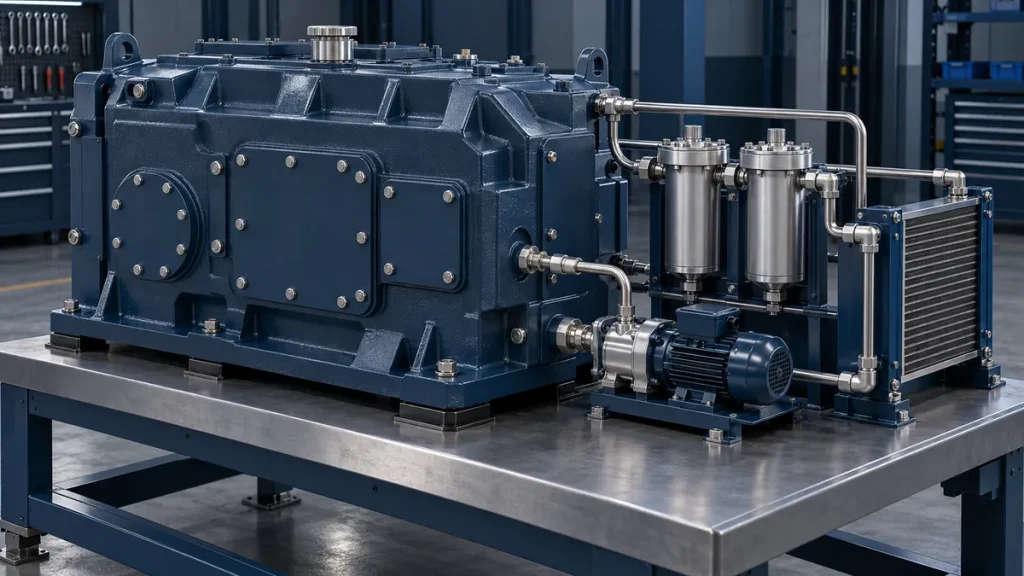
Twin screw extruder gearbox maintenance should connect the correct lubricant, the condition of the lubrication circuit and the gearbox’s actual duty. Checking an oil level alone does not establish that the transmission is ready for continued operation.
Start with the gearbox manufacturer’s instructions for the exact model. The machine builder’s maintenance schedule and the lubricant specification must agree with that installation. This article explains how to organize routine service and identify questions that require technical review, rather than prescribe one oil grade or change interval for every extruder.
Identify the gearbox and its lubrication arrangement
Record the gearbox model, serial number, installed orientation and applicable service manual. Identify the specified lubricant, approved alternatives and the conditions under which the oil level must be read.
Map the installed circuit. Depending on the design, it may include a reservoir, circulation pump, filter, cooler and monitoring devices. A familiar-looking gearbox on another line may have a different arrangement or service requirement.
Keep the gearbox identification separate from the extruder’s overall model. When requesting oil, filters or an exchange unit, both references may be needed. An old lubricant label on the machine should be checked against the current approved specification rather than treated as sufficient evidence.
Separate routine observations from intrusive service
Operators can collect approved external observations during production. Opening guards, disconnecting oil lines, changing filters or investigating the drive requires the appropriate equipment state and authorized personnel.
| Item | Useful observation or record | What to avoid assuming |
|---|---|---|
| Oil level | Reading under the specified operating or stopped condition | A level checked under a different condition is directly comparable |
| Leakage | Location, appearance and change over time | Every visible trace comes from the nearest seal |
| Lubrication circuit | Available pressure, flow, temperature and alarm history | One normal indication proves the whole circuit is healthy |
| Filter | Element identity, service history and any fitted condition indicator | A replacement is correct because the housing closes |
| Cooler | Available cooling conditions and recent cleaning work | High oil temperature automatically means gearbox damage |
A checklist should name the observation point and the applicable instruction. “Check oil” is too vague to produce comparable work between shifts.
Manage lubricant compatibility and cleanliness
Specify the complete approved lubricant identity when purchasing or topping up. Viscosity alone is not a full specification. Base-oil type, additive system and compatibility with the installed equipment can affect the choice.
Do not mix oils simply because their containers display the same viscosity grade. If the existing fill is uncertain, ask the gearbox or lubricant supplier how to identify it and whether an approved changeover procedure is needed.
Storage and transfer also deserve attention. Use the site’s designated clean transfer equipment, keep containers identified and prevent unintended mixing. Record top-ups, because repeated replenishment can hide a continuing loss and changes the history used to interpret an oil sample.
Plan oil and filter service from the applicable instructions
Use the manufacturer’s requirements as the starting point. Review them alongside operating hours, load history, temperatures, contamination events and any approved oil-analysis program.
There is no defensible universal rule such as changing every twin screw extruder gearbox oil after the same number of hours. The specification may distinguish initial service, later changes and particular lubricants or operating conditions.
A complete service work order should identify:
- The required equipment isolation and authorized scope.
- The correct oil and filter references.
- The approved draining, filling or flushing instructions.
- The verification steps before return to production.
- The readings and observations to be retained afterward.
Changing a filter or adding fresh oil does not explain an unresolved alarm. Keep corrective investigation separate from routine service completion.
Use oil analysis as a trend, not a single verdict
An oil-analysis program is useful only when the sample can be interpreted. Record the sample point, sampling method, oil identity, operating hours and time since the last change or top-up. The sampling arrangement itself must be approved for the equipment.
Ask the laboratory and gearbox supplier which tests and review criteria fit the application. A report may examine lubricant condition, contamination or wear-related indicators, but one unusual result is not a complete diagnosis of a particular gear or bearing.
Changes in lubricant, sampling practice or recent maintenance can affect comparisons. Preserve that context with the report rather than treating every difference as a deterioration in the machine.
Investigate temperature and noise in their operating context
If oil temperature changes, compare similar material, screw speed, loading and ambient conditions. Check the available cooling and lubrication records before selecting a cause. A trend from a light production run is not an adequate baseline for a heavily loaded formulation.
Unusual sound, vibration, leakage or a protective alarm should be escalated under the machine’s response procedure. Do not defeat a trip or raise its threshold to keep the line running. Also avoid using sound alone to choose which internal component to replace.
Specialist condition monitoring can support that investigation, while routine lubrication maintenance remains necessary. One does not replace the other.
Verify the result after service
Confirm the lubricant and component identities used, close outstanding work items and retain the authorized return-to-service checks. Compare the agreed operating case with its earlier baseline and record any limitations on the comparison.
Keep this history within the wider extruder preventive maintenance plan. When ordering service parts, include the gearbox nameplate, relevant circuit drawing, lubricant record and exact alarm details.
For sourcing support, use the after-sales and spare-parts checklist to prepare a clear supplier request. A photograph is useful, but it should accompany the equipment references rather than replace them.