

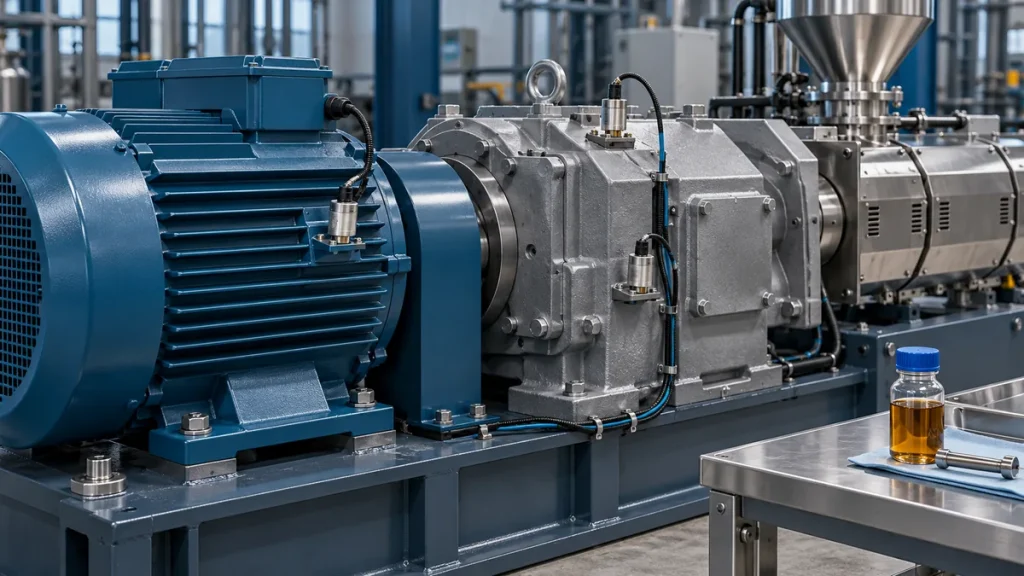
Twin screw extruder condition monitoring uses repeatable measurements to identify changes that deserve investigation. Vibration, lubricant condition and operating data can help maintenance teams choose what to examine and when, but the value comes from interpretation rather than simply collecting more numbers.
For a compounding line, a reading should be connected to the equipment, measurement point and operating case. A new material or a different screw load can change the machine’s behavior without establishing a mechanical defect.
Start with a maintenance decision
Define the decision before buying sensors. You may need earlier visibility of gearbox deterioration, evidence to plan a specialist inspection or a consistent way to evaluate a repaired drive.
Identify who reviews the information, how an exception is escalated and what work can follow. A dashboard without an assigned response can produce alarms that nobody has the evidence or authority to assess.
Keep the initial scope manageable. A pilot on a clearly identified motor or gearbox may be more useful than installing an extensive system before the team has agreed how to interpret its outputs.
Build an operating baseline that can be repeated
Select an operating case known to be acceptable. Identify the material, formulation, screw speed, loading and available temperature conditions. Record whether the machine is starting, stabilizing or producing normally.
Document sensor position, orientation, mounting and measurement settings. Moving a sensor or changing how a portable measurement is taken can affect comparisons independently of machine condition.
A single “healthy” reading should not become a universal reference for every formulation. Where the line operates across substantially different duties, the monitoring specialist should decide how to group comparable cases.
| Monitoring input | Context needed for comparison | Question it can support |
|---|---|---|
| Motor or gearbox vibration | Position, mounting, speed, load and acquisition method | Has behavior changed under a comparable duty? |
| Oil analysis | Lubricant identity, sample method, oil hours and top-ups | Is a condition or contamination trend developing? |
| Oil or housing temperature | Measurement point, load and cooling conditions | Is the thermal trend different from the relevant baseline? |
| Drive/process trends | Material, configuration and operating stage | Did the change coincide with a process or equipment event? |
The table describes review questions, not fault diagnoses or alarm limits.
Combine vibration and oil evidence appropriately
Vibration and lubricant analysis examine different aspects of the system. Their findings can complement each other, but neither should be interpreted without its limitations.
An unusual vibration trend may justify more detailed analysis by a competent specialist. An oil result may indicate a need to review lubricant condition, contamination or wear-related findings. It does not automatically identify the failed internal part.
Record what changed between measurements. Recent service, a new oil fill, different sampling practice or a sensor relocation may explain part of a difference and should be included in the review.
Avoid turning one signal into a predetermined purchase request. “Replace the gearbox” is a service decision that needs the relevant technical assessment and commercial scope.
Distinguish monitoring from a prediction guarantee
A condition-monitoring system can help identify anomalies and support maintenance planning. It cannot promise an exact remaining life for every component merely because it provides a trend or a health score.
Ask a supplier what the system measures directly, what it infers and what operating data the assessment needs. Clarify whether qualified analysts review the results and what an alert actually requests: observation, confirmation, inspection or another action.
Coperion’s 2025 twin-screw extrusion update describes monitoring of vibration and gearbox oil condition on its equipment. That is an example of an OEM-specific offering, not evidence that any sensor package is compatible with every installed extruder.
Define alert handling before the first exception
The response process should distinguish a maintenance advisory from an existing protective trip. Additional monitoring does not authorize changes to the machine’s protection settings.
Agree the following with the responsible specialists:
- Which conditions make a measurement valid or invalid.
- Who reviews an unusual result and within what site-defined process.
- What confirmation is needed before a maintenance decision.
- Which findings require action under the machine’s existing response procedure.
- How the action and subsequent verification will be recorded.
Do not copy vibration limits from a machine with a different structure, mounting or operating range. Thresholds and diagnostic methods need a defensible basis for the actual equipment.
Connect findings to service work and follow-up
A useful review ends with a clear conclusion: continue the agreed monitoring, obtain another measurement, inspect a defined component or perform approved work. Preserve the reasoning and unresolved uncertainty.
After service, collect the agreed comparison under identified conditions. A changed operating load should be visible in the assessment. If several components were serviced together, avoid claiming that one replacement alone caused the improvement.
Condition monitoring also complements screw and barrel wear assessment, but vibration and oil trends do not directly replace the dimensional inspection needed for those components.
Evaluate a monitoring proposal beyond the hardware price
Review installation requirements, sensor suitability, data access, analyst support, training and ongoing responsibilities. Clarify whether the scope covers the main gearbox, motor, auxiliary units or only selected points.
Ask how monitoring will fit the maintenance team and existing records. Avoid accepting a claimed reduction in downtime as a guaranteed result for your plant without relevant evidence and a stated basis.
Routine lubrication, inspection and scheduled service remain part of the maintenance plan. Monitoring helps guide decisions; it does not eliminate those tasks.
For supplier coordination, prepare the machine identity, drive arrangement, available trends and maintenance objective before contacting Extruder China. The appropriate solution should follow the equipment and decision you need to support.