

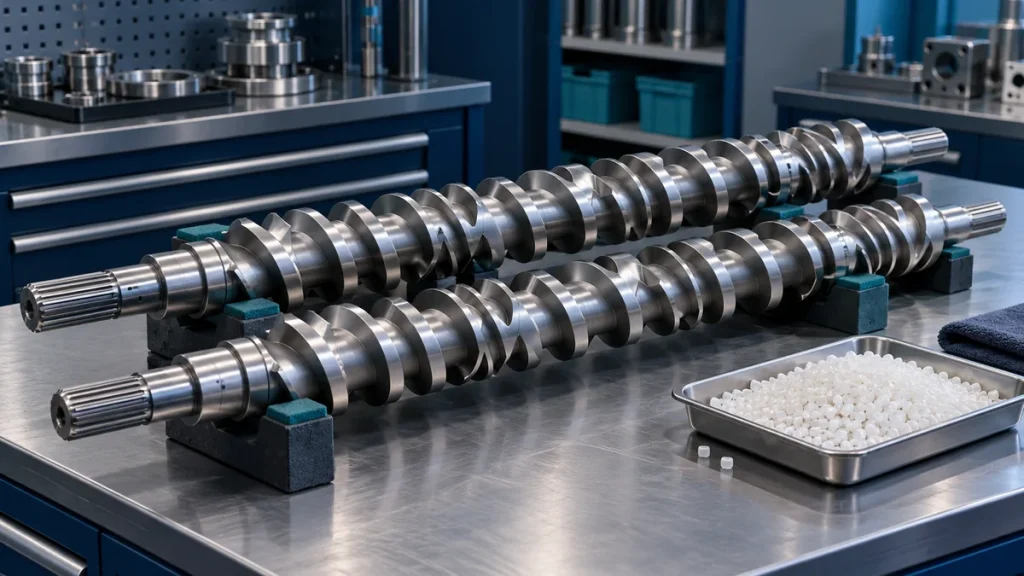
Effective twin screw extruder cleaning starts with identifying what must leave the line: the previous color, an incompatible polymer, loose deposits, or material that will obstruct a planned inspection. Purging can clear accessible material from the process, but it does not prove every feeder, vent, adapter or die is clean.
For a plastics compounding line, the useful question is therefore not simply which cleaning compound to buy. It is which cleaning method fits the material transition, the installed equipment and the next product’s acceptance requirements. This guide focuses on modular co-rotating twin screw extruders; the machine and purge supplier’s instructions determine the actual operating procedure.
Define the cleaning job before choosing a method
A routine color change, a polymer change and a screw pull have different endpoints. A purge that is adequate before another dark batch may be unacceptable before a natural or transparent compound. A clean-looking discharge can also conceal contamination in an auxiliary feeder.
Write down the outgoing formulation, incoming formulation, known contamination and components included in the job. For filled compounds, include the carrier resin, pigment, mineral or fiber package. The word “PP” alone may not describe the transition adequately.
| Cleaning job | Main question | Evidence to retain |
|---|---|---|
| Color or formulation change | What carryover can the next product tolerate? | Identified samples and the agreed quality checks |
| Change between polymers | Are the transition and cleaning materials compatible? | Approved material sequence and supplier instructions |
| Persistent deposits | Where might material remain or degrade? | Deposit description, process history and inspection findings |
| Preparation for screw removal | What condition does the service procedure require? | Cleaning record and authorized breakdown instructions |
Understand what self-wiping screws can and cannot do
Closely intermeshing screws can reduce material accumulation in the swept regions of the process section. That does not make the complete line maintenance-free. Screw geometry, element condition, operating conditions and the surrounding equipment still matter.
The material route may include a main feeder, side feeder, injection point, vent opening, adapter, screen changer and die. Some locations are outside the screws’ swept surfaces. Repeated contamination after an apparently successful purge is a reason to review the complete route rather than assume the screws need a longer purge.
The twin screw extruder guide explains the equipment architecture behind this distinction.
Select a compatible purge, not a universal recipe
A commercial purging compound has its own processing range, resin compatibility and restrictions. Some grades require particular clearances or cannot pass through certain screens and polished tooling. Instructions for a mechanical purge cannot automatically be applied to a different chemical or blended product.
Confirm these points with the responsible suppliers before the changeover:
- Compatibility with both the outgoing and incoming materials.
- The permitted temperature range and any residence-time restrictions.
- Suitability for the installed venting, screens, die and other melt-path components.
- The approved feeding method for the actual starve-fed arrangement.
- How the purge will be displaced and how the next product will be checked.
Do not combine the temperature from one product bulletin with the feeding instructions from another. Avoid an unapproved increase in speed, pressure or temperature to accelerate cleaning.
Include feeders and downstream components
Cleaning the main barrel while leaving old powder in a side feeder can reintroduce contamination immediately after restart. Hoppers, transfer connections and material-contact surfaces need a defined scope, with appropriate isolation for physical work.
Separate material carryover from a damaged component. Persistent black particles, for example, may justify inspecting a specific location, but their appearance alone does not identify the cause. Preserve a sample and note whether the problem appears continuously, after a pause or following a particular material transition.
Where fitted, the screen changer and die need their own cleaning instructions. Equipment that permits a continuous screen change during production does not necessarily permit cleaning or disassembly while operating.
Decide when purging should give way to inspection
Set an escalation point before beginning. If contamination returns after the approved cleaning sequence, repeated purging without new evidence can consume material while leaving the source unresolved.
A supplier review should consider inaccessible deposits, affected melt-path components and the condition of screws and barrels. Mechanical cleaning and screw removal require the approved service method, suitable lifting arrangements and qualified personnel. Improvised abrasives or tools can damage surfaces that the next production run depends on.
If inspection is needed, preserve the installed screw configuration and component positions. This makes cleaning findings useful for subsequent wear assessment or replacement planning.
Verify the next product, not only the purge discharge
A visually clear purge is a process observation. Release of the next batch should depend on its own agreed acceptance checks. Depending on the product, those may include color, visible contamination or other specified material properties.
A practical changeover record contains:
- The outgoing and incoming formulation references.
- The cleaning material and approved instruction revision.
- Components cleaned and any unresolved observations.
- Identified purge and production samples.
- The quality decision and person responsible for release.
Measure changeover duration and material consumption consistently if you want to compare future improvements. Do not compare different product transitions as though they were identical jobs.
Common cleaning questions
Can the next production resin be used as the cleaning material?
Sometimes an approved resin transition is sufficient. That decision depends on compatibility, contamination and product requirements; it should not be assumed for every formulation.
Does a longer purge eliminate the need for screw inspection?
No. Purging and inspection answer different questions. Inspection may still be required when contamination recurs or the machine’s condition needs assessment.
For an existing line, prepare the machine identification, material transition and affected-component details before requesting after-sales and spare-parts coordination. For a new project, include cleaning access and changeover requirements in the specification for the pelletizing line.