

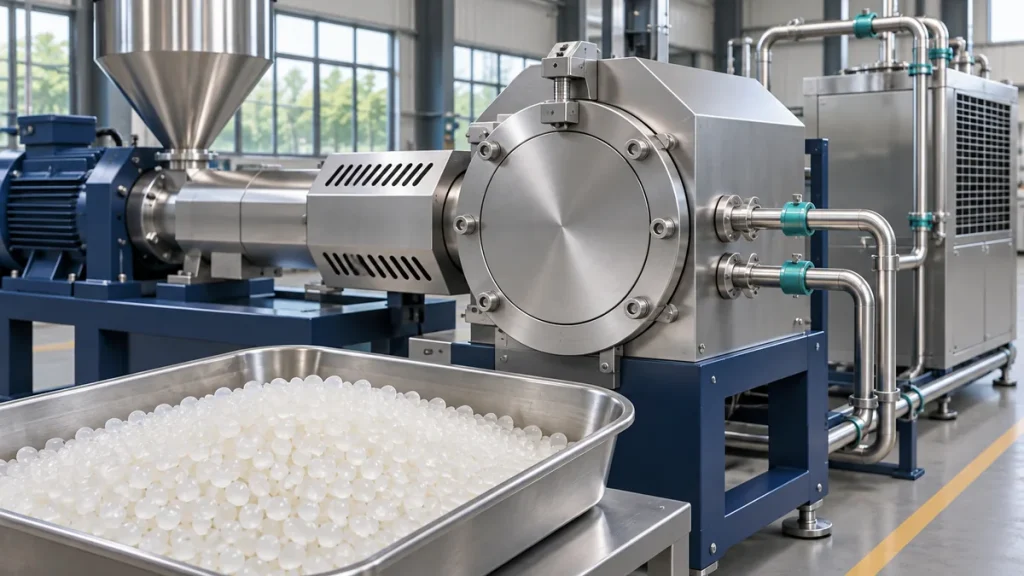
An elastomer pellet can leave the cutting system looking acceptable and still create trouble during storage or feeding. Its behavior while cooling, resting and being handled matters as much as the immediate cut.
For TPE and TPU pelletizing, begin with the actual material grade and process route. A family name alone cannot establish the right cutter, water conditions or dryer.
TPE is a family, not one processing specification
Thermoplastic elastomers include different material systems. TPU is one important type, but its requirements should not be used as a rule for every TPE compound.
State whether the project involves compounding purchased material, reprocessing a known grade or another operation. Reactive production of a polymer is a separate process and should not be confused with ordinary compounding.
The supplier needs the material specification, intended properties, formulation context and expected operating range. If several grades will run on the line, identify the difficult ones explicitly.
Evaluate the pellet after it leaves the cutter
Softness and tackiness can affect cutting and subsequent handling. Pellets may deform, adhere or behave differently under the temperature and loading conditions encountered later.
That makes a short collection at the machine outlet an incomplete demonstration. Define how samples will be cooled, held, packaged and evaluated. Where blocking or feeding is a concern, the agreed assessment should represent the relevant downstream conditions.
Do not infer an acceptable result from another grade merely because the hardness description seems similar. The material and processing route need to match the comparison.
Choose a cutting package around the grade
Strand, underwater and other die-face arrangements have different ways of supporting, cutting and cooling the material. The available window depends on the particular system and polymer.
A supplier should explain why the proposed route suits the grade and what limits apply. Consider the expected pellet characteristics, operating rate, startup requirements and the handling of off-specification material.
Our strand versus underwater comparison provides a starting point. For an elastomer project, the decision still needs a grade-specific assessment rather than a general preference for automation or one pellet shape.
Treat process water as part of the selection
Where a water-based route is used, the water system helps transport and cool the pellets. Its operating conditions and capacity must suit the cutting process and material.
Ask how the supplier has matched the chamber, transfer route, cooling duty and dryer. A standalone cutter rating does not establish that the complete package will deliver the requested pellet condition.
The factory utility connection is another part of the scope. Identify which components circulate or condition process water and which heat-removal services the site must provide.
Avoid applying a water temperature from a different grade or machine. The appropriate conditions must come from the proposed system and its material trial.
Separate dewatering from material drying
A pellet dryer associated with a water-based cutting system may principally remove surface water. That does not automatically satisfy every polymer’s moisture requirement before its next processing step.
For a material that needs additional moisture conditioning, define when that occurs and who supplies the equipment. Packaging and storage should preserve the agreed condition.
Use a suitable measurement method to assess moisture where required. Appearance and a quick touch are not a reliable substitute for a defined acceptance test.
A useful trial covers more than continuous cutting
The trial should answer three groups of questions.
At production: Can the system sustain the agreed case and produce the requested pellet characteristics? Identify the material, throughput, cutting package and relevant operating conditions.
During handling: Do the pellets transfer, separate and enter the collection or packaging arrangement as required? Note any agreed observation of deformation, adhesion or fines.
After holding: Does the material remain acceptable under the defined storage and downstream-use conditions? Preserve the sample history so that the receiving team can interpret the result.
The exact methods and criteria should be agreed for the grade. Do not create a universal blocking limit or storage test from another supplier’s demonstration.
Clarify what sits outside the quotation
Check additional cooling, screening, conveying, storage and any moisture-conditioning stage. Confirm the changeover requirements for the planned grade range.
If additives or processing aids are proposed to improve handling, make them explicit in the material specification and trial. A result achieved using an undisclosed formulation change is not a like-for-like equipment comparison.
For a new pelletizing line, send the material grades, intended properties, production range and handling concerns with the inquiry. Extruder China can help coordinate suitable supplier discussions; final selection should follow the grade-specific evidence.