

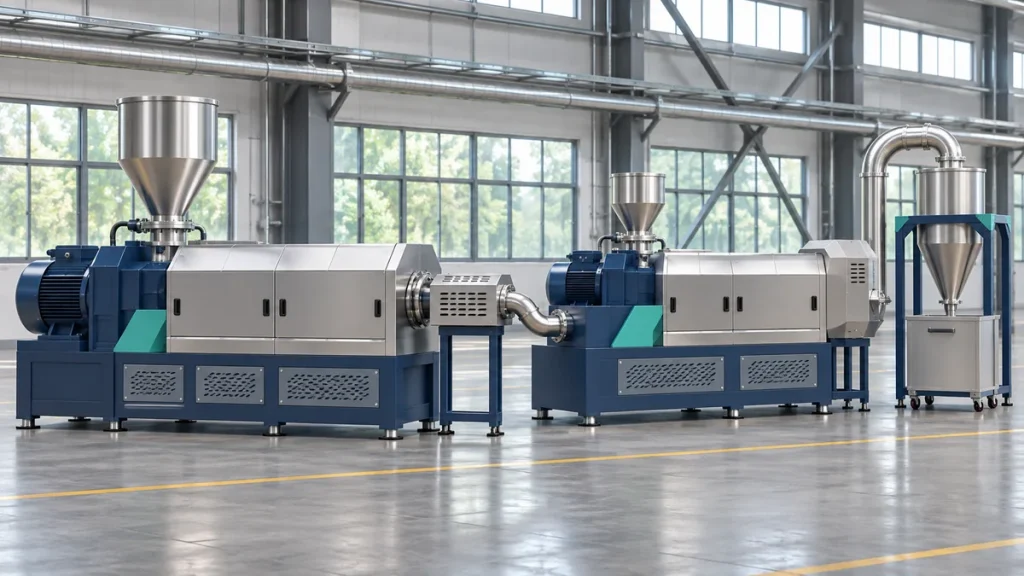
A second extrusion stage can be useful when a recycling process needs additional melt treatment or a different division of duties. It also adds equipment, connections and another part of the process to coordinate. The better choice depends on the waste stream and the pellet specification.
Before comparing quotations, establish what each supplier means by “two-stage.” The term can describe different arrangements. It should not be confused with a twin-screw extruder or with a machine that has two vent openings.
What is being counted as a stage?
In a single-stage recycling extrusion arrangement, one extruder carries the assigned melting, treatment and discharge duties. It may still include sophisticated preconditioning, filtration and devolatilization.
A cascade arrangement passes material through sequential extrusion units. Depending on the design, the second unit may provide another treatment opportunity or take on discharge duties. The transfer may be enclosed or use another specifically engineered arrangement; the proposed layout must show which.
A two-stage PVC compounder is a separate application again. Its process split can serve a different purpose from a recycling cascade. Count the actual machines and trace the material route before comparing descriptions.
Start with the difficulty in the feedstock
Clean factory film trim and heavily printed collected packaging do not present the same problem. Moisture, print-related constituents, residues and inconsistent material quality can change the melt-treatment requirement.
However, none of those descriptions proves that a second extruder is necessary. Some single-extruder recycling systems use substantial upstream conditioning and a carefully arranged filtration and degassing section. The complete process needs to be assessed.
A useful supplier question is: which part of our material problem does the additional stage address, and what trial evidence will show that it has done so?
Compare the proposed process rather than the machine count
| Question | Single-stage proposal | Two-stage proposal |
|---|---|---|
| Feed preparation | What has been removed or conditioned before melting? | What has been removed or conditioned before melting? |
| Devolatilization | Where does it occur, and under what material conditions? | What additional function does the second unit provide? |
| Filtration | Which contamination is the system designed to handle? | Where are the filters, and how do their duties differ? |
| Melt transfer | How is material delivered to the cutting system? | How is transfer between stages controlled? |
| Operating scope | Which formulations and feed conditions were evaluated? | Which formulations and feed conditions justify the extra equipment? |
This comparison deliberately asks for evidence on both sides. A single-stage line should not be dismissed as basic, and a cascade should not be accepted as inherently superior.
What changes when another unit is added?
More equipment changes the project scope. The layout, electrical services, controls, access and spare-parts plan must include both units and their interfaces.
The team should also understand how the line behaves during startup, an interruption or a change in feed rate. Where does material remain? Which component limits the rate? How are upstream and downstream duties coordinated?
These are operating-design questions to resolve with the supplier. They do not justify copying a startup sequence from another machine.
Extra melt treatment can also change the material’s thermal and processing history. The trial should examine the resulting pellet properties, rather than only whether the machine runs smoothly.
Filtration and venting need their own comparison
A specification listing more screens or vents is incomplete. Ask about filter area, intended separation, discharge losses and how the system handles the expected contamination.
For devolatilization, identify the material condition entering the relevant section and the result that must be demonstrated. The actual system arrangement matters; simply adding another vacuum connection does not establish sufficient treatment.
If odor is the concern, include an agreed odor assessment. If moisture or another volatile is the concern, define the relevant test and sampling method. A good-looking pellet may not answer either question.
A fair trial uses the same material and acceptance basis
Prepare enough representative material to include the variation you expect to buy or generate. State its source and preparation history.
For both proposals, agree:
- The target rate and how accepted output will be measured.
- The specified pellet tests and sample collection points.
- The treatment of transition material, rejects and filtration losses.
- The equipment included in energy and utility measurements.
- The operating observations to be retained with the results.
If the materials or measurement boundaries differ, explain that difference before interpreting the comparison.
Which proposal is easier to justify?
Choose the process that meets the defined output requirement with an acceptable operating scope and cost structure. A simpler arrangement can be sensible when it handles the actual material. An additional stage can be justified when its specific contribution is demonstrated.
Avoid buying spare complexity for an undefined future waste stream. Equally, do not base a commercial line on a clean-scrap demonstration if the planned feed is substantially wetter or more contaminated.
For a project discussion, send the material description and target pellet use alongside the proposed capacity. Our recycling-line page and plastic-machinery RFQ checklist help organize those details. For the separate question of screw architecture, see single-screw versus twin-screw extruders.