

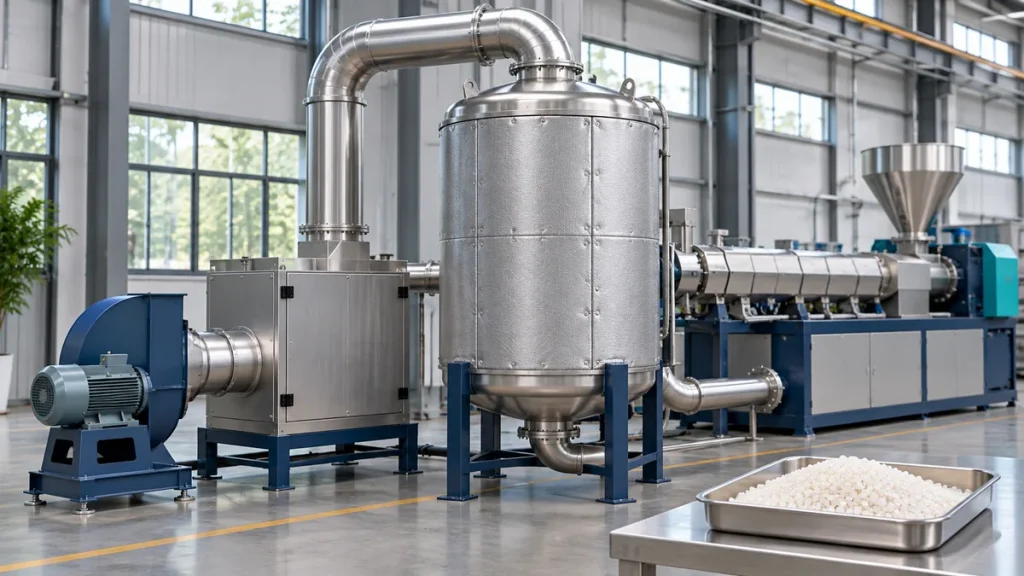
Reducing odor in recycled plastic pellets starts before extrusion. Incoming residues, absorbed substances, storage conditions and thermal degradation can all contribute. Washing, devolatilization and post-treatment address different parts of that problem, so an effective plan follows the material through the entire recycling process.
There is no reliable universal promise that one machine will make every recycled polymer odor-free. Define the material, intended application and acceptance method first. Then test which treatment steps produce a meaningful and repeatable improvement.
Identify where the odor enters or develops
Separate an incoming-material problem from a processing problem. Pellets made from contaminated packaging may carry a different odor from pellets produced when a clean polymer is overheated or remains too long in the process.
Start with consistent samples of incoming waste, prepared feed, newly produced pellets and stored pellets. Compare material lots and record storage time and conditions. Sensory assessment needs a controlled procedure; casual comparisons between a warm fresh sample and a cool week-old sample can be misleading.
Personnel should not directly sniff unknown fumes or hot process openings. Suspected hazardous contamination calls for appropriate handling and laboratory assessment, not a more determined smell test.
Control the feedstock before adding treatment equipment
Source separation is often the first practical intervention. Mixing highly contaminated material with cleaner feed may spread the quality problem through a larger batch. Identify unsuitable sources and set acceptance rules that purchasing and production can apply.
Storage also deserves attention. Uncontrolled mixtures of residues and wet waste can change while waiting to be processed. Keep collection, sorting and storage conditions consistent enough to understand what the line is receiving.
Washing can remove some surface residues, but it does not remove every absorbed compound. Confirm whether the wash process actually addresses the contamination involved and whether rinsing, drying or handling introduces another source of odor. A visually clean flake is not automatically suitable for an odor-sensitive application.
Review extrusion before changing the recipe
Check whether material is being processed within its validated operating window. Excessive thermal exposure, unstable feeding, contamination or material held in unsuitable areas can contribute to degradation. Compare actual process records with the onset of the complaint.
Useful questions include:
- Did the odor change after a new material supplier, additive or color was introduced?
- Does it appear during startup, interruptions or long production runs?
- Are feed rate, temperatures and vent behavior stable?
- Does retained material from a previous product affect the next batch?
Follow the equipment supplier’s cleaning and operating procedures. Masking an odor with an additive before identifying its cause can make the result harder to evaluate and may create a different downstream concern.
Understand what devolatilization can do
Devolatilization provides a route for removing some volatile substances from the melt. Its effectiveness depends on material behavior, melt-surface exposure, pressure conditions, temperature, residence time and the design of the extrusion system.
A vacuum pump alone does not establish that the melt is receiving effective treatment. Inspect the complete arrangement: vents, separation equipment, condensate handling, seals and operating stability. The vacuum-degassing troubleshooting guide explains why weak performance can have several causes.
Certain contaminants or degradation products may remain despite improved venting. Do not translate a deeper vacuum reading directly into a guaranteed odor result without testing the pellets.
When post-treatment may be worth evaluating
Some recycling systems use a separate pellet-treatment stage to reduce remaining volatile substances. The suitability of this approach depends on polymer grade, pellet characteristics, treatment conditions and the target application.
Ask the supplier to explain the treatment mechanism, material restrictions, required utilities and handling of the exhaust stream. Include the complete equipment boundary when comparing a proposal; treatment time can also influence storage volume and production scheduling.
Evaluate the same material before and after treatment with a common test protocol. A successful result on one relatively clean feedstock does not establish performance on every waste source. Record whether the improvement remains after packaging and storage under relevant conditions.
Agree on a test method that matches the application
“Low odor” needs a measurable or consistently assessable meaning. Depending on the application, evaluation may combine a controlled sensory method, targeted chemical analysis and a downstream processing trial. Select the approach with the customer or an appropriate laboratory.
Specify sampling, conditioning, packaging, elapsed time and test conditions. Keep retained samples so a complaint can be compared with the accepted batch. Do not use odor as evidence of food-contact suitability or general chemical safety; these are separate questions requiring their own assessment.
For sensitive applications, test the converted article as well as the pellets when appropriate. Heating and processing can change what is released and what the user perceives.
Build an improvement plan around evidence
Map each proposed action to a suspected cause: source control for contaminated incoming waste, washing for removable residues, process correction for degradation, devolatilization for suitable volatile substances, or post-treatment for a remaining problem it can actually address.
Change one important variable at a time where production conditions allow, and compare equivalent samples. This makes the results useful for the next purchasing or operating decision.
When discussing a recycling pelletizing line, provide representative material and the intended odor assessment. For an existing installation, a maintenance review may reveal a process issue before additional equipment is justified.