

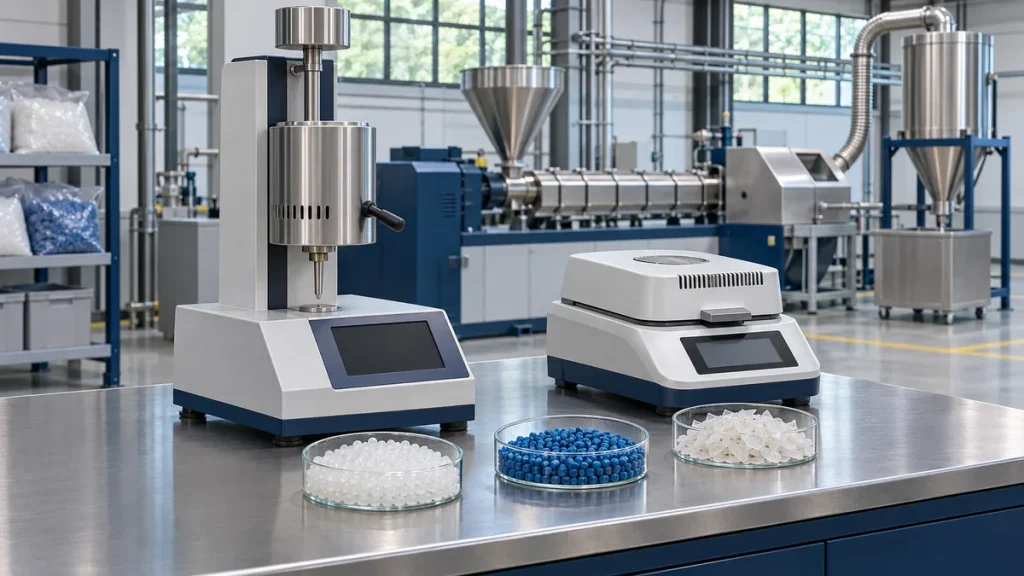
A useful recycled-plastic pellet specification describes how the material must behave in its next application. Melt flow rate, moisture and contamination tests provide important evidence, but no single result establishes that every batch will be suitable for every process.
Choose tests around the buyer’s actual failure risks. Then make sampling and test conditions consistent enough that a result from one delivery can be compared with the next. A certificate filled with numbers is of little use if the method or acceptance basis changes between batches.
Start with the receiving process
Film extrusion, injection molding and profile production can place different demands on the same general polymer family. Ask what causes a batch to be rejected: unstable processing, visible inclusions, poor color, odor, moisture-related defects or inadequate mechanical properties.
The resulting specification may need more than the three tests discussed here. Density, ash or filler content, color, mechanical properties and application trials can be relevant. Select them deliberately rather than adding every available laboratory measurement.
Also agree what defines a batch. A silo blend, a continuous production shift and a group of individually filled bags may have different variability. Sampling should reflect that production and packaging arrangement.
MFR: useful only with the test conditions attached
Melt mass-flow rate, usually abbreviated MFR, describes the mass of material passing through a specified die under defined temperature and load conditions. It is useful for comparing flow behavior within an appropriate material and test framework.
Always record the method, temperature, load and required sample conditioning alongside the result. A value without those conditions is not a complete specification. Results obtained under different conditions should not be treated as directly interchangeable.
MFR is also not a full material identity or a complete prediction of processing behavior. Two materials can have similar measured MFR while differing in contamination, formulation, molecular characteristics or mechanical performance. A change in MFR should trigger investigation in context, rather than an automatic conclusion about its cause.
If a recycled resin will enter a demanding process, connect the laboratory result to a representative conversion trial. For compounding projects, the twin-screw recycling guide provides a broader view of processing duties.
Moisture: define what the method is measuring
Residual surface water and moisture absorbed in a polymer are different conditions. The significance of each depends on the grade and its next processing step.
Specify the sampling location, sample storage, test method and acceptance requirement. Promptly sealing a sample may be necessary to preserve its original condition; an open dish left beside the line can change before testing.
A heated loss-on-drying method can be practical when validated for the material. However, other volatile substances may contribute to mass loss. If water-specific measurement is required, select a suitable method with the laboratory instead of assuming that every moisture-balance reading is directly comparable.
The requirement should come from the application and resin guidance. Avoid adopting one generic percentage for PET, polyolefins and engineering polymers.
Contamination: decide what counts as a defect
Contamination testing needs a defined target. A visual pellet check, examination of a molded plaque, film inspection and an automated pellet inspection system can reveal different things.
Decide which defects matter: black specks, foreign-colored material, metal, mineral particles, paper or incompatible polymers. State how samples are prepared, how much material is inspected and how findings are classified.
| Quality question | Possible check | Limitation to address |
|---|---|---|
| Are visible inclusions present? | Defined visual or optical inspection | Detection depends on size, contrast and sampling |
| Is there unexpected mineral content? | Appropriate ash or composition testing | A total value does not identify every contaminant |
| Does the material produce defects in use? | Controlled film, plaque or product trial | Processing conditions must be comparable |
| Is the polymer stream consistent? | Agreed identification and property tests | One test rarely establishes full composition |
A clean-looking pellet can contain an inclusion that becomes visible only after conversion. Conversely, an attractive photograph does not replace a documented cleanliness test.
Make sampling and traceability part of the system
Create a sampling plan that captures variation across the batch. Identify when and where samples are collected, how they are combined where appropriate and how retained samples are stored.
Keep links between incoming feedstock, process records, filter changes, finished packaging and test results. When a result moves outside the normal pattern, this history helps distinguish a material change from a sampling or instrument problem.
Define what happens after a failed test: hold the affected material, confirm the result, investigate the cause and agree the disposition. Repeated testing until one sample passes is not a meaningful release system.
Turn the specification into a practical acceptance sheet
For each chosen property, include the method, conditions, unit, acceptance range or defect rule, sampling frequency and responsible party. Mark whether the limit comes from a customer requirement, a resin specification or an agreed trial.
Use the same sheet during a factory acceptance test and routine production where appropriate. If the pellets show shape or cutting defects, the strand-pellet troubleshooting guide can support the process investigation. The goal is a repeatable decision about material suitability, with enough evidence to explain it.