

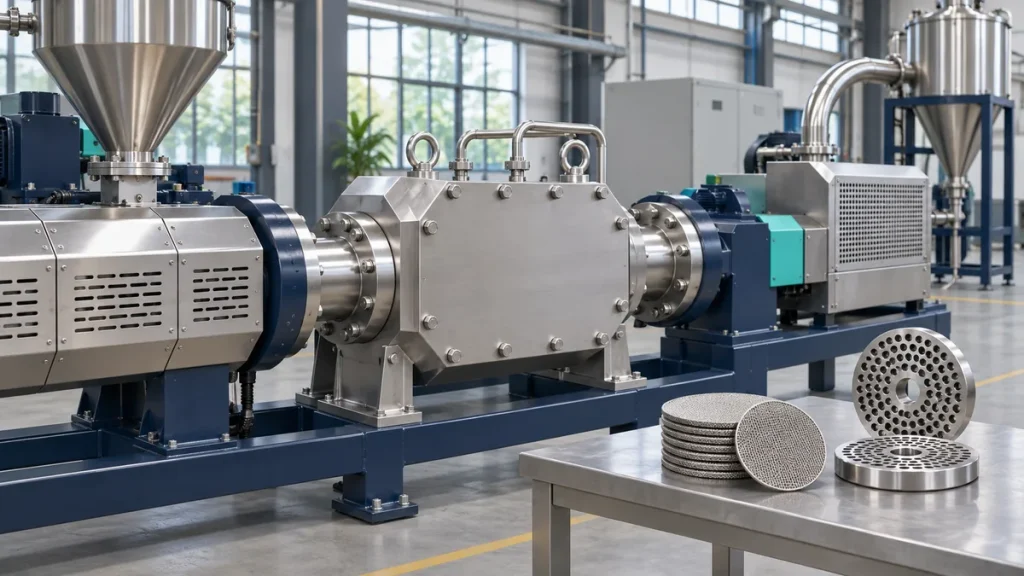
A recycling melt filter is selected for the contamination it must handle and the pellet quality it must deliver. The screen specification matters, but so do available filter area, changing pressure, cleaning or changeover behavior, polymer loss and the effect on the rest of the line.
Two filters described with the same nominal fineness can behave differently on real waste. Compare them using representative material and a common operating and quality basis, rather than treating the smallest advertised number as the best choice.
Separate solid contamination from other quality problems
Melt filtration can retain certain solid particles that remain distinct from the polymer melt. Its effectiveness depends on particle size, shape, deformability and how the filter operates under process conditions.
It does not identify every unwanted polymer, reverse degradation or guarantee odor removal. An incompatible material that melts and passes through the filter may remain in the pellets. Feedstock sorting, washing, process control and devolatilization still have their own roles.
Before choosing a system, describe the contaminants found in ordinary deliveries: paper, mineral dirt, metal fragments, wood, residual labels or other materials. Consider how their concentration changes during a shift and between sources. Stable clean trim and variable post-consumer flakes create different filtration duties.
Compare the operating arrangement
A simple manually changed screen can be appropriate where contamination is limited and planned interruptions are acceptable. More demanding streams may justify an arrangement designed to maintain production during screen changes or cleaning. Continuous operation is a process requirement to demonstrate, rather than a word to accept without qualification.
Different systems can use replaceable screens, backflushing, scraping or other contaminant-removal arrangements. These categories do not establish a universal ranking. The important comparison is how each design handles the actual polymer and waste stream.
| Comparison point | Useful evidence |
|---|---|
| Filter area and usable capacity | Stable throughput and pressure on the specified material |
| Changeover or cleaning | Recorded pressure and flow behavior during the event |
| Contamination handling | Run duration and cleaning frequency over a representative load |
| Melt loss | Collected purge or reject mass on an agreed measurement basis |
| Service requirements | Access, consumables, wear parts and safe maintenance procedure |
Ask the supplier to identify which functions are automatic and what still requires operator intervention. A system that can change screens without stopping may still affect melt flow or produce material that needs to be diverted.
Pressure behavior matters to the whole line
As a filter loads, resistance can increase. The relevant limits include the extrusion system, connecting components, filter, melt pump if fitted and pelletizing equipment. These limits must come from the equipment design and process specification, not a generic operating recommendation.
Compare pressure before and after filtration where instrumentation permits, and record the trend rather than a single value. Check what happens during startup, a contaminated feed event and a cleaning cycle. Ask how alarms, interlocks and material diversion work when the system cannot maintain acceptable conditions.
Do not compensate for an unsuitable filter by repeatedly overriding pressure protection or increasing temperature beyond the validated processing window. Investigate the cause: contamination, insufficient usable area, unsuitable screen selection or changing material behavior may require different responses.
Define the required pellet cleanliness
A finer screen is useful only when it addresses a product requirement without creating unacceptable process consequences. More restrictive filtration can change pressure and operating cost; the magnitude depends on the actual melt and filter arrangement.
Begin with the pellet buyer’s defect definition and test method. For film applications, a small inclusion that is tolerable in a thick molded part may be a serious defect. Conversely, a demanding screen specification does not by itself prove that the pellets will process successfully.
Connect filter selection with the pellet-quality troubleshooting guide and a downstream conversion trial where needed. The final application is a stronger acceptance basis than a photograph of clean-looking pellets.
Measure losses and maintenance alongside output
Request a balance that distinguishes accepted pellets, startup waste, filter purge and other rejects. Collect data over a suitable run; a short clean-material demonstration may understate the burden of a variable waste stream.
Consumables and cleaning practices affect daily operation. Establish which screens, seals and wear components are needed, whether they are locally obtainable and what training the maintenance team receives. Maintenance should follow the supplier’s pressure-release, temperature-control and isolation procedures. Opening hot, pressurized polymer equipment is not a routine adjustment to improvise.
Access deserves attention during layout approval. A filter positioned behind crowded pipework may meet the flow diagram but make ordinary service unnecessarily difficult.
Put the comparison into the material trial
Use a written trial plan with the same feedstock description, target throughput, filter specification and pellet acceptance checks for each proposal. Include enough variation to reveal loading and cleaning behavior, rather than demonstrating only an initial steady state.
Ask for time-linked records of throughput, pressure, cleaning events, diverted material and pellet observations. If the proposed system differs from the trial machine, identify what must be revalidated.
The pelletizing-line RFQ checklist can help keep these requirements in the quotation, while factory inspection planning makes them reviewable before shipment. A defensible filter selection connects contamination, product quality and operating evidence in one specification.