

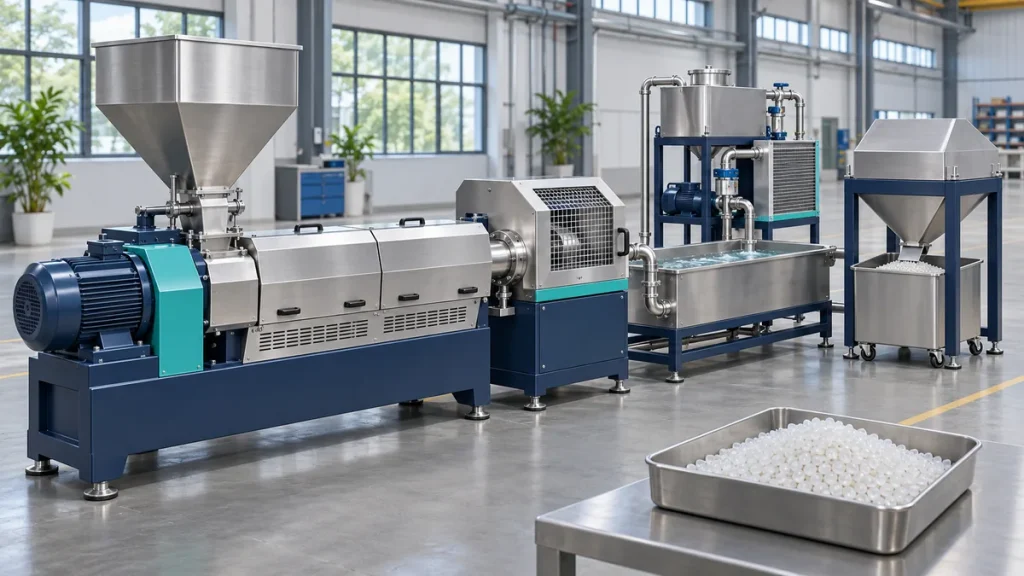
A plastic pelletizing line turns a defined material stream into pellets that can be handled, blended and used in another manufacturing process. The extruder is central to the line, but it cannot compensate for every problem arriving at its feed opening. Sorting, preparation, dosing, filtration, cutting and drying all influence what ends up in the finished bag.
There are two common starting points. A recycler may receive film, bottle regrind or factory scrap. A compounder may begin with purchased resin, powders, pigments and other ingredients. Both can produce pellets, although their equipment lists and quality checks will look quite different.
Two routes that arrive at a similar-looking pellet
For mechanical recycling, a typical route is:
- Identify and separate the incoming plastic.
- Reduce its size and remove the contamination that the chosen process requires.
- Wash and dry it where necessary.
- Prepare and feed the material to the extruder.
- Melt, filter and, where required, devolatilize it.
- Cut, cool and dry the pellets.
- Check, store and package the accepted material.
A compounding route usually starts with formulation and controlled ingredient feeding. The extruder must distribute those ingredients and develop the required compound, followed by suitable discharge, filtration and pelletizing arrangements.
These routes are not interchangeable shopping lists. Adding a side feeder to a recycling extruder does not, by itself, establish that a formulation will be dispersed adequately. Nor does a powerful compounding extruder make sorting unnecessary.
Preparation sets the conditions for extrusion
Thin film occupies a lot of space for its weight. A rigid regrind stream behaves differently in a hopper. Woven sacks, fibers and large purge lumps introduce further handling questions.
The preparation system must deliver material in a form the next machine can accept consistently. Depending on the input, that may involve shredding, grinding, cutter-compaction, drying, buffering or a combination of these steps.
Washing belongs in this decision too. Clean, segregated factory trim may follow a different route from collected packaging carrying dirt, labels or residues. The need for washing comes from the material and intended output, not simply from whether the project is called recycling.
A buyer should describe the feed as it will actually arrive. “LDPE film” is less useful than its source, thickness range, printed content, moisture information and typical contamination.
Feeding and melting perform different jobs
A feeding system delivers material to the process. In compounding, it also controls the proportion of individual ingredients. In recycling, it may need to accommodate a bulky or irregular stream before a stable melt can be produced.
Inside the extruder, material is conveyed and melted. The screw design and operating conditions determine how the process handles mixing, pressure and other assigned duties. A twin screw extruder is one option within this wider system; it is not the definition of every pelletizing line.
Ask what each proposed machine is responsible for. If an external unit builds the pressure for cutting, that should be clear in the layout and control philosophy.
Filtration and devolatilization address different problems
A melt filter is intended to separate the solid contamination its design can capture. Devolatilization provides a route for removing moisture or other volatile components under the relevant process conditions.
A filter does not make an incompatible polymer blend equivalent to a single clean resin. Likewise, a vacuum connection does not guarantee that every odor or contaminant will be removed.
The order and configuration of these operations vary. Suppliers should explain the proposed arrangement using the actual material problem, rather than treating the number of filters or vents as a quality score.
Cutting is part of a cooling and handling system
The pelletizer determines how the melt is cut, but it needs an appropriate discharge and cooling arrangement.
Strand systems form strands before cutting. Water-ring and underwater systems cut near the die face using different relationships between the die and cooling water. The practical choice depends on the material, expected particle characteristics, throughput and operating requirements.
Our strand versus underwater pelletizing comparison covers two common routes. A supplier’s proposal should also identify the necessary water system, dryer, screening and any additional cooling.
A pellet that leaves the cutting unit is not automatically ready for a sealed bag. Surface water, temperature and the material’s subsequent moisture requirements still need attention.
What should be included in a complete supply?
| Line section | Scope to clarify |
|---|---|
| Material preparation | Incoming condition, sorting, size reduction, washing and drying boundaries |
| Feeding | Storage, transfer, metering and the connection to extrusion |
| Extrusion | Assigned melting, mixing, devolatilization and pressure-building duties |
| Melt treatment | Filter arrangement, contamination assumptions and rejected-material handling |
| Pelletizing | Cutting method, water system, dryer and screening |
| Finished product | Cooling, conveying, silos, sampling and packaging |
| Site interfaces | Electrical supply, cooling duties, other utilities and installation responsibilities |
Not every supplier includes every item. Two offers with the same nominal capacity may have very different boundaries.
Define the pellet before choosing the machinery
The most useful project brief connects input to output. State the material source, expected feed condition, target production rate and intended use of the pellets. Then list the quality characteristics that the receiving process requires.
For a recycler, that may involve contamination and batch consistency. For a compounder, it may also involve ingredient content, dispersion and agreed material properties. The test methods and sampling conditions matter as much as the names of the tests.
Use a representative material trial to examine the proposed process and its limits. A trial on easy material should not stand in for a more variable commercial feedstock.
Extruder China helps overseas buyers match project requirements with suitable Chinese machinery suppliers. Our pelletizing-line overview is a starting point for the equipment scope; the RFQ checklist helps turn that scope into a comparable inquiry.