

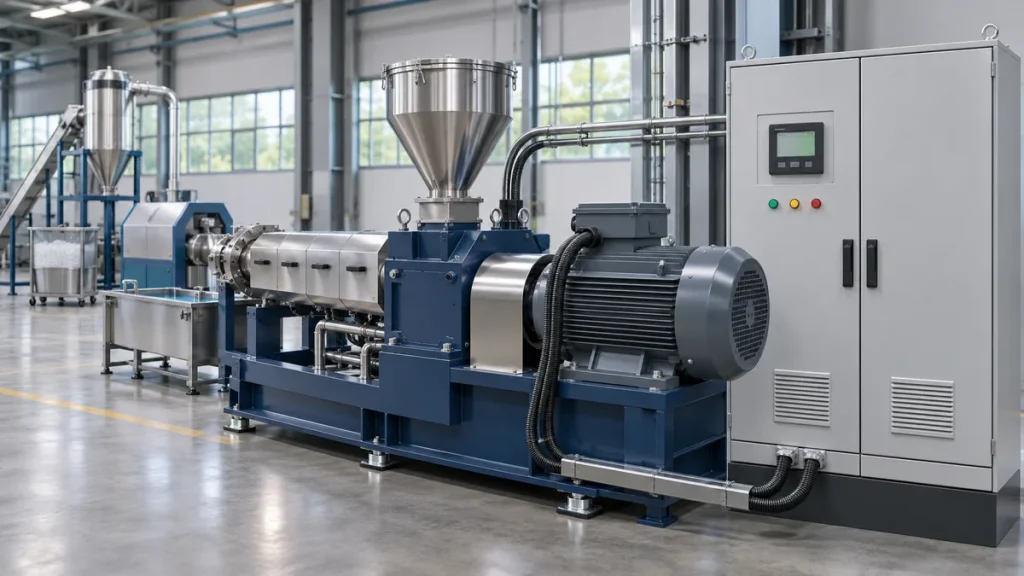
The motor rating on a plastic pelletizing machine tells you about installed power. It does not tell you the electricity required to make a kilogram of acceptable pellets.
For a useful comparison, measure electrical energy over a defined period and divide it by output over that same period. Then check which equipment and operating conditions the measurement includes. Without that boundary, a low kWh/kg claim can be difficult to interpret.
Keep power and energy separate
Power, expressed in kW, is a rate. Energy, expressed in kWh, accumulates over time. A drive does not necessarily draw its rated power continuously, and the main extruder is rarely the only electricity consumer in the project.
Specific electrical energy can be expressed as:
Specific electrical energy = electricity consumed during the measurement period / accepted pellet mass produced during the same period.
If the numerator is in kWh and the denominator is in kg, the result is kWh/kg. State whether the output is wet, dry, gross or accepted product.
Draw a boundary around the equipment being measured
A recycling line may include shredding, washing, mechanical drying, thermal conditioning, extrusion, filtration, cutting, pellet drying and conveying. A compounding line may have a different preparation and feeding scope.
A measurement taken at the extruder cabinet cannot automatically be described as the whole plant’s electricity use. Shared utilities create another question: how much of a central chiller or compressed-air system belongs to this line?
| Energy boundary | Items to clarify |
|---|---|
| Main extrusion unit | Drive, heaters and the components actually included in its meter |
| Pelletizing package | Cutter, process-water equipment, dryer and associated controls |
| Material preparation | Shredder, compactor, feed equipment and installed drying stages |
| Shared services | Cooling, air, ventilation and the allocation method where relevant |
| Whole project | Whether washing, treatment and finished-product handling are included |
Use the same boundary for competing offers. Separately identify electricity and any other purchased energy; a change from electrical heating to another fuel should not disappear from the comparison.
Compare the same production case
Feedstock condition changes the job the line must perform. Washed film with residual moisture is not equivalent to clean, dry factory trim. Filtration requirements and formulation also influence the process duty.
The operating rate matters as well. Fixed or partly fixed loads are spread over a different pellet mass when output changes. A figure from stable full-rate production may not describe a plant running short campaigns or frequent stops.
Record material, accepted output, operating period and relevant auxiliary duties with the meter result. For a supplier trial, make these conditions part of the agreed test plan.
An example of the calculation
Suppose an agreed metering boundary records 1,500 kWh during a run that produces 5,000 kg of accepted dry pellets. These are illustrative numbers, not a promised performance level.
The specific electrical energy is 1,500 / 5,000 = 0.30 kWh/kg.
If 5,500 kg passed through the cutting stage but only 5,000 kg met the specification, using the larger denominator would answer a different question. That is why the accepted mass must be identified.
Electricity cost per kilogram can then be calculated using the applicable tariff and its charging structure. Demand charges, time-of-use prices and shared services may need separate treatment. Obtain the actual site tariff rather than applying an online electricity price to the project.
Include warm-up and interruptions deliberately
There is nothing wrong with measuring a stable production window when that is the purpose of the test. The problem arises when the result is presented as a full-shift or annual figure without the additional operating periods.
For a plant budget, account for the expected startup pattern, standby, cleaning and grade changes. State how electricity consumed during a period with no accepted output is allocated.
Keep stable-run efficiency and schedule-related losses visible as separate questions. A technical improvement to the extrusion duty may not offset an unsuitable production schedule.
Look for the cause of high consumption before changing equipment
Begin by checking the measurement and output definitions. Then review actual material conditions, production rate, interruptions and whether auxiliaries are operating as intended.
A higher result does not identify a damaged screw or an inefficient motor by itself. Additional evidence is needed to separate process demand, mechanical condition and operating practice.
Do not raise settings or disable protective functions in pursuit of a lower energy figure. Any process change needs to preserve the material specification and the equipment’s operating requirements.
What to request from a machinery supplier
Ask for the measurement boundary, material description, production rate, operating period and method of weighing accepted pellets. Identify which utility loads are included and which are estimates.
If a claimed saving is relative to another machine, request the comparison basis. Different materials, capacities or auxiliary scopes can make an apparently precise percentage misleading.
The line-cost guide helps separate capital items from operating assumptions. To discuss a new pelletizing project, provide the intended material, schedule, output requirement and site utilities through the inquiry form. That gives suppliers a useful basis for an energy proposal.