

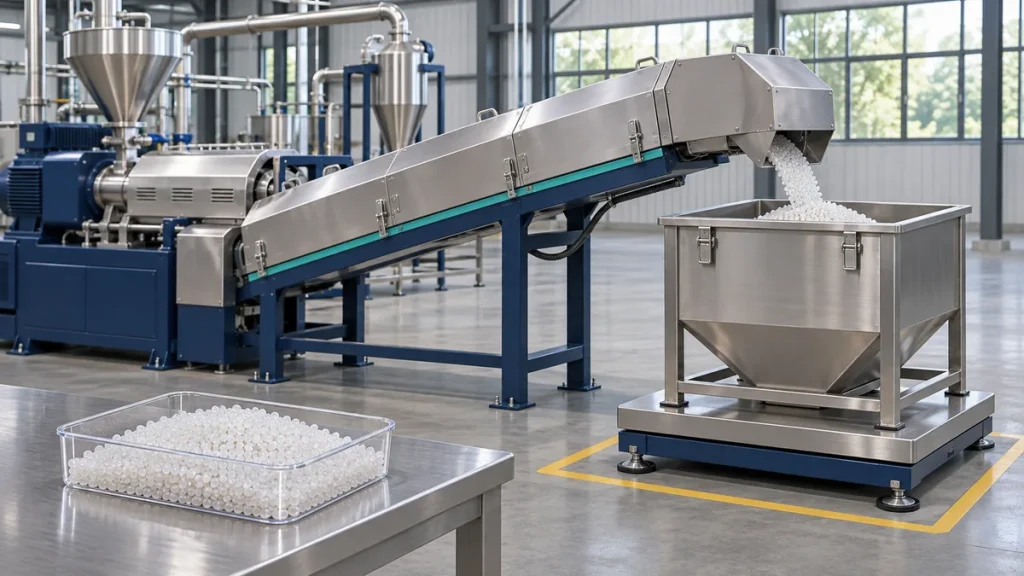
A pelletizing line quoted at a certain kg/h will not necessarily produce that quantity of saleable pellets throughout every shift. The rating describes a production case. Your commercial result depends on whether the actual material, equipment configuration and operating schedule match it.
That distinction matters when comparing offers. A higher number can describe a more favorable feedstock or a narrower measurement boundary, rather than a more capable line.
Establish what the quoted kg/h includes
Ask where output is measured. Is the figure extruder discharge, material leaving the cutter, or accepted dry pellets after screening? Does it describe a stable running period, an average trial or a shift including stops and changeovers?
The answer should be written into the proposal. Otherwise, two correct numbers may still be impossible to compare.
A nameplate motor rating is not a substitute for this definition. Neither is screw diameter. Both describe aspects of the equipment, while the production rate depends on the complete process and its duty.
Describe the material behind the rating
Film thickness, bulk density, moisture, melt behavior and contamination can all affect the production case. Preparation and filtration choices matter too.
A rate demonstrated on clean, dry factory film should not quietly become a promise for washed agricultural film. Similarly, the volume of lightweight flakes that the feed section must handle is different from the volume of dense regrind at the same mass rate.
Provide the supplier with the expected range of feed conditions. Identify the normal commercial material and the difficult fraction, rather than choosing only the easiest sample for a demonstration.
| Condition | Why it belongs in the capacity discussion |
|---|---|
| Material form and bulk density | Determine the volume that preparation and feeding must accommodate |
| Moisture and volatile content | Affect the conditioning and melt-treatment requirement |
| Contamination | Influences filtration duty, rejected material and interruptions |
| Formulation and melt properties | Change the processing and discharge conditions |
| Pellet specification | Can limit the acceptable cutting, cooling or drying rate |
Follow the bottleneck through the entire line
The extruder may not be the limiting machine. Material preparation can restrict its supply; a filter can create an operating constraint; a dryer or bagging station can limit the usable finished output.
Ask the supplier to identify the basis for each section’s capacity. Matching separate maximum figures is not enough if those maxima apply to different materials or conditions.
Storage can smooth short interruptions, but it does not remove a persistent mismatch. If a downstream station consistently accepts less than the upstream process produces, a larger buffer eventually fills.
This is particularly important when buying components from several sources. Define who is responsible for the integrated production case and its control interfaces.
Separate stable running output from shift production
Consider this illustrative calculation, not a machine benchmark. During a 20-hour measurement period, a line produces 8,000 kg in total. After transition material and rejects are separated, 7,600 kg is accepted.
The average gross rate is 400 kg/h. The accepted rate over the same period is 380 kg/h. Both numbers are valid, but they answer different questions.
If the quotation was based on a short stable run, comparing it directly with the full-period accepted rate would hide the effect of stops, changeovers and rejection. Keep the time boundary visible.
For planning, distinguish at least three quantities: the agreed stable running rate, the available production time and the fraction that meets the product specification. Do not combine optimistic assumptions for all three without evidence.
Put the trial conditions into the acceptance plan
A useful capacity trial should identify:
- The feedstock source, preparation and relevant material measurements.
- The installed equipment and configuration used.
- The start and end of the measurement period.
- How material is collected, weighed and classified.
- The quality tests that determine accepted output.
- Interruptions, filter events and material changes during the trial.
A handful of good pellets proves little about sustained production. Conversely, an interruption caused by an external trial arrangement should be described accurately rather than automatically attributed to the machine.
Our factory acceptance test checklist provides a framework for agreeing the test scope before the equipment is shipped.
Check what happens beyond the reference case
If the plant will process several grades or waste streams, ask which cases the proposed line has been assessed against. A single guaranteed rate may not describe the complete operating range.
Where material variation is substantial, agree how the supplier will express that range and what additional trials are needed. This is more useful than treating the highest brochure figure as the daily target for every feedstock.
Also consider the production schedule. Frequent grade changes and short campaigns affect output differently from long runs on one material. The business plan should use the schedule you expect to operate.
Make offers comparable before negotiating the final number
Send the same material brief, output definition and quality requirements to each supplier. Ask them to state exceptions and excluded equipment. Then compare the proposed production cases alongside the complete line cost.
For an inquiry, the pelletizing-line overview and RFQ checklist help connect the quoted rate to an actual supply scope. The aim is a rate you can evaluate and plan around, rather than the largest number on the page.