

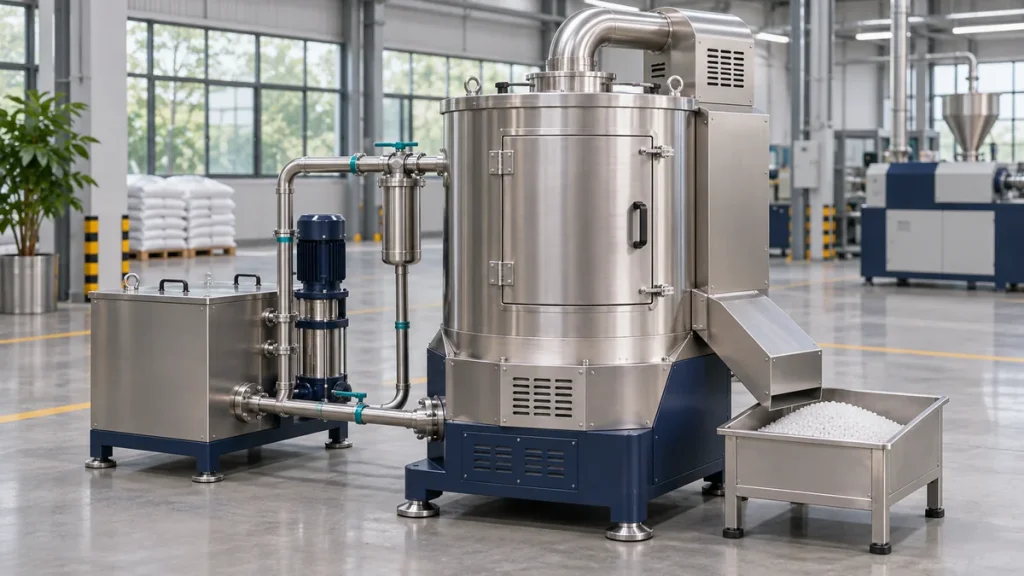
Plastic pellet drying can mean two different operations: removing water from the outside of freshly cut pellets, or reducing moisture absorbed inside a polymer before further processing. A pelletizer’s dryer may perform the first job without meeting the second requirement.
This distinction matters when specifying a complete production line. Pellets that look dry can still contain moisture that affects a moisture-sensitive polymer during its next melt-processing step. Equally, a material that does not readily absorb water may still need effective surface-water removal after cutting.
Follow the water through the process
In a water-assisted pelletizing system, pellets contact process water during or after cutting. Separation equipment removes most of that water, and a suitable dryer reduces the remaining surface water. The pellets then move to cooling, conveying, screening, storage or packaging, depending on the line.
Absorbed moisture is a separate material condition. Hygroscopic polymers can take up moisture from their surroundings. Some require controlled drying before melt processing to avoid quality problems, including hydrolytic degradation where the chemistry is susceptible.
The appropriate moisture requirement comes from the specific resin grade and application. Do not infer it solely from the polymer family name, pellet appearance or the presence of a dryer on the equipment list.
Match dewatering equipment to pellet behavior
Mechanical pellet dryers can use centrifugal action and airflow or other arrangements to separate water from the pellets. Their suitability depends on pellet size, temperature, mechanical strength, abrasiveness, tackiness and production rate.
Abrasive or brittle compounds deserve particular attention. For example, belt-based drying arrangements are available for materials where gentler handling is useful. That does not mean one dryer architecture is best for all highly filled compounds; actual pellets and operating conditions still need evaluation.
Ask the supplier to show how the dryer handles startup pellets, fines and changes in output. A demonstration on firm, uniform pellets may not reveal the behavior of a softer or more fragile product.
Why surface-dry pellets may still need conditioning
A surface-water removal stage generally does not establish the internal moisture content needed for every later application. If the polymer absorbs moisture, the buyer should define where conditioning happens and who is responsible for it.
Drying requirements may depend on temperature, time, airflow and the moisture condition of the drying air. The equipment also needs a suitable material residence pattern. A correctly specified dryer is of limited benefit if wet material bypasses it, the hopper is too small for the required duty or material reabsorbs moisture before processing.
For PET, the relationship between moisture and melt processing is particularly important. The existing PET washing-line guide addresses the upstream material preparation; the pelletizing project must carry that control through the subsequent stages.
Specify the condition at a defined point
A statement such as “dry pellets at discharge” is incomplete without a location, method and acceptance limit. Consider whether the requirement applies immediately after the pellet dryer, at bagging, after storage or at the next machine’s inlet.
| Specification item | Why it belongs in the agreement |
|---|---|
| Polymer grade and formulation | Moisture sensitivity and handling behavior can change |
| Sampling point and elapsed time | Pellets can cool or absorb moisture after discharge |
| Test method and sample preparation | Different procedures may measure different losses |
| Packaging and storage conditions | Accepted pellets can change before use |
| Responsibility for final conditioning | The pellet producer and converter need a clear boundary |
An analyzer that measures mass loss during heating needs a validated method for the material. Volatile substances other than water can affect the reading. Where this distinction matters, use an appropriate reference method or laboratory assessment rather than treating every lost gram as water.
Check cooling, fines and conveying as part of drying
Water removal is only one aspect of the discharge condition. Pellets may need further cooling before packaging to avoid handling problems. Soft grades can agglomerate, while brittle or abrasive materials may generate fines or wear during transport.
Follow the pellets through the proposed line during a trial. Look at discharge consistency, dust collection, screen rejects, conveying behavior and the material collected at the bagging station. The finished package is the relevant product boundary for many buyers.
If surface moisture is inconsistent, inspect operating conditions before purchasing a larger dryer. Changing water load, damaged or obstructed separation components, unstable pellet quality and unsuitable airflow may call for different corrections. Follow the supplier’s maintenance and isolation procedures when inspecting rotating equipment.
Trial the difficult grade and the intended storage period
A useful trial uses the actual formulation, target throughput and intended water conditions. Collect samples at more than one relevant point and preserve their identity. Record both immediate observations and the condition after realistic cooling and storage.
Compare any moisture result with the agreed method and acceptance basis. Do not convert a successful visual check into a numeric moisture guarantee. For softer materials, include a check for clumping and package discharge, not only the appearance of loose pellets on the day of the trial.
When comparing pelletizing systems, identify dewatering, drying, cooling and packaging as separate duties. The strand versus underwater pelletizing comparison helps place the water-contact stage in context. A clear equipment boundary prevents the word “dryer” from hiding an unfinished moisture-control plan.