

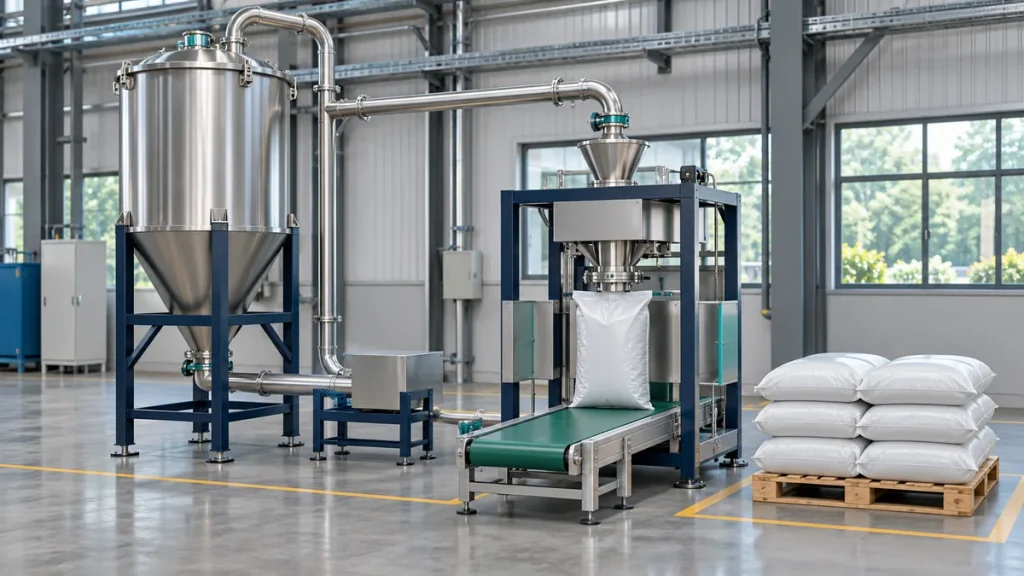
A plastic pelletizing line is not complete when pellets leave the dryer. They still need to reach storage or packaging without excessive heat, moisture pickup, dust, contamination or handling damage. Conveying and bagging should therefore be specified as part of the production process, rather than purchased as an unrelated final accessory.
Begin with the finished package and work backward. The required bag, bulk container or silo delivery determines how pellets should be cooled, screened, transferred, stored and weighed.
Establish the condition at the pelletizer outlet
List what enters the handling system: polymer grades, pellet size and shape, temperature, surface-water condition, bulk density and fines content. Also describe variation during startup, product changes and normal production.
Soft or warm pellets may behave differently from cool rigid pellets. Brittle compounds can suffer damage during transport, while abrasive compounds can create a different equipment-wear duty. These differences matter even where the nominal mass flow is the same.
Confirm which upstream equipment is responsible for acceptable discharge conditions. A conveyor should not be expected to correct inadequate cooling or drying unless it has been designed for that additional duty.
Choose a conveying route around the material and layout
Pneumatic conveying can connect equipment across a building and reduce some manual handling. Mechanical arrangements may suit other distances, products or plant constraints. Selection should account for pellet behavior, routing, cleanliness, maintenance and utilities.
In a pneumatic system, conveying conditions and pipe geometry can influence attrition, dust generation and material buildup. More air or greater velocity is not automatically a better solution. Ask for a system designed for the specified product and duty, including bends, receiving equipment and air filtration.
Long routes and multiple transfers can increase the opportunity for damage or contamination. Review the full path on a layout, including access for cleaning and inspection. Confirm how different grades are kept separate and how residual pellets are removed during a changeover.
For the upstream material specification, the pelletizing-line RFQ checklist helps define what the supplier should deliver at each interface.
Include cooling, screening and dust control where needed
A product may need additional cooling before storage or bagging. Determine the acceptable condition from material behavior and packaging requirements, rather than adopting one universal pellet-temperature limit.
Screening can remove specified oversize or undersize fractions, but it does not replace good cutting control. Establish where rejects go and how they are identified. Automatically returning every reject to production can hide a persistent quality problem or introduce unsuitable material into another grade.
Dust and fines management should address both product quality and safe plant operation. Evaluate the actual material and relevant requirements for collection, filtration, cleaning and equipment protection. Do not assume a dust problem can be solved solely by adding a filter at the bagging station.
Use storage to support the operating schedule
A buffer silo or hopper can separate extrusion from short packaging interruptions. Its useful capacity depends on the operating plan, material bulk density, usable volume and discharge behavior.
Determine how long the packaging system may stop while extrusion continues, and what happens if that period is exceeded. Include high-level detection, controlled shutdown or diversion as appropriate to the process design.
Storage design should also address grade separation, traceability, cleaning and material flow. A large vessel that retains an unpredictable residue can complicate product changes and batch identification. Consider whether moisture-sensitive pellets need a controlled atmosphere or suitable packaging strategy before they reach their next process.
Specify bagging from the package outward
Bagging equipment must suit the intended package, fill mass, required accuracy and production schedule. State bag material and dimensions, closure requirements, labeling, handling and palletizing scope.
| Interface | Detail to settle before ordering |
|---|---|
| Pellet supply | Flow consistency, buffer volume and level control |
| Weighing | Agreed accuracy basis and verification procedure |
| Bag handling | Bag type, dimensions and operator or automation tasks |
| Closing and labeling | Closure method, batch identity and required information |
| Finished goods | Conveyor, pallet handling and storage arrangement |
A bagging rate quoted under ideal conditions may not represent the actual shift output. Include bag changes, refills, labeling, pallet handling and routine interruptions in the capacity discussion. Clarify whether the operator staffing used during the demonstration will be available in production.
Test the complete route, not only the filling machine
Collect samples at the dryer outlet and the final package. Compare pellet condition, fines, contamination and relevant moisture or handling results. This reveals whether acceptable product is being degraded after pelletizing.
Test startup, a packaging interruption and a product change where these are part of the intended operation. Confirm alarms, level controls and communication between separately supplied machines. Split procurement requires a clear owner for each interface.
Record the usable throughput and package quality on the same basis as the project requirements. A short burst of successful filling does not establish the capacity of a whole-shift system.
When planning auxiliary equipment or reviewing a factory acceptance test, include finished-pellet handling in the scope. The product the buyer receives is the packaged pellet, so that is where the line’s quality boundary should end.