

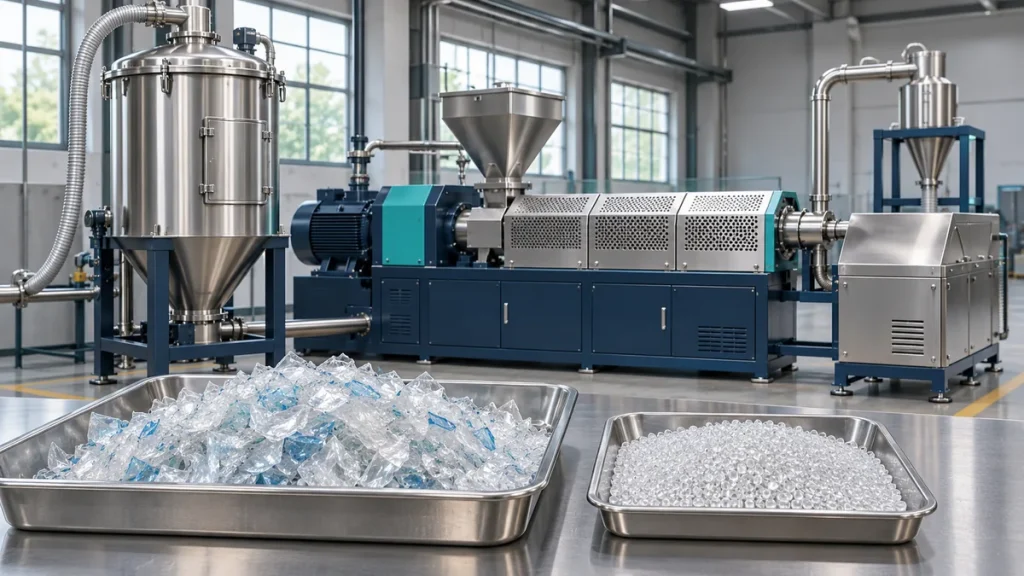
PET bottle flakes can be converted into pellets, but a successful line needs a more precise target than “clean rPET.” The intended application determines which material characteristics must be preserved or developed, how the pellets will be handled and what evidence the buyer needs.
Moisture, melt treatment and intrinsic viscosity belong in the same discussion. They are related process concerns, although drying, filtration and viscosity adjustment do different jobs.
Start with the required PET output
Describe whether the pellets are intended for fiber, sheet, strapping or another application. Obtain the receiving process’s material requirements and test methods before selecting machinery.
Intrinsic viscosity, commonly abbreviated IV, is often part of that specification. It is a material-characterization result associated with polymer molecular size under a defined measurement method. It should not be treated as another name for a melt-flow index or for a machine’s displayed pressure.
Specify the incoming flake condition as well. Source, sorting, washing, remaining contamination, moisture information and available material data all help define the duty between input and output.
Distinguish surface cleaning from moisture control
Washing and separation address the relevant contamination in the feedstock. Mechanical dewatering removes water associated with the washed flake stream, but does not establish that every moisture requirement for PET processing has been met.
Moisture control matters during melting because water can contribute to polymer degradation. The resulting material change cannot be evaluated simply by looking at the pellets.
Keep moisture results connected to the sampling method and material history. A sample left exposed to different storage conditions may no longer represent what entered the extruder during a trial.
Two drying concepts need different equipment evidence
Some PET routes use controlled drying and conditioning before extrusion. Other specifically engineered systems use substantial vacuum treatment in the extrusion process to handle their defined incoming moisture conditions.
These are complete process concepts, not permission to omit a dryer from an otherwise unrelated machine. Evaluate the supplier’s proposed route, its demonstrated input scope and the required final material result.
| Process function | Question it should answer |
|---|---|
| Washing and separation | What unwanted material is removed before extrusion? |
| Pre-drying or conditioning | What material condition is delivered to the melt process? |
| Melt filtration | What solid contamination is the filter designed to capture? |
| Devolatilization | Which moisture or volatile-removal duty is assigned to this stage? |
| Viscosity adjustment | How is the required material condition reached and verified? |
| Pellet cooling and handling | In what form and condition do pellets leave the line? |
Ask the supplier to connect these functions rather than presenting each optional device as an independent quality guarantee.
Filtration is important, but it cannot answer every quality question
Define the remaining contamination and the filter’s intended separation duty. Include the filter configuration and operating behavior in the material trial.
A clear-looking melt is not proof of a defined chemical or material quality. Likewise, filtration should not be described as a reliable way to turn an unknown mixture of polymers into pure PET.
Where flake batches vary, decide how that variation will be managed. The equipment proposal and quality plan should address the actual commercial feedstock, not only an unusually uniform sample.
Preserve IV, adjust IV, or increase IV?
These are different project objectives. One application may require limiting the change during processing; another may need a defined adjustment. Some projects evaluate additional equipment for increasing viscosity.
Clarify what the proposed system does directly and what depends on a downstream reactor or other stage. Solid-state or melt-phase treatments should be identified by their actual process and acceptance basis, rather than grouped under a vague “IV control” label.
An online viscosity indication can help process control, but the relationship to the agreed product test needs to be established. Keep the laboratory method, sample identity and reported units consistent when comparing results.
Check the pellet form and downstream requirements
The cutting route influences pellet shape, cooling and the associated drying package. The line may also require crystallization or other conditioning for its intended handling and application.
Agree the required outlet condition and any further processing outside the supplied scope. A quotation ending at the cutter is different from one delivering pellets ready for the specified storage or conversion process.
If a special end use has additional compliance requirements, evaluate those separately for the exact process, feedstock and jurisdiction. A general rPET pelletizing capability is not an automatic approval for every application.
Make the trial demonstrate the complete material change
Use identified incoming flakes and retain the relevant preparation and moisture records. Collect output samples under the agreed operating case and test them using the defined methods.
Record accepted output and the equipment involved. If an additional viscosity-treatment stage is used, show its contribution rather than attributing the complete result to the extruder alone.
For an existing washing project, the PET bottle recycling overview helps frame the upstream scope. The PET washing-line buying guide addresses preparation, while a project inquiry can identify the pelletizing and material-quality requirements for supplier matching.