

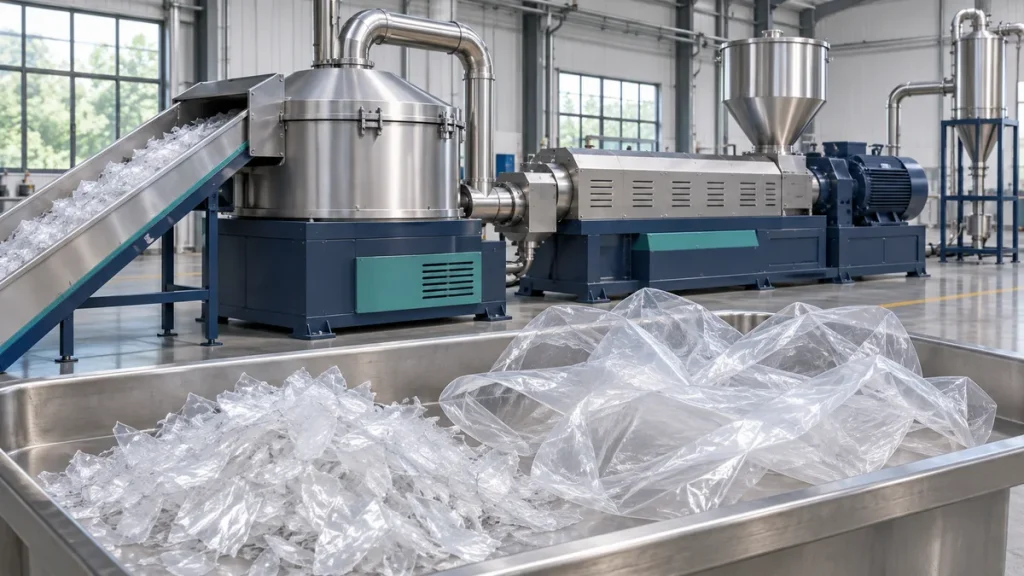
The description “LDPE film waste” can refer to clean edge trim, printed packaging or washed film collected after use. Those streams can look similar in a photograph while placing very different demands on a pelletizing machine.
A sensible LDPE film pelletizing proposal starts with that distinction. The preparation, filtration and degassing equipment should match the incoming film and the intended use of the pellets.
Three film streams worth describing separately
Clean production trim
Segregated film from a known production process may need a relatively direct recovery route. The key questions include its handling form, additives, temperature history and whether it stays clean during collection.
Rolls, loose strips and shredded flakes still present different feeding situations. “Clean” describes contamination; it does not describe how consistently the material can enter the machine.
Printed film
Printing introduces another part of the material history. Describe the printed fraction and any known coatings, adhesives or laminated structures. The word “printed” alone is not enough to establish a treatment requirement.
The supplier should explain how the proposed route manages the relevant volatile material and remaining contamination. Do not assume extrusion will turn any printed or laminated stream into the equivalent of clean LDPE.
Washed post-consumer film
Washed film brings the performance of the upstream washing and drying process into the discussion. Residual water, remaining dirt and variations in material composition need to be described.
Include the commercial feed condition, not just a carefully dried laboratory sample. If the washing plant’s output varies, use representative samples that show that range.
Film preparation is a volume-and-condition problem
Thin film is bulky relative to its mass. A preparation unit must accept the planned loading pattern and deliver material that the extruder can process consistently.
Cutter-compactor designs can combine several conditioning duties before extrusion. Other arrangements may use different size-reduction and feeding equipment. Evaluate the actual design rather than treating one machine label as mandatory for every film project.
Moisture capability needs the same care. A particular supplier’s stated limit describes its own configuration and conditions; it is not a universal allowance for all film pelletizers.
Give filtration a defined job
List what remains after preparation: paper, dirt, other solid matter and any known foreign-material concerns. The filter proposal should relate to those contaminants and to the pellet specification.
A smaller stated filtration size does not settle the comparison. Filter area, operating continuity, pressure behavior and rejected-material handling also affect the line.
Mixed polymers require separate attention. A melt filter should not be described as a sorting system that reliably converts an unknown polymer mixture into pure LDPE.
Ask what the degassing section is expected to remove
The requirement may involve water or other volatile components associated with the feed. Define the problem and the result that will be measured.
The condition of the melt entering the relevant section and the overall process arrangement matter. Counting vacuum connections is less informative than seeing a demonstration on comparable material.
Odor and visible appearance deserve separate checks where they affect the planned application. A visually clean pellet can still be unsuitable for the receiving process.
Work backward from the pellet’s next use
Pellets intended for a demanding film application may need a different acceptance basis from material intended for another conversion process. Agree the required properties with the receiving team before selecting the line.
| Information to provide | Why it changes the discussion |
|---|---|
| Film source and known polymer structure | Defines what is being recovered |
| Printed, coated or laminated content | Identifies additional processing questions |
| Collection and handling form | Shapes preparation and feeding needs |
| Moisture and remaining contamination | Defines conditioning and melt-treatment duties |
| Intended pellet application | Establishes the relevant quality checks |
Avoid choosing acceptance criteria solely because they are easy to measure during a machine demonstration.
Run a trial that resembles the planned business
Include normal variation in the material package. Record how the film was prepared and the condition in which it reached the machine.
Evaluate accepted dry-pellet output, the agreed quality results, interruptions and material losses over a defined period. If different materials are tested, keep their results separate. An easy run should not be averaged into a difficult run without explanation.
Clarify the equipment included in the trial. A demonstration using an upstream dryer or filter outside the quotation leaves an important supply assumption unresolved.
What to send before requesting a quotation
Photographs are useful when accompanied by the material source, film form, known structure, moisture information, contamination and target pellet use. Add the required production schedule and output definition.
The film recycling and pelletizing overview can help frame the route. For a broader equipment discussion, use the recycling-line page and RFQ checklist. The material brief should lead the machine selection, rather than be fitted to a quotation afterward.