

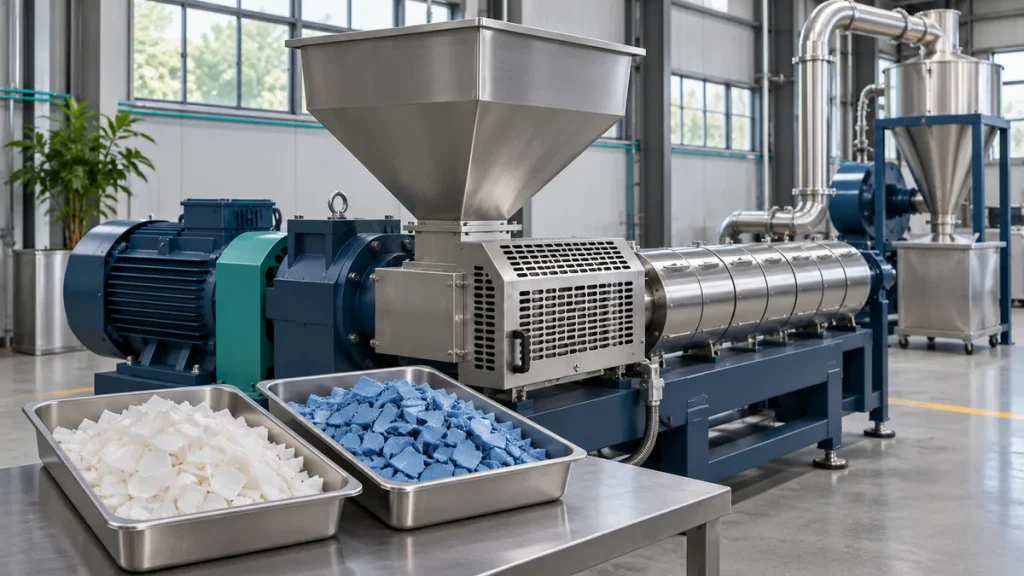
Rigid regrind often appears straightforward: it has already been reduced to pieces, so the next step seems to be melting and cutting. In practice, the condition of those pieces determines much of the line’s work.
A hopper of clean, segregated production regrind is different from a mixed collection stream with labels, moisture and unknown material history. Before choosing an HDPE or PP pelletizing line, establish which situation the equipment must handle.
Keep polymer identity separate from machine versatility
A machine may be offered for both HDPE and PP. That means the supplier proposes an operating scope covering the relevant materials. It does not mean an unknown HDPE/PP mixture can automatically be processed into pellets with predictable properties.
Describe whether the plant will run separate streams, controlled blends or variable mixed material. If a blend is intended, its acceptance needs to be established for the actual application.
Color is another separate question. A white or blue sample does not establish polymer identity, previous use or compatibility. Preserve the available material identification alongside the photographs.
Check what “already ground” actually means
Regrind includes different shapes, dimensions and distributions of fines. Flat bottle flakes, thicker molding scrap and irregular lumps do not behave identically in storage or at the feed opening.
The supplier needs the typical material and the expected extremes. Include oversize pieces, fine material and normal variations rather than screening everything into an unusually tidy sample.
If an upstream grinder is part of the proposed process, define its required output. The connection between preparation and extrusion should be a clear equipment interface, not an assumption that somebody else will make the pieces suitable.
Match the feeding arrangement to the regrind
Dense, free-flowing regrind can suit a different intake arrangement from lightweight or difficult-flowing flakes. Storage geometry, conveying and the actual feed mechanism need to be reviewed together.
Ask how the system handles bridging, inconsistent loading and the planned material form. A force-feeding option may have a purpose in one case without being necessary in another.
When suppliers demonstrate different arrangements, compare the material presented at the inlet. Preconditioning that is invisible in a short machine video can be important to the result.
Give contamination and volatiles separate treatment
Identify the remaining solid contamination and the intended filtration task. Labels, dirt, foreign pieces and other concerns should be described as specifically as the available evidence allows.
For collected rigid packaging, the previous use and the performance of washing and separation can matter. Extrusion is one part of the route, not an automatic replacement for preparation.
Moisture and volatile constituents need another review. The required devolatilization arrangement depends on the actual material and quality target. A clean factory-regrind case may not justify the same configuration as a washed post-consumer stream.
Our recycling extruder guide discusses when compounding capability becomes relevant in a wider recycling process.
Choose cutting and drying around the finished pellet
The material’s cutting behavior and the requested pellet characteristics should guide the proposed pelletizer. Include the necessary cooling, drying and screening equipment in the comparison.
A cutter’s nominal rate cannot be considered alone. The associated system must handle the production case and deliver pellets in the condition required for storage or the next process.
Where water is used, distinguish removal of surface water from any additional moisture-conditioning requirement. Set the acceptance method for the actual material rather than assuming that every dry-looking pellet is ready for its next application.
Build the specification from the receiving process
Melt-flow behavior, contamination, appearance and the intended performance of the material may all be relevant. Choose the required checks with the receiving team.
For comparisons, keep polymer, test method and conditions consistent. A melt-flow value measured under one set of conditions should not be compared casually with a value from another polymer or test condition.
The trial should preserve the relationship between incoming regrind, operating case and pellet sample. If several feed batches are combined, make that mixture clear in the results.
Five details that make a supplier inquiry more useful
- Polymer identity, source and previous use where known.
- Typical piece dimensions, material form and available bulk-density information.
- Washing or drying history, moisture information and known contamination.
- Intended pellet application and the tests used to accept it.
- Target accepted output, schedule and equipment already installed at the site.
These details help distinguish a straightforward recovery line from a project needing more preparation, treatment or compounding.
See the rigid-plastic recycling overview for the process scope. If an existing line is being expanded, identify its interfaces in the project inquiry so supplier proposals can address the equipment that is actually needed.