

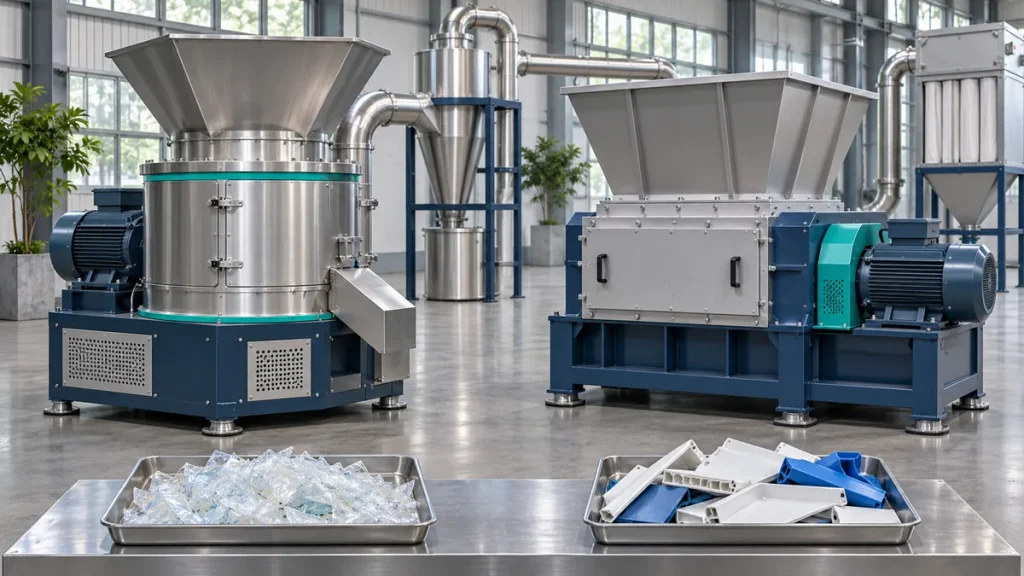
A bale of thin film and a pile of thick purge lumps can contain the same polymer while requiring very different preparation. That is why the feed system deserves attention before screw diameter or nominal output dominates a recycling-machine discussion.
Cutter-compactor and shredder-extruder systems organize preparation differently. Neither label identifies a universal solution for every waste stream. The choice should follow the material’s shape, condition and delivery pattern.
A cutter-compactor prepares a bulky stream for extrusion
A cutter-compactor combines cutting and material conditioning in a chamber connected to the extrusion process. Depending on the design, preparation can include densification, heating, drying and buffering.
This can be relevant for lightweight film or flakes that would otherwise be difficult to deliver consistently. The important point is the condition of the material reaching the extruder, not merely that a rotating cutter is present.
Supplier claims about allowable moisture or particular materials belong to that model and its conditions. They should not be treated as the capability of every cutter-compactor.
A shredder-extruder integrates size reduction and feeding
A shredder-based arrangement reduces material using a defined cutting and feeding mechanism before transferring it into the extruder. Certain designs are intended to accept bulky scrap, thick sections, fibers or textiles without a separate preliminary shredder.
That does not mean any piece that can be lifted into the hopper is acceptable. Opening size, geometry, toughness, contamination and the machine’s approved input limits still apply.
The supplier should explain how irregular loading is buffered and how the shredder and extruder are coordinated. An attractive installation photo cannot answer those questions.
Make the comparison with actual material forms
| Feed characteristic | What to examine in the proposal |
|---|---|
| Loose, low-density film | Intake consistency, conditioning and control of the prepared material |
| Washed film flakes | Moisture management and the defined condition at the extrusion inlet |
| Long tapes, fabric or fibers | Cutting behavior, wrapping risk and material-transfer arrangement |
| Thick or bulky scrap | Permitted dimensions, size-reduction duty and feed control |
| Variable mixtures of shapes | Whether the system remains stable across the planned mix and loading pattern |
This table identifies questions rather than automatic selections. Both architectures have design variations and optional equipment.
Bulk density changes the feeding conversation
Two bags with the same dimensions may carry very different masses. The extruder needs a suitable mass flow, while the preparation equipment must accept the corresponding volume.
Describe the material in the form it will enter the line. State whether film arrives loose, baled, shredded or on rolls. For rigid scrap, include typical dimensions and the largest expected pieces.
A small, neatly prepared sample may remove the very feeding problem that the commercial machine needs to solve. Keep the proposed sample preparation consistent with the planned factory operation.
Preparation does not replace contamination control
A system that handles the shape of the material has not necessarily resolved its contamination. Metal, paper, dirt, incompatible polymers and residues require their own review.
Explain what sorting or washing occurs before the machine and what contamination remains. The supplier can then identify the relevant protection, filtration and melt-treatment scope.
For collected material, ask whether the proposed route was demonstrated on a comparable feedstock. A design proven on clean factory trim should not quietly become a promise for unknown post-consumer waste.
Compare the whole installation, including the parts outside the main frame
One quotation may include an upstream conveyor, material detection, storage or pre-drying. Another may assume that these services already exist in your plant.
Check the interfaces at both ends. The preparation unit must receive material at the intended loading pattern, and downstream cutting and drying must accept the resulting output.
The arrangement also affects access. Can the relevant parts be serviced with the planned factory clearances? Which supplier owns an interface problem if the upstream and extrusion equipment come from different sources?
Our RFQ scope checklist is useful for turning those assumptions into explicit supply boundaries.
Use a trial that challenges the proposed feed system
Bring representative variation: light and dense fractions, typical moisture conditions, awkward shapes and the normal loading pattern. Stay within the supplier’s approved trial arrangements.
Agree how the trial will evaluate intake, interruptions, accepted pellet output and relevant quality tests. Keep the original feed condition documented so a later comparison is meaningful.
Do not judge the result only from the best-looking handful of pellets. A feeding-system comparison should show whether the process can sustain the agreed production case.
The selection can be narrowed before a machine is quoted
Prepare a short material brief with photographs, polymer identification, source, dimensions, handling form, moisture information and known contamination. Add the intended pellet use and the expected production schedule.
That gives the supplier a basis for choosing an architecture rather than simply offering a familiar machine size. The film-recycling route covers one common input family; the rigid-plastic recycling route covers another.
Extruder China can help match that brief with suitable machinery suppliers through the project inquiry form. Final equipment suitability should be demonstrated using the material and operating scope you intend to run.