

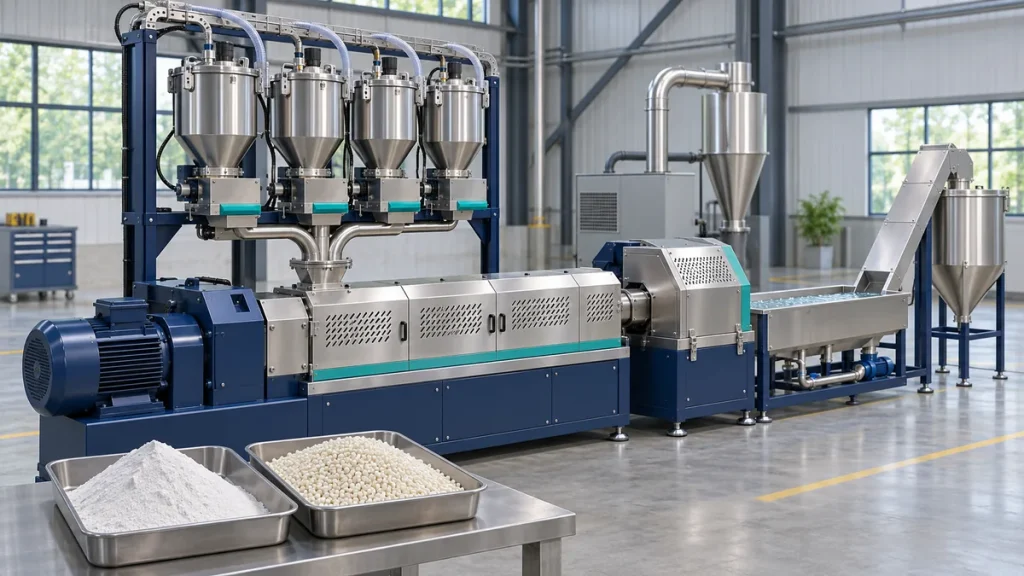
A calcium carbonate filler masterbatch line combines mineral powder with a carrier polymer and other formulation components, then produces pellets for later use. Selecting the line requires more than a target filler percentage and a headline output rate.
Powder behavior, carrier resin, dispersion requirements, feeding accuracy and downstream handling all influence the equipment. A useful quotation connects these material properties to a defined process and a testable pellet specification.
Define the product before specifying the extruder
Start with the application in which the masterbatch will be used. Film, woven products, sheet and molded parts may require different balances of dispersion, handling and performance. The carrier must also be suitable for the intended downstream polymer system.
Describe the calcium carbonate grade, particle-size information, surface treatment where applicable, moisture and bulk behavior. Include the additives and carrier-resin characteristics needed for the supplier to assess the process. Protect commercially sensitive formulation details through an appropriate purchasing arrangement if necessary, but do not expect reliable equipment selection from an unspecified “mineral powder.”
The target formulation should be accompanied by a finished-product requirement. Define what acceptable dispersion, pellet consistency and downstream processing look like. A high mineral loading is not by itself proof of a useful product.
Powder feeding is a core process duty
Fine powders can bridge, flood, aerate or behave inconsistently during refill. A feeder that works well with one calcium carbonate grade may need a different configuration for another.
Discuss hopper geometry, agitation where appropriate, feeder type and the way powder enters the compounding process. Gravimetric feeding can support controlled proportions, but accuracy still depends on equipment selection, installation, calibration and stable refill behavior.
Ask how the system manages air displaced or carried by the powder, and how it prevents dust from disrupting weighing or the surrounding work area. Dust-control design should follow the characteristics of the actual formulation and applicable site requirements, rather than assuming all powder mixtures behave alike.
For a highly filled process, a short interruption in one feeder can change the product ratio. Confirm how the control system detects the event, responds and identifies affected material.
Match compounding to dispersion and thermal limits
The process must distribute the components and achieve the required dispersion while maintaining suitable thermal and mechanical conditions. Screw configuration, feed positions, available torque, melt temperature and residence behavior interact.
Co-rotating twin-screw systems are used for many compounding duties, but the label “twin screw” does not establish the correct configuration. Other process arrangements may be proposed for particular formulations or production objectives. Evaluate the actual duty and evidence.
The masterbatch extrusion guide explains the broader role of feeding and mixing, while the screw-design article shows why element selection belongs to the process brief.
Moisture and air handling also need a defined route. Ask what venting or devolatilization is included and what material condition must be achieved upstream. No vent arrangement removes the need to understand incoming powder and resin conditions.
Consider wear and downstream handling early
Mineral-filled compounds can impose wear duties that should influence materials of construction, inspection planning and spare-part scope. The appropriate protection depends on the formulation and operating conditions. Avoid accepting an unqualified service-life promise without supporting evidence and stated assumptions.
Cutting and drying must suit the finished compound. Pellet strength, abrasiveness and fines generation may affect the choice of pelletizer and dryer. Some materials need gentler handling than a demonstration on an unfilled polymer would suggest.
Follow the product through conveying, screening and bagging. A line that makes acceptable pellets at the cutter but produces excessive fines before packaging has not met the finished-product requirement.
Write a specification the trial can answer
| Area | Information to provide | Evidence to request |
|---|---|---|
| Powder and resin | Grades, relevant properties and expected variation | Stable feeding and material handling |
| Formulation | Component proportions and allowed variation | Recorded recipe and feeder behavior |
| Compounding | Dispersion and thermal requirements | Process records and representative samples |
| Pellet finishing | Size, strength, fines and moisture criteria | Samples after drying and handling |
| Production basis | Accepted output and operating conditions | Timed mass balance and quality results |
For the downstream trial, state the masterbatch addition level and conversion conditions. A plaque or film made under an unspecified recipe gives limited evidence about how the product will behave for the intended customer.
If production covers several grades, test the difficult cases and define which parts of the operating range remain unverified. Include changeover, cleaning and the handling of off-spec material in the discussion.
Compare complete line boundaries
Check whether the proposal includes raw-material transfer, powder storage, feeders, extrusion, cutting, drying, dust collection, cooling, conveying and packaging. Identify utilities and site work separately so quotations can be compared fairly.
The operating plan should also cover calibration, wear inspection, consumables and training. These details determine whether the buyer can sustain the trial result after installation.
For an initial enquiry about a masterbatch compounding project, send the intended application, material information and acceptance sheet. EXCN can help organize supplier comparisons around those requirements. The objective is a line that produces a repeatable, usable compound at an agreed output basis.